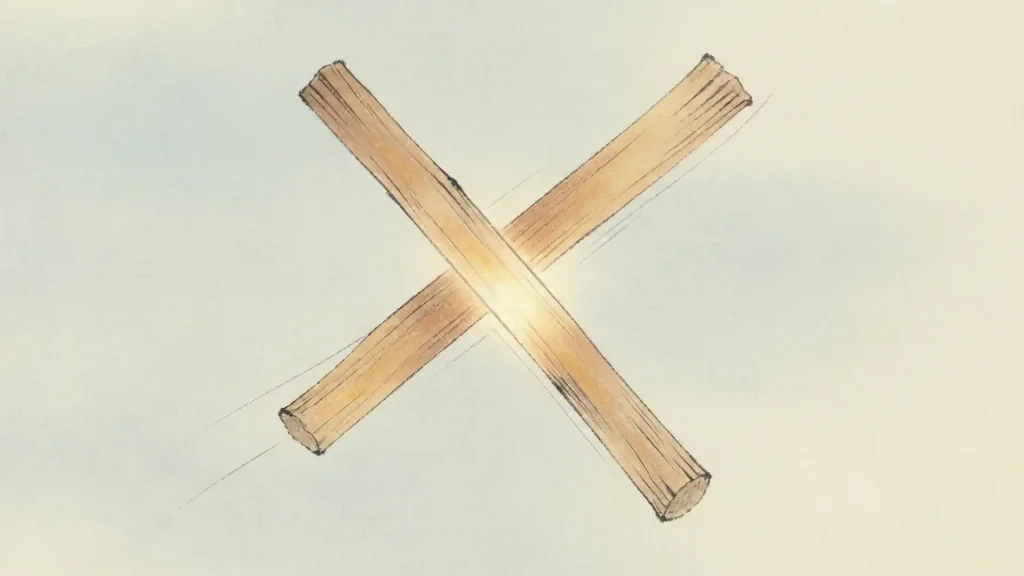
Two simple sticks of wood, no longer than the length of your forearm, have carried the weight of Chinese civilization for over four thousand years. 筷子 (kuài zi) — chopsticks — are so fundamental to daily life in China that a child's first lesson in their use is treated as a small family celebration, and an adult who handles them gracefully is recognized as someone raised with care. Yet for such a simple tool, chopsticks come wrapped in a dense web of history, technique, and taboo. Knowing how to hold them is only half the story; knowing what not to do with them is just as important.
This guide walks through the origin of chopsticks, the proper way to hold them, the ten taboos every diner should avoid, and the surprising differences between chopstick cultures across East Asia. Whether you are sitting down to your first Chinese meal or refining habits formed over years, these small details reveal a great deal about a culture that has turned eating into an art.
Four Thousand Years of Two Sticks
Chopsticks predate forks in China by millennia. The earliest known chopsticks, unearthed in Henan Province, date to the Shang Dynasty (around 1200 BCE), and they were already well-developed tools rather than crude experiments. Some scholars believe chopsticks were used even earlier, during the Xia Dynasty, as early as 2070 BCE. Originally they were cooking implements — long branches used to stir pots and retrieve food from boiling water — rather than eating utensils. As Chinese cuisine evolved toward bite-sized pieces (a response to fuel scarcity, which demanded quick cooking in hot oil or steam), chopsticks became the perfect eating tool, and by the Han Dynasty (206 BCE – 220 CE) they had largely replaced the spoon at the dining table.
The Chinese word 筷子 (kuài zi) is itself a linguistic curiosity. The original term was 箸 (zhù), meaning "utensil" or "assist." But because zhù sounds identical to the word for "stop" or "halt" — an inauspicious meaning for travelers and boatmen — sailors in southern China began calling them 快 (kuài), "quick," as a wish for swift passage. The bamboo radical ⺮ was later added, producing the modern 筷. So a pair of chopsticks carries, in its very name, a wish for safe and speedy travel — a small piece of folk poetry hidden in everyday speech.
Traditionally, chopsticks were made of bamboo, wood, ivory, bone, or — for the imperial court — silver, which was believed to blacken in the presence of poison. Modern chopsticks are most often bamboo, wood, stainless steel, or melamine. In Chinese homes, each family member often has their own pair, distinct in color or design, and guests are given a fresh pair.
How to Hold Chopsticks Properly
Before learning the taboos, it helps to know the basic technique. The lower chopstick rests in the crook of your thumb and the side of your ring finger, anchored and largely stationary — it acts as a fulcrum. The upper chopstick is held like a pen, between your thumb, index, and middle fingers, and it is the one that moves. To pick up food, you pivot the upper stick down against the stationary lower one, like a pair of tweezers. The tips should meet evenly; if they cross, the grip is off.
The ideal hold is about one-third from the top of the chopsticks. Holding them too close to the tips looks childish and clumsy; holding them too far up appears affected. In some families, it is said that the higher you hold your chopsticks, the farther from home you will marry — a charming superstition that turns grip into prophecy.
When not in use, chopsticks rest horizontally on a 筷架 (kuài jià) — a small chopstick rest — beside the bowl, never stuck into the food and never laid directly across the mouth of a bowl. This is where the etiquette begins to thicken.
The Ten Chopstick Taboos
At a Chinese dining table, chopstick etiquette is governed by a set of 忌讳 (jì huì) — taboos. Some are practical, some are superstitious, and others are simply matters of respect. The following ten are the most important to remember.
1. Never stick chopsticks upright in a bowl of rice. This is the most serious taboo of all. Two chopsticks standing vertically in a bowl of rice resemble the incense sticks burned at funerals and at shrines for the dead. Doing so at a meal invokes death and is considered a curse on the table. If you must put your chopsticks down, lay them flat across the bowl or on a rest.
2. Never point with your chopsticks. Gesturing at people or dishes with chopsticks is as rude as pointing a finger at someone's face. If you need to direct attention to a dish, set your chopsticks down and use words.
3. Never drum on your bowl. Tapping chopsticks against a bowl or table is associated with beggars drawing attention to themselves, and it is also said to attract hungry ghosts. It signals impatience and poor upbringing.
4. Never stab or spear food. Chopsticks are designed to pinch, not pierce. Stabbing a piece of meat as if with a fork defeats the elegance of the tool and suggests you cannot use it properly. If a piece is too slippery, try a different angle.
5. Never dig for food. Reaching into a shared dish and rummaging for the best morsel — sometimes called "grave-digging" — is greedy and unsanitary. Take the piece nearest to you, or use the public serving chopsticks (公筷, gōng kuài).
6. Never pass food from chopstick to chopstick. Transferring a morsel directly from your chopsticks to another person's chopsticks resembles a funeral rite in which family members pass the deceased's bones with chopsticks after cremation. If you want to share food, place it on the other person's plate.
7. Never wave your chopsticks over dishes. Hovering your chopsticks over several dishes while deciding what to take — sometimes called "chopstick hovering" — is considered indecisive and disrespectful to the cook. Choose quickly and commit.
8. Never lick or suck your chopsticks. Chewing on the ends or sucking them clean is unhygienic and childish. If bits of food cling to them, wipe them discreetly with a napkin or on the edge of your bowl.
9. Never use mismatched chopsticks. Using one long and one short, or two of different colors, evokes the Chinese phrase 三长两短 (sān cháng liǎng duǎn, "three long, two short"), which originally referred to the uneven boards of a coffin and is a strong symbol of bad luck.
10. Never cross your chopsticks. Crossing them in an X on the table is, in some regions, a sign that you are disowning the company at the table — historically used to mark a dispute or to indicate you considered the meal poisoned. Always lay them parallel.
Chopsticks Across East Asia
Though chopsticks are used across East Asia, each country has developed distinct styles and customs. Chinese chopsticks are typically long — about 25 to 27 centimeters — with blunt, squared ends. The length reflects the Chinese tradition of sharing dishes from the center of a round table; long chopsticks let diners reach comfortably without standing.
Japanese chopsticks are shorter — about 21 centimeters — with tapered, pointed tips. The pointed ends suit the bone-picking tradition of eating fish, which is central to the Japanese diet, and the shorter length suits the individual bowl style of Japanese dining. Japanese chopsticks are also traditionally lacquered and often come in pairs of subtly different lengths for men and women.
Korean chopsticks are unique: they are typically made of metal — stainless steel or silver — and are flat, like a ribbon, rather than round. They are paired with a long-handled spoon for rice and soup, so the chopsticks are used mainly for side dishes. The metal tradition dates to the Korean royal court, where silver chopsticks were used to detect poison, and the flat shape keeps them from rolling off the table.
These differences mean that chopstick etiquette is not perfectly portable. A gesture that is harmless in Tokyo might be impolite in Beijing, and vice versa. But the underlying principle — that chopsticks are an extension of the hand and a test of one's manners — is shared across the entire region.
Chopsticks as a Cultural Mirror
What makes chopsticks so fascinating is how much they reveal. A civilization that invented chopsticks chose, very early on, to value the small and precise over the large and forceful. Forks stab; chopsticks pinch. Forks are tools of the individual diner; chopsticks are tools of a shared table. Forks were developed in cultures that ate large pieces of meat; chopsticks evolved alongside a cuisine of finely cut vegetables, dumplings, and rice — a cuisine shaped in turn by scarcity, philosophy, and the rhythm of the seasons.
So when you pick up a pair of chopsticks and hold them the right way, lay them down on the rest when you pause, and avoid the ten taboos without thinking, you are doing more than following manners. You are taking part in a four-thousand-year-old conversation about how to eat, how to share, and how to treat the people sitting around the table with you. The sticks are small. The tradition is enormous.
Why Chopsticks Fit Chinese Cuisine
Chopsticks are not an arbitrary choice but a tool shaped by the food it meets. Chinese cooking favors ingredients cut into small, bite-sized pieces, a habit born of fuel scarcity that made quick stir-frying and steaming efficient. Small pieces need no knife at the table, so a pinching tool suffices where a European roast demanded a carving fork. The chopstick also suits shared dishes placed at the center of a round table, letting each diner lift a morsel cleanly without claiming it with a blade. In this light the taboo against stabbing food is not merely manners but the logic of a cuisine built for pinching. The stick and the stir-fry evolved together, each reinforcing a culture of the shared, precisely cut meal.
Chopsticks as Gifts and Symbols
Beyond the table, chopsticks carry symbolic weight in Chinese life. A new pair is a common wedding or housewarming gift, because the two sticks used as one stand for a union that stays paired from beginning to end, and because the word for 'quick' in kuaizi sounds like a wish for prompt happiness. Idioms play on the tool too, praising a person who 'can pick up' a task with ease, or warning against 'three long two short,' the unlucky mismatch that recalls a coffin's boards. Even the act of giving a child their first pair is a small rite of growing up. These associations show how an ordinary utensil becomes a quiet carrier of hopes about harmony, speed, and family.
Chopsticks in Modern Life
The twentieth century brought the disposable wooden chopstick and, with it, both convenience and concern. Hundreds of millions of pairs are used and discarded each year in restaurants and on trains, prompting debates about deforestation and a slow turn toward reusable and branded sets. At the same time, public-health campaigns have promoted separate serving chopsticks at shared meals, a practice that gained urgency during recent epidemics and that quietly updates an ancient table manner. Yet the core habit endures: children still learn the grip at home, and a well-set Chinese table still places a pair to the right of each bowl. The form persists even as the material and the etiquette around it keep shifting.
❓ Frequently Asked Questions
📝 Chinese Vocabulary
筷子 — : chopsticks; the everyday Chinese eating utensil, in use for over 4,000 years. The name originally meant "quick" — a sailor's wish for safe travel.
筷架 — : chopstick rest; a small ceramic, wood, or metal stand on which chopsticks are placed when not in use, to keep them clean and off the table.
忌讳 — : taboo; something forbidden or avoided by custom, especially out of respect, superstition, or fear of bad luck. Chopstick taboos are a major category of jì huì at the dining table.
箸 — : the older word for chopsticks, meaning 'utensil' or 'to assist,' later replaced in speech by kuaizi for reasons of folk taboo.
公筷 — : public or serving chopsticks; a separate pair used to take food from a shared dish, kept distinct from one's eating pair for hygiene.
三长两短 — : three long and two short; an inauspicious phrase for a coffin's uneven boards, evoked by using mismatched chopsticks.
天圆地方 — : round heaven and square earth; the cosmological idea reflected in chopsticks' round tips and square handles.
银筷 — : silver chopsticks; used at court and among the wealthy because legend held they would darken in the presence of poison.
🎉 Fun Facts
- The earliest chopsticks, found in Henan Province, date to the Shang Dynasty — around 3,200 years ago. They were originally cooking tools for stirring pots, not eating utensils.
- The Chinese word 箸 (zhù) was replaced by 筷子 (kuài zi) because sailors considered zhù — which sounds like "stop" — bad luck for a voyage. The new name literally means "quick ones."
- Standing chopsticks upright in rice mimics funeral incense — this is the single most serious chopstick taboo and is avoided by everyone, everywhere, at every Chinese table.
- Korean chopsticks are uniquely metal and flat, a tradition from the royal court where silver was used to detect poison. Chinese chopsticks are long and blunt; Japanese chopsticks are short and pointed.
- There is a folk saying that the higher you hold your chopsticks, the farther from home you will marry — turning a small detail of grip into a prediction about your future spouse.
- A pair of chopsticks is a traditional Chinese wedding gift symbolizing harmony and togetherness from start to finish, since the two sticks are meant to be used as one inseparable pair.