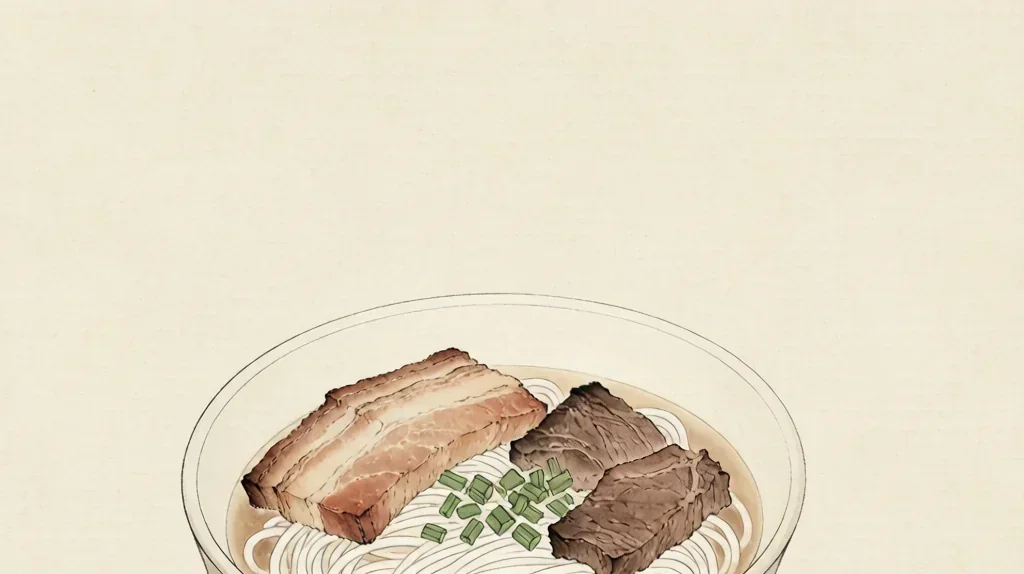
Guilin rice noodles are the morning ritual of one of China's most beautiful cities, a bowl so woven into daily life that locals say they cannot leave town for long without craving it. In Mandarin they are guì lín mǐ fěn, written 桂林米粉 — "Guilin rice flour." The dish is deceptively simple: springy rice noodles under a savory meat sauce, scattered with peanuts, scallion, and pickles, often eaten dry first and then with broth. This article explores the history of Guilin mifen, the karst landscape that shaped it, what goes into an authentic bowl, how it is served, and why it is less a recipe than a routine.
Origins in Karst Country
Guilin, in the Guangxi Zhuang Autonomous Region, is famed for its surreal limestone peaks rising from the Li River — scenery so iconic it appears on Chinese banknotes. The city's rice noodles are at least a few centuries old, born of a region where rice is king and rivers provide both water and transport. Rice has been grown in the Guilin area since antiquity, and turning it into noodles (mǐfěn) was a natural way to make a portable, quick-cooking staple. Over time a local style emerged: noodles dressed with a meat sauce rather than served purely in soup.
One local legend credits the dish to traveling officials or to the needs of boatmen who wanted a fast, filling meal by the river; another ties it to the region's many markets, where a hot bowl at dawn fueled the day's trade. However it began, Guilin mifen became the city's default breakfast, a role it still holds. The dish is part of the wider rice-noodle family of southern China, cousins to the rice noodles of neighboring Yunnan and Guangdong.
Regional Context: A City That Eats Standing
Unlike the broth-heavy luosifen of nearby Liuzhou, Guilin mifen is typically served in two stages. First comes the "dry" version (gān mǐfěn): noodles dressed with a meat sauce, oil, and toppings, eaten like a savory noodle salad. After the noodles are gone, the vendor pours hot clear broth into the bowl so you can drink it as a soothing soup. This "eat the noodles, then drink the broth" rhythm is the authentic Guilin way and part of the pleasure.
The dish reflects Guangxi's rice culture and its love of textural contrast — the noodles chewy, the peanuts crunchy, the pickles sharp. It is also a great equalizer: students, officials, and tourists queue at the same stalls, often eating standing or on small stools. In a city built around tourism, Guilin mifen remains stubbornly local, a daily habit rather than a performance.
Ingredients: Noodles, Sauce, and the Crunchy Toppings
The noodles are fresh rice vermicelli, made from rice milled and pressed into springy, opaque strands that are cooked briefly and drained. The signature element is the shíròu sauce — a braised meat topping, traditionally of pork (sometimes beef in Halal versions), slow-cooked with spices, soy, and often a little fermented bean, then chopped or sliced over the noodles. A spoon of the meat's braising liquid forms the dressing.
Toppings complete the bowl: roasted peanuts for crunch, scallion, pickled long beans or mustard greens for tang, and sometimes fried soybeans or cilantro. A little chili oil or a scoop of local chili sauce adds heat. The broth served at the end is a light pork or bone stock, clean and unsparing, meant to refresh rather than flavor heavily. The balance of soft noodle, rich meat, and sharp pickle is the dish's quiet genius.
How Guilin Mifen Is Made and Served
Making the noodles is its own craft: rice is soaked, ground into a slurry, steamed into sheets, and cut or extruded into strands, then briefly boiled to order. The meat sauce is prepared in advance and kept warm. At the stall, a handful of noodles is blanched in boiling water for seconds, drained into a bowl, and topped with meat, peanuts, pickle, and scallion; a little of the meat liquor and some oil dress it.
The customer adds chili to taste and mixes. Eating the dry bowl first lets you appreciate the noodle's texture and the sauce's savor; when only broth remains, the vendor tops it up, and you sip it down. This two-phase service is distinctive and efficient — a full breakfast in minutes. Good stalls are judged by noodle springiness and the depth of the meat sauce above all.
Cultural Meaning: Breakfast as Belonging
Guilin mifen is less symbolic than seasonal festival foods, but it carries a strong sense of place and belonging. For Guilin natives, the bowl is home; returning travelers' first stop is often a mifen stall. The dish also illustrates a southern Chinese truth: that rice, in endless forms, is the center of life, and that a great bowl need not be complex to be essential.
There is a democratic warmth to the stalls. Everyone eats the same basic bowl, differentiated only by how much chili or how many extra toppings they choose. In a scenic city where much is staged for visitors, the mifen queue is refreshingly real — a daily communal act that connects locals across age and class over a few minutes and a few coins.
When and How It Is Eaten
Guilin mifen is above all a breakfast, eaten from dawn through mid-morning at countless stalls and small shops. It can also be a quick lunch or late snack. The dry-then-soup format makes it both substantial and refreshing, ideal for a warm Guangxi morning. Locals often customize with extra peanuts, more pickle, or a second helping of meat.
To eat it properly, mix the dry bowl well, enjoy the noodles and toppings, then accept the broth top-up and drink it from the bowl. Add chili oil gradually — Guilin's local chili is fragrant and can be hot. Simple, fast, and deeply local, Guilin mifen is the taste of a city waking up beneath its green peaks.
The Soul of the Bowl: Guilin's Master Sauce (Lu Shui)
Ask a Guilin local what makes a bowl sing and the answer is rarely the noodle — it is the lu shui, the master braising sauce. Each shop keeps a stockpot of this dark, aromatic liquid, built from soy, spices, and slowly simmered meat, replenished and aged like a sourdough starter so its depth grows over months and years. The braised pork or beef cooks in this sauce, and a spoonful of the reduced liquid becomes the dressing that binds the dry bowl. A great lu shui is a trade secret passed from one cook to the next, and customers can tell a shop by its scent from the street. Because the noodles and toppings are similar everywhere, the sauce is the true differentiator. It is the quiet, simmered heart beneath a dish that looks rustically simple. In Guilin, the master sauce is the recipe and the reputation at once.
A Local Ritual in a Tourist City
Guilin is one of China's top tourist draws, famous for karst peaks and Li River cruises, yet its rice-noodle stalls remain stubbornly local. At dawn the queues are full of students, market vendors, and retirees, not visitors, eating standing or on low stools before the day's sightseeing begins. The ritual — order, mix the dry bowl, slurp, then accept the broth top-up — is a daily equalizer that cuts across age and income. Even as the city markets postcard scenery, the mifen queue is real life, a habit natives protect as their own. Returning travelers often name the noodle as the thing they missed most, more than the views. In a place built for the camera, Guilin mifen is the taste that belongs to the people who live there. It is belonging served in a bowl, one quick breakfast at a time.
❓ Frequently Asked Questions
📝 Chinese Vocabulary
桂林米粉 — : Guilin rice noodles, the city's signature breakfast.
米粉 — : Rice vermicelli, the fresh noodles used.
卤肉 — : Braised meat, the savory topping.
干拌 — : "Dry-mixed," the first stage of serving without broth.
桂林 — : Guilin, the karst-landscape city famous for its peaks and its noodles.
锅烧 — : Guo shao, pork belly braised then fried crisp, a prized topping
卤水 — : Lu shui, the master braising sauce that flavors the meat and dressing
酸豆角 — : Pickled long beans, a sour crunchy topping
🎉 Fun Facts
- Guilin's karst peaks are so famous they appear on the back of the 20-yuan banknote.
- Locals often judge a stall by the springiness of its noodles and the depth of its meat sauce alone.
- The "dry then soup" serving style lets one bowl be both a noodle meal and a closing broth.
- Guilin mifen is a daily habit for natives, who say they crave it within days of leaving the city.
- Some Guilin stalls offer a luxury version topped with crispy pork and extra meat, and regulars debate fiercely which shop's lu shui master-sauce tastes best.
- The dish is so tied to local identity that natives living abroad often import the dried noodles and lu shui packets to rebuild the exact taste of home.