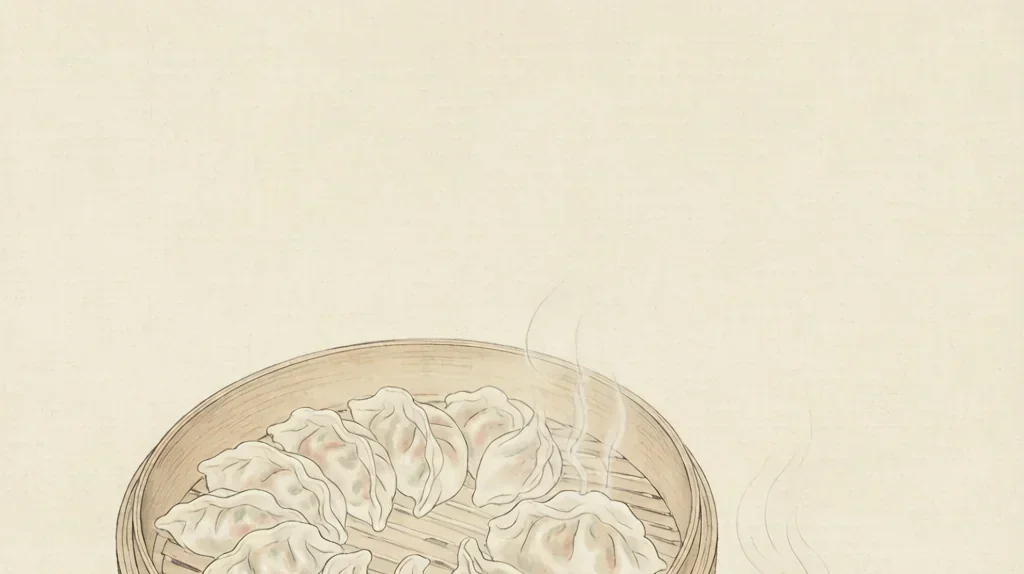
Jiaozi are among the most beloved foods in all of China, and they carry more symbolic weight per bite than almost anything else on the Chinese table. In Mandarin they are jiǎo zi, written 饺子. They are small crescents of thin dough wrapped around a savory filling, pleated closed by hand and boiled, steamed, or pan-fried until tender. To a Western eye they resemble dumplings, and indeed the family resemblance is real — but jiaozi are more than a snack. They are the centerpiece of the Lunar New Year's Eve meal in northern China, a token of prosperity, and an occasion for the whole family to gather and make together. This article looks at where jiaozi came from, how they are made, what they mean, and why the simple act of folding dough has endured for well over a thousand years.
Origins: From Medicine to Meal
The popular origin legend credits jiaozi to Zhang Zhongjing (张仲景), a revered physician of the Eastern Han period who is sometimes called the "Sage of Medicine." The story goes that during a bitter winter Zhang saw poor villagers with frostbitten ears and devised a remedy: little packets of dough stuffed with mutton, chili, and warming herbs, boiled in soup and given to the sick. He called them jiǎo'ěr ("ear-shaped"), and eating them was said to keep ears from freezing. Whether historical or folk invention, the tale links jiaozi to both nourishment and care, a theme that runs through the food's whole history.
Archaeological finds suggest filled dumpling-like foods existed surprisingly early; some scholars point to dough-wrapped morsels depicted or excavated from sites along the Silk Road. By the Tang and Song dynasties the word jiǎo zi appears in records, and by the Ming and Qing eras jiaozi were firmly established as a northern New Year food. The shape itself — a swollen half-moon — was said to resemble ancient gold or silver ingots, planting the association with wealth that still defines the dumpling today.
Regional Context: North and South
In China there is a famous divide between the wheat-eating north and the rice-eating south, and jiaozi belong squarely to the north. In Beijing, Tianjin, Shandong, Hebei, and the northeast, jiaozi are everyday fare and the undisputed star of the Spring Festival. Southerners, who favor rice and rice-flour foods such as tāng yuán (sweet glutinous balls), may eat jiaozi too, but often as one dish among many rather than the ritual centerpiece.
That said, jiaozi travel. Migration, students, and restaurants have spread them nationwide, and today nearly every Chinese city has a jiaozi eatery or a street stall. The wrappers also vary: northern ones tend to be wheat-flour and rolled thin, while regional fillings reflect local larders — pork and cabbage in the north, shrimp and chive near the coast, lamb and scallion in the northwest. The dumpling is a flexible canvas, which is part of its endurance.
Ingredients and Fillings
The dough is simply wheat flour and water, kneaded into a smooth, elastic ball and rested so the gluten relaxes; then it is rolled into thin rounds. The filling is where households express themselves. The classic northern combination is ground pork with Chinese cabbage or napa, seasoned with soy sauce, sesame oil, ginger, scallion, and a little Shaoxing wine. Other favorites include chives with egg (a vegetarian standard), shrimp and pork, beef with onion, or lamb with cumin-scented scallion.
Texture matters as much as taste: the filling should be moist but not watery, seasoned enough to stand on its own, and finely chopped so it cooks evenly inside the thin wrapper. A small amount of gelatinous or finely minced fat keeps the meat juicy. Some families add a splash of broth that sets into jelly, melting into rich liquid during cooking — a technique shared with the soup dumpling tradition. The point is balance: too much filling bursts the skin; too little leaves a sad, empty pleat.
How Jiaozi Are Made
Making jiaozi is famously a group activity. Someone rolls the dough into a rope, cuts it into thumb-sized pieces, and presses each into a disc; another rolls discs into thin, centered wrappers. Fillers spoon a small mound of mixture just off-center, and then come the pleats — the signature crimped edge that seals the dumpling and gives it its shape. Pleating is a skill passed from parent to child, and everyone's "family pleat" looks a little different.
Cooking offers three main paths. Shuǐjiǎo are boiled in plenty of water, lifted out when they float and the wrapper turns translucent. zhēngjiǎo are steamed, delicate and shiny. guōtiē — literally "pot-stuck" — are pan-fried to a crisp golden bottom while the tops stay soft, often finished with a splash of water and a lid. Dipping sauce is essential: a mix of black vinegar, soy, and sliced ginger, sometimes with chili oil. The whole process, done together, is as much the point as the eating.
Cultural Meaning: Luck Wrapped in Dough
Jiaozi are steeped in symbolism. Their shape recalls ancient yuánbǎo, boat-shaped ingots of silver and gold, so eating them at New Year is a wish for wealth in the coming year. The very act of making them on New Year's Eve — the family seated around a tray, talking and folding late into the night — is a ritual of togetherness. In the past, a coin was sometimes hidden in one dumpling; the person who found it was promised good fortune, a playful gamble now often replaced by a candy for safety.
The word jiǎo also sounds like the word for "change" or "the turn of time," linking the dumpling to the boundary between years. Eating jiaozi at midnight, as the old year ends and the new begins, is a way of welcoming fortune at the exact moment of transition. Few foods are so tightly woven into a single national holiday, and the dumpling's warmth is the warmth of family continuity.
When and How They Are Eaten
Although jiaozi reach their cultural peak at Spring Festival, they are eaten year-round: as a quick lunch, a festival treat, or a late-night comfort food. In northern cities a plate of boiled jiaozi with vinegar is a common restaurant order any day. They freeze well, so many families make large batches and store them, a practical virtue that helped the tradition survive modern busy lives.
At the table, jiaozi are served with the dipping sauce and often a side of garlic or pickles to cut the richness. They are eaten by the piece, dipped, and savored, usually with tea. Whether steamed, boiled, or crisp-fried, the dumpling remains a small, perfect unit of Chinese hospitality: made by hand, shared by the plate, and full of good wishes.
Jiaozi Across China: Regional Filling Styles
Although the crescent shape is constant, the filling changes as you travel. In Beijing and Tianjin the classic is pork with napa cabbage, seasoned simply so the vegetable stays sweet. Shandong leans toward leeks and pork, while the northeast adds a generous hit of garlic and sometimes cabbage fermented lightly for tang. Along the coast, shrimp and chive fillings appear, celebrating the local catch, and in the northwest lamb with cumin and scallion reflects the pastoral larder. Vegetarian versions, built from egg, mushroom, and glass noodles, are common during fasting periods and among those who simply prefer them. The dough, too, varies in thickness, with northern wrappers rolled paper-thin and some regional styles left a touch chewier. What unites them is the logic of using what the local pantry offers, so that the same dumpling speaks in a different dialect in every province.
Jiaozi Go Global: From Northern Staple to World Favorite
Jiaozi left China with migrants and now appears on tables from Tokyo to Toronto. In the late twentieth century, frozen dumplings turned a handmade holiday food into an everyday supermarket item, and brands from northern China became staples in Asian grocery aisles worldwide. Restaurants abroad often serve them as an appetizer or main, boiled, steamed, or pan-fried, with the potsticker style proving especially popular with diners new to the food. The dish also travels well because it is endlessly adaptable: fillings shift to local tastes, and dipping sauces are reimagined with everything from black vinegar to chili crisp. Yet the social core survives. Around the world, Chinese families still gather to fold dumplings for the Lunar New Year, passing the pleat from elder to child, so that even far from home the dumpling remains what it has always been, a small unit of togetherness.
❓ Frequently Asked Questions
📝 Chinese Vocabulary
饺子 — : Jiaozi, crescent-shaped wheat dumplings with savory filling.
水饺 — : Boiled jiaozi, the most common cooking style.
锅贴 — : Potstickers, pan-fried jiaozi with a crisp base.
蒸饺 — : Steamed jiaozi, delicate and translucent.
元宝 — : Ancient gold or silver ingots, whose shape jiaozi resemble.
馅 — : The filling of a jiaozi, typically a savory mixture of minced meat and vegetables seasoned with soy, sesame oil, and aromatics.
皮 — : The wrapper or skin, a thin round of wheat dough that encloses the filling and is sealed with a pleated edge.
褶 — : The pleat or crimp along a jiaozi's sealed edge, both a seal and a mark of the maker's style.
🎉 Fun Facts
- The legendary inventor Zhang Zhongjing is also honored as a patron figure of Chinese medicine, not just cooking.
- In some northern households, making jiaozi on New Year's Eve is a marathon that lasts past midnight.
- The pleated edge is sometimes called the "flower edge," and families take quiet pride in their distinctive crimp.
- Frozen jiaozi were among the first Chinese prepared foods to become a global supermarket staple.
- In some regions the number of pleats is said to carry a wish, and a dumpling folded with exactly twelve pleats is thought to echo the twelve months of the year.
- A whole sub-culture of dumpling restaurants in northern China serves only boiled jiaozi with a row of a dozen dipping sauces, letting diners mix and match flavors at will.