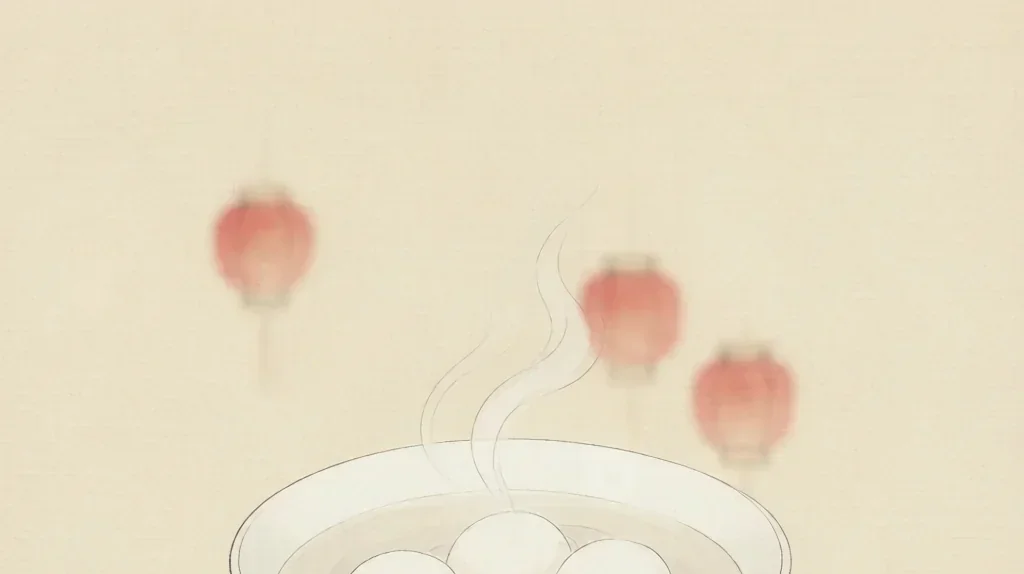
Tangyuan are small, sweet, glutinous rice balls that shine at one of China's warmest festivals — the Lantern Festival — and at family reunions throughout the winter. In Mandarin they are tāng yuán, written 汤圆, literally "soup rounds." They are spheres of soft, chewy rice dough, usually filled with a sweet paste such as black sesame, peanut, or red bean, and served floating in a light, sweet broth. Their round shape and the word tuányuán ("reunion") make them edible wishes for family togetherness. This article looks at where tangyuan came from, how they differ from similar foods, how they are made, and why they glow with meaning at the year's first full moon.
Origins and the Lantern Festival
Tangyuan are the traditional food of the Lantern Festival (Yuánxiāo jié), the fifteenth day of the first lunar month, which closes the Spring Festival period with lantern displays, riddles, and night markets. Eating tangyuan on this night is a custom stretching back over a thousand years, to at least the Tang and Song dynasties, when sweet stuffed rice balls were recorded as a festival treat. The round balls in a bowl of broth mirrored the round moon and the round lanterns, all symbols of completeness.
There is a charming folk tale linking tangyuan to a palace maid during the Han dynasty who longed for her family; the emperor, moved, declared a festival of lanterns and sweet balls so households could reunite. Like many food legends the details are soft, but the emotional core is real: the balls are about bringing people back together after the separation of the old year. In the south they are usually called tāngyuán; in parts of the north the same kind of ball is called yuánxiāo and made by a different rolling method.
Regional Context and the North-South Split
Although tangyuan are eaten nationwide, they belong to the rice-cooking south by temperament, while the wheat-loving north favors jiaozi at New Year. The distinction between tāngyuán and yuánxiāo is worth knowing: southern tangyuan are made by wrapping filling in a flattened dough (like a tiny dumpling), giving a soft, unified texture. Northern yuanxiao are made by rolling a solid filling in dry rice flour while damping it repeatedly, producing a slightly grainier, more brittle skin. The tastes are similar; the techniques differ by region.
Beyond the Lantern Festival, tangyuan appear at winter solstice in some areas, at weddings, and at any gathering where a host wants to wish guests unity and sweetness. In overseas Chinese communities the frozen versions are now available year-round, but they still feel most right in deep winter, steaming in a bowl as the lanterns glow outside.
Ingredients: Rice, Paste, and Broth
The dough is simply glutinous rice flour (nuòmǐ fěn) mixed with water into a smooth, pliable mass; sometimes a little regular rice flour is added for structure. The filling is sweet: toasted black sesame ground with sugar and lard or oil is the classic, prized for its nutty, almost smoky depth; peanut butter-like peanut paste and red bean paste are close rivals. Some modern shops offer chocolate, matcha, or fruit fillings.
The serving broth is deliberately light so it does not overwhelm the balls — often just water sweetened with a little rock sugar, sometimes scented with ginger, osmanthus flowers, or fermented rice wine (jiǔniàng) for a gentle fragrance and faint tang. A few goji berries or lotus seeds may be added. The contrast is the point: plain warm broth, tender sweet ball, aromatic hint of ginger or flower.
How Tangyuan Are Made
For wrapped tangyuan, a piece of rice dough is flattened in the palm, a dab of filling is placed in the center, and the dough is gathered and rolled between the hands into a smooth sphere, sealing the filling inside. The skill is evenness — a ball too thin in one spot can leak during cooking. They are dropped into gently boiling water and stirred once so they don't stick; when they float to the surface they are nearly done, then simmered a minute more to cook the filling.
Because the skins are delicate, the water should not rage, or the balls may burst and lose their filling to the broth. Once cooked they are ladled into bowls with some of the cooking liquid, sweetened and perhaps infused with ginger. The whole process is quick and gentle, suited to a dish whose appeal is softness rather than crispness. Making them by hand, especially the rolling, is often a family activity on festival night.
Cultural Meaning: Roundness and Reunion
The Chinese love of round things is on full display in tangyuan. The word yuán in tāngyuán sounds like tuányuán (reunion) and like yuánmǎn (completeness, fulfillment). To serve round balls in round bowls under a round moon is to stack symbol upon symbol of wholeness. The Lantern Festival is, after all, the moment the scattered family reconvenes one last time before the new year's work begins, and tangyuan give that reunion a taste.
There is also a playful side. Lantern Festival nights feature riddles written on lanterns, and eating tangyuan is part of the evening's gentle merrymaking. In a culture that often communicates feeling through food, the sweet round ball is a quiet, reliable way to say "I hope we stay together" — which may be why it also appears at weddings, where two families become one round circle.
When and How They Are Eaten
Tangyuan are eaten hot, in a bowl with their broth, typically on the Lantern Festival and increasingly at winter solstice or any cold-evening gathering. A serving is several balls per person; they are eaten with a spoon, sipped with the broth, the filling bursting softly as the skin is broken. Ginger in the broth adds warming heat that suits the season.
For newcomers, tangyuan are a gentle introduction to Chinese sweets — not cloying like some festival pastries, but soothing and faintly aromatic. Eaten on a cold night among lanterns and family, they deliver exactly what their name promises: warmth, roundness, and the simple happiness of everyone being in the same room.
Tangyuan At The Winter Solstice And Weddings
Although the Lantern Festival is the headline occasion, tangyuan appear at other meaningful moments through the year. At the winter solstice in parts of southern China, families eat them to mark the turning of the year and wish everyone a longer, fuller life. At weddings they symbolize the joining of two families into one round circle, echoing the same logic of completeness that governs the New Year. Because the balls are easy to make in quantity and gentle to eat, they suit any gathering where hosts want to wish guests unity and sweetness. The dish is therefore less a single-holiday food than a small, edible blessing reused whenever family comes together. Its roundness does the talking.
A Family Activity: Rolling Balls Together
Making tangyuan is often a group affair, especially on festival night, when several pairs of hands flatten dough, tuck in filling, and roll smooth spheres side by side. The work is simple enough for children yet satisfying for adults, and the round results look uniform only with a little practice, which is part of the fun. Rolling together turns a snack into a ritual of togetherness that mirrors the meaning of the food itself. Many overseas families keep the habit alive, buying frozen balls but still gathering to cook and eat them as a link to home. The activity matters as much as the taste: the balls are, quite literally, made by the people who will share them.
❓ Frequently Asked Questions
📝 Chinese Vocabulary
汤圆 — : Tangyuan, sweet glutinous rice balls served in warm broth.
元宵 — : Yuanxiao, the northern rolled style of the same festival ball.
糯米粉 — : Glutinous rice flour, the dough base.
元宵节 — : The Lantern Festival, when tangyuan are traditionally eaten.
团圆 — : Reunion, the wish encoded in the round shape.
芝麻 — : Sesame, the classic filling whose toasted paste gives tangyuan its nutty, faintly smoky core.
桂花 — : Osmanthus, the fragrant flower often steeped into the serving broth for a gentle aroma.
酒酿 — : Fermented rice wine, added to the broth for a faint tang and fragrance.
🎉 Fun Facts
- The Lantern Festival with its tangyuan is considered the real "end" of Chinese New Year celebrations.
- Black sesame filling is so prized that some say a perfect tangyuan should taste faintly of roasted nuts and smoke.
- In the north, yuanxiao are sometimes made by tumbling filling in a large rotating sieve of flour — almost like a tiny snowball fight.
- Tangyuan's broth is often scented with osmanthus or fermented rice, turning a simple sweet into a fragrant one.
- In several regions tangyuan are also eaten at the winter solstice, a time when the round balls symbolize adding a year to one's life and gathering the family together.
- Because the word for the balls sounds like reunion, eating them is considered good luck for family gatherings, and a ball that leaks while cooking is gently teased as a sign of a cook's inexperience.