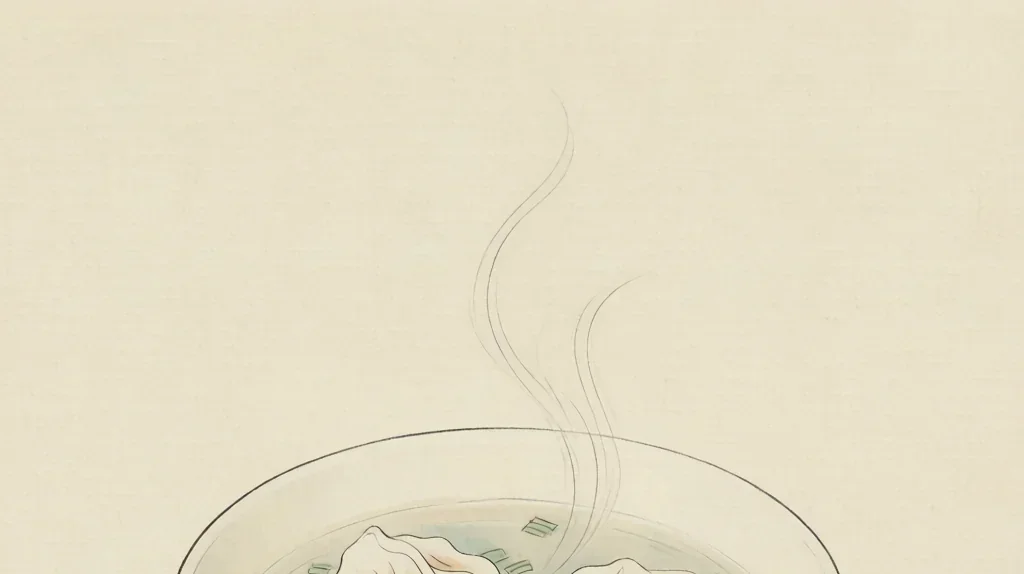
Wonton are the quiet workhorse of Chinese comfort food — small, delicate parcels of seasoned meat wrapped in a tissue-thin sheet of dough, usually floated in a clear, fragrant broth. In Mandarin they are hún tún, written 馄饨. The name is onomatopoeic, evoking the swirling, formless chaos of the filling and wrapper tumbling together. Across China wontons appear at breakfast stalls, late-night noodle shops, and festive tables, served either swimming in soup or fried to a crisp. This article traces the wonton from its ancient beginnings to its many regional guises, and explains why these little parcels have earned such a permanent place in the Chinese bowl.
Ancient Origins of a Humble Parcel
Wontons are old. References to foods much like them appear in writings from the Han dynasty, and by the Tang and Song periods huntun were a recognized staple, especially in the south and around the lower Yangzi. One folk explanation for the name ties it to the primeval chaos (hùndùn) of Chinese cosmology — the wrapping enclosing an undefined filling mirrors the world before order. Whether or not that is the true etymology, it captures the wonton's nature as a small enclosed world of flavor.
Historically wontons were a food of the Yangzi delta and southward, where wheat and rice both flourished and thin wrappers could be made. They spread with migration and trade until nearly every region had its own version. The dish's longevity owes much to its practicality: a little meat stretched by a wide, thin wrapper makes a filling meal from modest means, which is precisely why it became a food of ordinary people.
Regional Varieties and Context
The wonton changes its costume by region. In Cantonese cooking, wàntān are tiny, often filled only with shrimp, served in a clean pork-and-shrimp broth with slender noodles — the famous "wonton noodles" (wàntān miàn). In Sichuan, húntún are dressed in a fiery red chili-and-sesame sauce and called hóngyóu chǎo shǒu ("red oil wontons"), a cold or room-temperature appetizer. Shanghai and Jiangnan styles favor larger pork wontons in a rich, often vinegar-spiked soup.
In the north, wontons blur into jiaozi territory but keep their thinner skin and soup serving. This variety means a traveler can eat wontons daily for a week and never quite repeat the experience. The constant is the wrapper: far thinner and more delicate than dumpling dough, usually made with egg, so it turns translucent and silky in broth rather than chewy.
Ingredients: The Thin Wrapper and the Filling
The defining ingredient is the wrapper — a sheet of dough made from wheat flour, water, and egg, rolled or machine-pressed until almost paper-thin and cut into squares or rectangles. Good wrappers are elastic enough to fold without tearing yet delicate enough to disappear into the broth. The filling is typically ground pork, sometimes alone, sometimes blended with chopped shrimp for sweetness and bounce; seasonings include soy, sesame oil, ginger, scallion, and a little Shaoxing wine.
The broth is not an afterthought. A proper wonton soup uses a clear stock — often chicken or pork bone simmered with ginger and scallion — lightly seasoned so it comforts rather than competes. Garnishes might be shredded lettuce, a few drops of sesame oil, white pepper, or a scatter of scallion. In chili-dressed versions, the sauce of chili oil, black vinegar, soy, and sesame paste does the heavy lifting instead of broth.
How Wontons Are Made and Cooked
Folding a wonton is quicker than pleating a jiaozi. A small spoon of filling sits near one corner of a thin square; the corner is folded over to make a triangle, the edges pressed to seal, and then the two outer points are brought together and pinched, forming the classic "nurse's cap" or little purse shape. Some styles simply roll the square around the filling into a cigar. Because the wrapper is thin, the seal must be light but complete to prevent leaks.
Cooking is brief. Wontons are slipped into simmering broth or water and cooked just until the filling is done and the wrappers turn translucent — often only two or three minutes. For soup wontons they are lifted directly into bowls and topped with hot broth and greens; for fried wontons they are deep-fried until crisp and served with dipping sauce. The speed is part of their appeal as a street or café food that appears before you have finished your tea.
Cultural Meaning and Everyday Comfort
Wontons are not laden with the heavy symbolism of festival foods like mooncakes or zongzi; their meaning is simpler and perhaps more universal — comfort, affordability, and care. A bowl of wonton soup is what a Chinese grandmother makes for a child with a cold, what a night-shift worker eats at 2 a.m., what a traveler orders for a taste of home. The name's echo of "chaos" is gently ironic: the dish brings order and calm in a small bowl.
There is also craft pride. A wonton maker's skill shows in thin, unbroken wrappers and a filling that stays juicy; famous shops guard their broth recipes like family secrets. In cities like Hong Kong and Guangzhou, a great wonton noodle shop is a point of local identity, reviewed as seriously as any fine restaurant. The little parcel, in other words, carries both tenderness and technique.
When and How They Are Eaten
Wontons are an all-day food: breakfast in a soup, a quick lunch with noodles, a late snack on the street. In the Cantonese tradition, wonton noodles are a meal in themselves, the wontons and thin egg noodles sharing the bowl with broth. Elsewhere they may begin a banquet as a light soup course or close a night as supper. The broth version is soothing; the chili-dressed Sichuan version is bracing and appetizing.
To eat them, lift one with the spoon, sip the broth, maybe add a dash of vinegar or chili oil to taste. The wrapper should be barely there, the filling tender and savory. Whether in a hushed teahouse or a neon-lit food stall, the wonton remains what it has been for nearly two thousand years: a small, perfect gesture of nourishment.
Wontons in the Home Kitchen
Making wontons at home is a hands-on tradition passed down through Chinese families, especially in the south where the dish is a staple. A home cook mixes a simple pork-and-shrimp filling, then folds each thin wrapper by hand into a little purse or nurse's-cap shape. Children are often enlisted to help seal the edges, turning the task into a small family gathering. Unlike restaurant versions, home broths tend to be modest and comforting, built from a pot of pork bones and ginger rather than elaborate stock. The parcels are cooked to order and lifted straight into bowls of soup. Because the technique is forgiving and the ingredients are cheap, homemade wontons remain a weeknight solution as much as a festive one, keeping an ancient food alive in ordinary kitchens.
Wontons Around the World
As Chinese immigrants carried their cuisine abroad, wontons traveled with them and adapted to new kitchens. In the United States the deep-fried wonton became a ubiquitous appetizer, often served with a sweet-and-sour dip that barely resembles the southern Chinese original. In Latin America, particularly Peru, wonton-like parcels appear in chifa cooking, the fusion of Chinese and Peruvian flavors. Southeast Asian communities folded the idea into their own soups and fried snacks. Yet in Chinatown restaurants from San Francisco to Sydney, the Cantonese wonton noodle soup still anchors the menu much as it does in Guangzhou. These migrations show how a humble parcel of meat and dough became a small ambassador of Chinese food, recognizable in dozens of local accents while keeping its essential character.
❓ Frequently Asked Questions
📝 Chinese Vocabulary
馄饨 — : Wonton, a thin-wrapped parcel of seasoned meat, usually in broth.
云吞面 — : Wonton noodles, the Cantonese soup of wontons and egg noodles.
红油抄手 — : Red oil wontons, the Sichuan chili-dressed style.
馄饨皮 — : Wonton wrapper, the thin egg dough sheet.
混沌 — : Primordial chaos, the cosmological echo behind the name.
高汤 — : Clear soup stock, the savory base that carries the flavor of wonton broth.
紫菜 — : Laver seaweed, a common fragrant garnish scattered over wonton soup.
鲜虾 — : Fresh shrimp, a classic component of the Cantonese wonton filling.
🎉 Fun Facts
- The word huntun is thought to mimic the sound of the filling and wrapper swirling together in broth.
- Cantonese wonton wrappers are so thin that a stack of a hundred can be smaller than a deck of cards.
- In some regions wontons were traditionally eaten on the winter solstice as a counterpart to northern dumplings.
- A great Hong Kong wonton noodle shop is often judged as fiercely as a Michelin restaurant by locals.
- In parts of northern China, wontons go by a different local name and are sometimes served dry-tossed with a savory sesame sauce rather than floated in broth.
- Wonton soup is a quintessential late-night street food across southern China, with small stalls keeping broth simmering well past midnight.