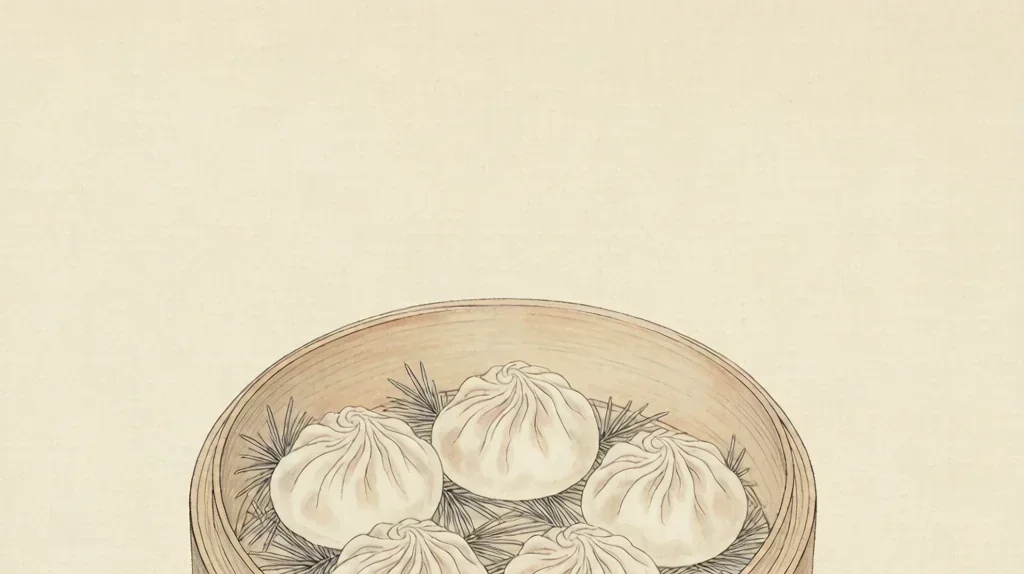
Xiaolongbao (小笼包, xiǎolóngbāo), the ethereal soup dumplings that have captivated food lovers from Shanghai to San Francisco, represent perhaps the most delicate and technically challenging achievement in the vast universe of Chinese dim sum. These seemingly modest parcels—thin-skinned, pleated dumplings cradling a sphere of seasoned pork and a reservoir of molten, savory broth—are the product of a culinary tradition that demands years of training to master and seconds of care to consume properly. The name xiaolongbao translates literally to 'little basket bun,' referring to the small bamboo steaming baskets (小笼, xiǎolóng) in which the dumplings are traditionally cooked and served. But this humble name belies the extraordinary complexity hidden within each dumpling: the secret of the soup, the mathematics of the pleats, the chemistry of the dough, and the generations of craftsmanship that have refined this dish into an edible work of art. To eat a xiaolongbao is to experience a miracle of culinary engineering—a self-contained soup course wrapped in a translucent skin so thin it seems to defy the laws of physics, yet strong enough to hold its precious cargo until the moment it reaches your mouth.
The Birth of the Soup Dumpling in Nanxiang
The origin story of xiaolongbao is inextricably linked to a small town on the outskirts of Shanghai called Nanxiang (南翔). In 1871, during the reign of the Tongzhi Emperor of the Qing Dynasty, a restaurateur named Huang Mingxian sought to create a new type of steamed bun that would distinguish his establishment from competitors. Nanxiang was a prosperous market town along a canal, and its teahouses were crowded with merchants and travelers seeking refreshment. Huang's innovation was inspired by a traditional Jiangnan region technique for making aspic—a savory jelly made by simmering pork skin and bones until the collagen dissolved, then cooling the liquid until it set into a firm gel. Huang realized that if he incorporated cubes of this aspic into his pork filling, the jelly would melt during steaming and transform into a rich, flavorful soup trapped within the sealed dumpling.
The original Nanxiang xiaolongbao differed from the versions that would later become famous. Huang's dumplings were larger, with a thicker skin designed to be eaten as a substantial meal rather than a delicate dim sum item. The filling was simpler—primarily pork with minimal seasoning—and the soup was lighter, reflecting the clean, subtle flavors preferred in Jiangnan cooking. But the fundamental innovation—the aspic-to-soup transformation—was a stroke of genius that would inspire generations of dumpling makers. As the reputation of Nanxiang's soup dumplings spread, travelers carried word of the miraculous 'buns with soup inside' to Shanghai proper, where the city's competitive restaurant scene would refine and elevate the dish to new heights of sophistication.
The Sacred Geometry of 18 Pleats
Among the many exacting standards that define a perfect xiaolongbao, none is more visually iconic than the pleats. Tradition holds that a properly made soup dumpling should have exactly 18 pleats (十八个褶, shíbā gè zhě), each of uniform size and spacing, converging at a central point on top of the dumpling like the petals of a flower closing around its center. This number is not arbitrary—it represents the ideal balance between structural integrity and aesthetic beauty. Fewer pleats would create weak points where the dough might rupture during steaming, spilling the precious soup. More pleats would thicken the gathered dough at the top, creating an unpleasant, doughy nub. Eighteen pleats, executed with precision, create a dumpling that is both strong enough to be lifted from the steamer without breaking and delicate enough that the skin is nearly translucent, revealing the shadow of the filling within.
Mastering the 18-pleat technique is the benchmark by which xiaolongbao chefs are judged. An apprentice dim sum chef may spend two to three years practicing pleating before being allowed to prepare dumplings for customers. The process begins with a small disk of dough—typically 6 to 8 centimeters in diameter and less than a millimeter thick in the center, slightly thicker at the edges. A portion of filling is placed in the center, and the chef begins folding the edges upward in a rapid, rhythmic motion, pinching each pleat against the previous one while rotating the dumpling. The speed of a master is breathtaking: some can pleat and seal a xiaolongbao in under three seconds, producing a perfect 18-pleat dumpling that is indistinguishable from the dozens that came before it. In the most renowned xiaolongbao restaurants, each chef's dumplings can be identified by their pleating style, much as a painter's brushstrokes reveal the artist's hand.
The Secret of the Soup
The defining characteristic of xiaolongbao—the hot, savory soup that bursts forth when the dumpling is bitten—is achieved through a process that is equal parts chemistry and culinary art. The key ingredient is aspic (皮冻, pídòng), a gelatin-rich jelly made by simmering pork skin, pork bones, and sometimes chicken feet for several hours until the connective tissues release their collagen into the water. When this liquid is chilled, the dissolved collagen forms a three-dimensional protein network that traps water molecules, creating a firm jelly that can be diced and incorporated into the raw pork filling. During steaming, the heat melts the gelatin, releasing the trapped water and dissolved flavor compounds as a clear, intensely savory broth.
The composition of the aspic varies by region and by chef. In Shanghai, the classic aspic is made primarily from pork skin, which is rich in collagen and produces a clean, pure pork flavor. In the crab-obsessed kitchens of the Yangtze River Delta, the aspic may be enriched with crab shells and tomalley, adding a briny sweetness that complements the crab meat and roe in the filling. Some modern chefs have experimented with aspics made from different proteins—chicken, duck, even fish—each producing a soup with distinct flavor characteristics. The ratio of aspic to meat is also critical: too little aspic and the dumpling will be dry; too much and the soup will overwhelm the filling and weaken the dough. The ideal proportion is roughly 40% aspic to 60% meat by volume, ensuring that each bite delivers both the rich soup and the savory filling in perfect balance.
The Ritual of Eating Xiaolongbao
Eating a xiaolongbao is a ritual that requires as much skill as making one, and the uninitiated diner who bites directly into a steaming dumpling will quickly learn a painful lesson about the temperature of molten pork broth. The proper technique, passed down through generations of Shanghai diners, involves a precise sequence of actions. First, the dumpling is lifted gently from the steamer basket using chopsticks, being careful not to tear the delicate skin. The diner then dips the dumpling into a saucer of black Zhenjiang vinegar (镇江香醋, Zhènjiāng xiāngcù) laced with thin slivers of fresh ginger. The vinegar cuts through the richness of the pork and soup, while the ginger provides a cleansing, aromatic heat that refreshes the palate between dumplings.
The critical moment comes next: the diner places the dumpling on a soup spoon and nibbles a small hole in the skin, allowing steam to escape and the soup to cool slightly. Some diners sip the soup directly from the dumpling through this hole before eating the remainder; others prefer to let the soup pool in the spoon and consume everything together. Either way, patience is essential—the soup inside a freshly steamed xiaolongbao can exceed 80 degrees Celsius, hot enough to cause serious burns. Once the soup has cooled to a safe temperature, the entire dumpling is consumed in one or two bites, allowing the flavors of the thin skin, savory filling, and rich broth to meld in the mouth. The experience is fleeting but transcendent, which is why a serving of xiaolongbao typically includes six to eight dumplings—each one a small, perfect moment to be savored.
Crab Roe Xiaolongbao: The Ultimate Luxury
Among the many variations of xiaolongbao, none is more prized than the crab roe xiaolongbao (蟹粉小笼, xièfěn xiǎolóng), a seasonal delicacy that appears in Shanghai's finest restaurants during the autumn months when the hairy crabs (大闸蟹, dàzháxiè) of Yangcheng Lake are at their peak. The preparation is labor-intensive and luxurious: female crabs are prized for their bright orange roe, while males contribute rich, creamy tomalley. The crab meat is painstakingly extracted by hand—a skilled worker can process only about two kilograms of crab per day—and combined with the roe and tomalley to create a filling that is equal parts pork and crab. The aspic is enriched with crab shells, deepening the oceanic flavor, and the dumplings are often topped with a small garnish of golden crab roe as a visual announcement of their premium status.
The price of crab roe xiaolongbao reflects the labor and ingredients involved. A single steamer basket of six to eight dumplings can cost anywhere from 80 to 300 yuan at top Shanghai restaurants, and during the brief hairy crab season—roughly October through December—reservations at the most famous establishments can be nearly impossible to secure. Din Tai Fung, the Taiwanese restaurant chain that has done more than any other to globalize xiaolongbao, offers a truffle xiaolongbao that pushes the boundaries even further, incorporating black truffle into both the filling and the skin for an earthier, more aromatic experience. Yet for purists, nothing surpasses the original crab roe version—a dish that captures the essence of autumn in the Yangtze Delta in a single, perfect bite.
Xiaolongbao Goes Global
From its origin in a single Shanghai suburb, the soup dumpling has become a global icon of Chinese dining. Taiwanese chains such as Din Tai Fung carried it to Tokyo, Los Angeles, and Sydney, setting exacting standards that turned a street food into fine dining. In North America and Europe, xiaolongbao now appears on the menus of both humble noodle houses and upscale restaurants, often photographed mid-bite as the soup spills out. Cookbook authors and home videos have demystified the pleating, so curious cooks everywhere attempt the eighteen folds. Yet the dish still signals a specific place: order it in any Chinatown and you are tasting a piece of Jiangnan craft that conquered the world without changing its essential trick of holding hot soup inside a paper-thin skin.
The Home Cook's Challenge
Making xiaolongbao at home is rewarding but demanding, which is why the dumpling is respected even by experienced cooks. The wrapper must be rolled thin at the center yet sturdy at the rim, then cradled with one hand while the other pinches a ring of pleats. The filling is bound with aspic that must be cold and firm; if it warms, the soup leaks before steaming even begins. Timing matters too, since the baskets steam for only a few minutes. Most beginners start with a simpler pleat count and accept occasional bursts, treating torn dumplings as a cook's snack. With practice the rhythm comes, and the reward is pulling a tray of intact, soup-filled parcels from the steamer that taste every bit as good as the shop version at a fraction of the price.
New Twists on an Old Classic
While purists defend the pork-and-soup original, chefs keep reinventing xiaolongbao for new palates. Truffle, foie gras, and lobster versions appear at luxury hotels, and dessert editions filled with molten chocolate or mango custard close a meal on a playful note. Some shops print edible landscapes on the dough, while others dye the skin with vegetable juices for a festive look. Fusion fillings borrow from Japanese, Southeast Asian, and Western kitchens, turning the dumpling into a canvas for cross-cultural taste. None of these innovations change the core feat of sealed soup, but they show how a nineteenth-century snack stays relevant by welcoming novelty. The result is a dish that honors its Nanxiang roots while comfortably sitting on a modern, global plate.