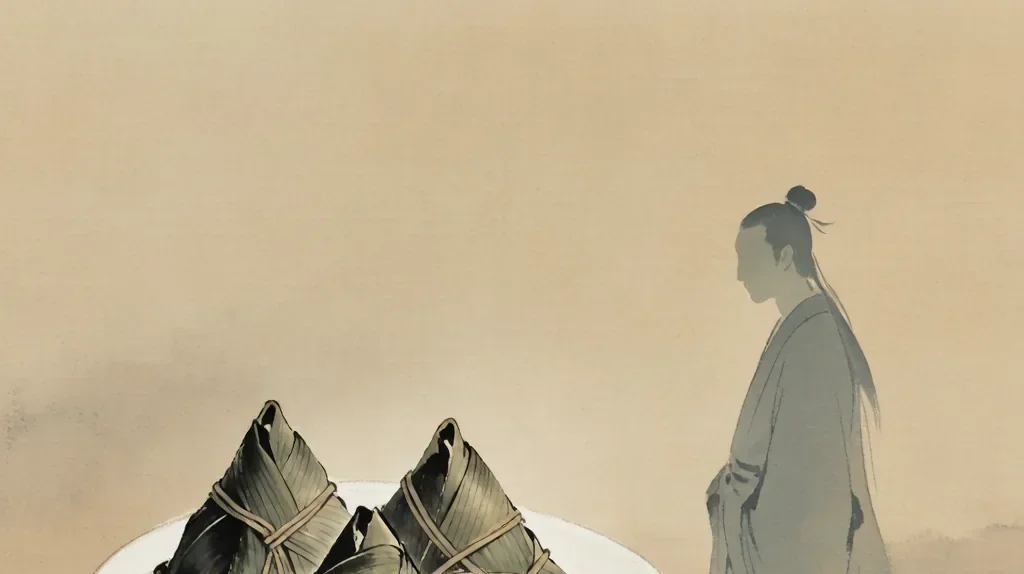
Zongzi are a food with a story, and the story is one of the most moving in Chinese culture. In Mandarin they are zòng zi, written 粽子. They are packets of glutinous rice — often with a sweet or savory filling — wrapped in bamboo or reed leaves, tied with string, and boiled or steamed until the leaves have imprinted the rice with their green, grassy fragrance. Zongzi are eaten at the Dragon Boat Festival, held on the fifth day of the fifth lunar month, and they exist to honor a poet who drowned more than two thousand years ago. This article follows the leaf-wrapped rice from ancient Chu to the modern festival table, and explains why a humble parcel became an act of remembrance.
The Poet and the River
The heart of zongzi's meaning is the story of Qu Yuan (屈原), a minister and poet of the state of Chu during the Warring States period. Qu Yuan was loyal, learned, and outspoken; when his counsel was ignored and he was exiled, he wandered, composing some of the finest poetry in the Chinese language, including the Lisao ("Encountering Sorrow"). As Chu fell to the rival state of Qin, the despairing poet is said to have embraced a stone and thrown himself into the Miluo River. The local people, grieving, rushed out in boats to search for his body and threw rice into the water so the fish would eat the grain instead of the poet. Those rice offerings, wrapped in leaves to keep them from being eaten by water creatures, became zongzi.
Whether the historical Qu Yuan died exactly so, the legend has shaped Chinese memory for over two millennia. The Dragon Boat Festival (Duānwǔ jié) grew around his commemoration, and zongzi became its defining food. To eat one is to participate, however lightly, in an act of mourning and respect that has been repeated every summer for twenty centuries.
Regional and Historical Context
The Dragon Boat Festival falls near the summer solstice, a time traditionally associated with disease and malign spirits, and many of its customs — racing boats, hanging mugwort, wearing scented sachets — are about warding off harm as much as honoring Qu Yuan. Zongzi sit at the center of this, both as tribute and as seasonal food. The festival is celebrated across China and throughout the Chinese diaspora, from Singapore to San Francisco, making zongzi one of the most widely made foods in the sinophone world on a single day.
Historically, the leaf-wrapped rice took many forms. Early records describe rice thrown loose into rivers; the leaf wrapping is a later refinement that also happens to make the food portable and flavorful. Over the centuries regional styles crystallized, and today a traveler can taste the geography of China in zongzi alone — sweet in the south, savory in the north, stuffed in the east, plain in the interior.
Ingredients: Leaves, Rice, and Filling
The wrapper is as important as the contents. Most zongzi use the long leaves of bamboo or of a reed-like plant (zōngyè), which are wiped clean, softened in hot water, and folded into a cone or rectangle. The rice is glutinous or "sticky" rice (nuòmǐ), which becomes tender and cohesive when cooked — note that "glutinous" here refers to texture, not gluten. Fillings divide the zongzi world into two great camps.
Sweet versions, popular in the south, may contain red bean paste, lotus seed paste, or a smear of sweetened pork fat and mung bean; salty versions, beloved in the north and east, pack in marinated pork belly, salted egg yolk, chestnuts, mushrooms, or even pork with taro. A famous regional specialty is the Jiaxing zongzi of Zhejiang, known for a savory pork filling. The leaves are tied with cotton string or strips of leaf, and the parcel is cooked whole, so the filling and rice steam together inside their green envelope.
How Zongzi Are Made
Making zongzi is a hands-on craft. Two or three softened leaves are overlapped and folded into a tight cone, leaving no gaps. A spoon of soaked glutinous rice goes in, then the filling, then more rice to bury it. The leaf is folded over to seal the top, and the whole thing is bound snugly with string so it holds shape through a long boil. The folding technique has many regional variants — some triangular, some long and fat — and a neat, leak-proof parcel is a point of pride.
Cooking is slow: the wrapped bundles simmer in a large pot for two hours or more, until the rice is fully tender and has drunk the leaf's aroma. They can be eaten warm, at room temperature, or reheated by steaming. Making them is often a family or neighborhood affair, with experienced hands teaching newcomers the tricky fold — much like jiaozi at New Year, the making is its own social ritual.
Cultural Meaning and the Festival
Zongzi are inseparable from the values the Dragon Boat Festival teaches: loyalty, remembrance, and communal care. Qu Yuan stands in Chinese culture as the archetype of the wrongly persecuted patriot-poet, and his story is taught to children alongside the food. Eating zongzi is therefore implicitly a lesson in integrity — that a person of principle is worth remembering, even in defeat. The boats that race on festival day re-enact the search for his body, linking the leaf-wrapped rice to the oars on the water.
There is also a domestic, affectionate layer. Grandmothers and mothers wrap zongzi for the family; giving them to friends and colleagues is a small gesture of seasonal goodwill. In modern cities, where few people wrap their own, shops and brands sell elaborate gift boxes, turning an ancient tribute into a contemporary token of relationship and respect.
When and How They Are Eaten
Zongzi appear in the days around the fifth day of the fifth lunar month, which usually falls in June. They are eaten as a snack, a breakfast, or part of a festive meal, often with tea to balance the sticky richness. Because they keep well and travel easily, they are shared widely during the holiday. Savory ones may be accompanied by soy or chili sauce; sweet ones need nothing at all.
For the curious outsider, unwrapping a zongzi is a small ceremony: the string is cut, the leaves opened to reveal the glistening, leaf-scented rice, the filling discovered inside. It is a food that asks you to slow down and notice — which, fittingly, is exactly what the festival of a drowned poet is meant to do.
The Many Shapes of Zongzi
Although the leaf-wrapped rice is one idea, its shape changes from place to place. The classic southern parcel is a neat four-sided cone pinched from two or three bamboo leaves, while northern cooks favor longer, fatter rectangles tied snug with cotton string. Some regions make slim triangular bundles, and street vendors in big cities sell bite-sized versions meant for a single mouthful. The folding is a quiet test of skill: a leaky wrap lets the broth escape and the rice turn soggy. Because the technique is handed down in the kitchen, families often recognize their own style, and a grandmother's particular fold becomes a small signature. The variety of forms is part of the fun, turning a single festival food into a gentle regional dialect everyone can taste.
Zongzi in the Wider Festival
Zongzi sit at the heart of the Dragon Boat Festival, but they share the day with a cluster of older customs meant to protect the living. Communities race long boats down rivers to the beat of drums, re-enacting the search for the poet Qu Yuan, while doorways are hung with mugwort and calamus to drive off illness. Children wear scented sachets, and adults drink realgar wine in token of protection. The rice parcel connects all of it: offered to the river, eaten at the family table, and given to friends, it carries both mourning and goodwill. Seen this way, zongzi are not only a food but a knot tying together remembrance, seasonal health, and community. The festival as a whole is less a single rite than a bundle of habits, with the leaf-wrapped rice as its most portable thread.
❓ Frequently Asked Questions
📝 Chinese Vocabulary
粽子 — : Zongzi, glutinous rice wrapped in leaves, eaten at the Dragon Boat Festival.
糯米 — : Glutinous (sticky) rice, the base of the filling.
粽叶 — : Bamboo or reed leaves used to wrap and scent the rice.
端午节 — : The Dragon Boat Festival, the holiday honoring Qu Yuan.
屈原 — : The Chu poet whose drowning the festival commemorates.
嘉兴 — : Jiaxing, a Zhejiang city famed for its savory pork zongzi.
豆沙 — : Sweet red bean paste, a classic southern filling.
红枣 — : Red date, a simple sweet filling used in plain zongzi.
🎉 Fun Facts
- UNESCO lists the Dragon Boat Festival, with its zongzi and boat races, as an intangible cultural heritage of humanity.
- The leaves are not eaten; they are the cooking vessel and flavoring, then discarded.
- Some regional zongzi are the size of a small loaf, meant to be shared, while others are bite-sized.
- Qu Yuan's poem Lisao is still memorized by Chinese schoolchildren today.
- In southern China, sweet zongzi are sometimes tied with different-colored string than savory ones, so a guest can tell them apart before unwrapping.
- Families that wrap their own often turn the task into a group effort, with one person folding leaves, another spooning rice, and a third tying the string.