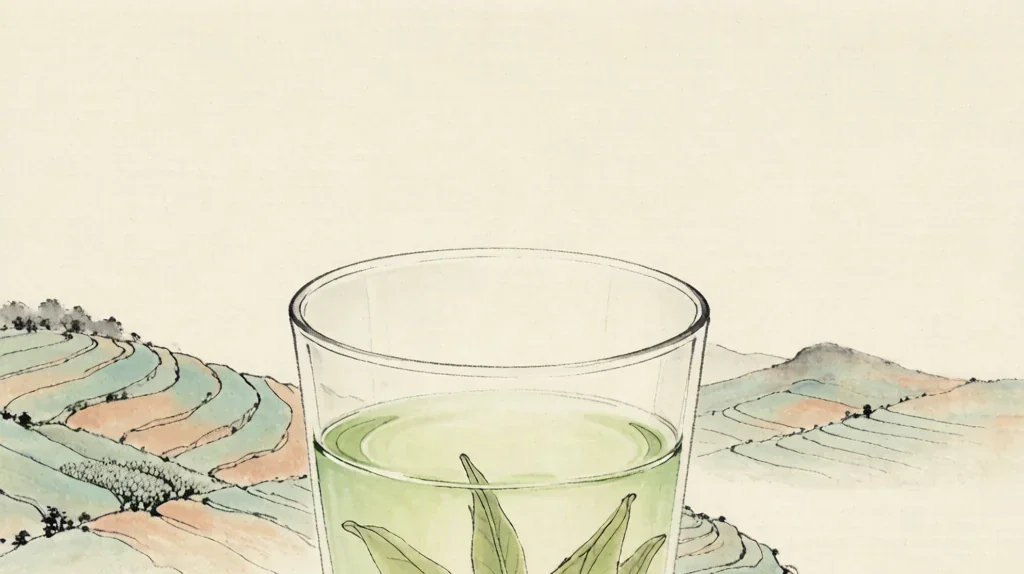
Longjing tea (龙井茶, Lóngjǐng Chá), known in English as Dragon Well tea, stands as China's most iconic green tea and one of the most celebrated teas in the world. Grown on the mist-shrouded hills surrounding Hangzhou's West Lake (西湖, Xī Hú) in Zhejiang Province, Longjing has been prized for over a thousand years for its distinctive flat, sword-shaped leaves, its jade-green infusion, and its uniquely sweet, chestnut-like flavor with delicate orchid undertones. The tea's name comes from the Dragon Well (龙井, Lóng Jǐng), an ancient spring located in the village of Longjing within the West Lake scenic area. According to legend, the spring was home to a benevolent dragon who ensured the water never ran dry — a vital blessing for the surrounding tea gardens. The exceptional quality of Longjing tea arises from a perfect confluence of terroir: the mineral-rich, well-drained soils of the Lion Peak (狮峰, Shī Fēng) area, the gentle mists that roll in from West Lake and filter the sunlight, the temperate climate with distinct seasons, and the ancient tea cultivars that have adapted to this microclimate over centuries. So esteemed is this tea that it has been designated one of China's 'Top Ten Famous Teas' (中国十大名茶, Zhōngguó Shí Dà Míng Chá) consistently since the Tang Dynasty, and it was the first tea to be recognized with a Protected Designation of Origin status by the Chinese government.
Emperor Qianlong and the Imperial Endorsement
No story of Longjing tea is complete without the legendary encounter between the Qianlong Emperor (乾隆皇帝, Qiánlóng Huángdì, r. 1735–1796) and the tea gardens of the West Lake. During one of his famous southern inspection tours, the emperor visited the Hu Gong Temple (胡公庙) at the foot of Lion Peak Mountain, where he observed local women picking tea leaves with remarkable dexterity. Fascinated, the emperor decided to try picking tea himself — only to be interrupted by an urgent messenger bearing news that his mother, the Empress Dowager, had fallen ill. The emperor tucked the freshly picked leaves into his sleeve and rushed back to Beijing. Upon arriving at the imperial palace, he went directly to visit his mother, who noticed a pleasant fragrance emanating from his robes. When she inquired about the source of this aroma, the emperor remembered the tea leaves in his sleeve. He had them brewed immediately, and the empress dowager, upon drinking the clear, fragrant liquor, found her illness miraculously relieved. Overjoyed, the emperor decreed that the eighteen tea bushes in front of Hu Gong Temple — the very bushes from which he had picked leaves — would be designated as 'Imperial Tea Trees' (御茶树, Yù Chá Shù), and their harvest would be sent exclusively to the imperial court as tribute tea (贡茶, gòng chá). These eighteen bushes still grow today in the same spot and are revered as living national treasures. Their annual harvest — a mere few hundred grams of leaves — is auctioned for astronomical prices, with the finest batches often selling for more than their weight in gold. Qianlong's endorsement elevated Longjing tea from a regional specialty to the undisputed 'Queen of Chinese Teas,' a reputation it has maintained for nearly three centuries.
The Art of Hand-Frying: Ten Perfect Gestures
The production of authentic Longjing tea is a manual art form that has been refined over a thousand years and is now recognized as part of China's National Intangible Cultural Heritage. Unlike most teas that undergo withering, Longjing leaves are processed within hours of picking to preserve their freshness. The freshly harvested buds — consisting of one tender bud and one or two young leaves (一芽一叶 or 一芽二叶) — are spread briefly to reduce surface moisture and then immediately taken to the frying wok. The hand-frying process (手工炒制, shǒugōng chǎozhì) is the soul of Longjing production and involves ten distinct hand gestures (十大手法, shí dà shǒufǎ) performed in sequence: grasping (抓), shaking (抖), pressing (搭), spreading (拓), rubbing (捺), pushing (推), buckling (扣), tossing (甩), grinding (磨), and pressing-flat (压). These gestures are not merely mechanical movements but a rhythmic dance performed in a heated iron wok at temperatures reaching 200°C (392°F), with the tea master's bare hands constantly moving the leaves to achieve three simultaneous objectives: kill-green (杀青, deactivating the oxidation enzymes), shaping (the distinctive flat, sword-like form), and drying (reducing moisture content to about 5%). A master tea fryer can process only about 250 grams of finished tea per hour, and it takes a full day to produce one kilogram. The training to become a master is rigorous — apprentices typically spend three to five years simply learning to tolerate the heat of the wok before they are permitted to touch actual tea leaves, and a decade or more to achieve full mastery. The finest Longjing is still entirely handmade, and the price difference between hand-fried and machine-processed Longjing can be tenfold or more, reflecting not just the labor involved but the qualitative difference that experienced hands can achieve.
The Four Perfections and Grading System
Connoisseurs evaluate Longjing tea according to four qualities known as the 'Four Perfections' (四绝, sì jué): the emerald-green color (色绿, sè lǜ), the rich fragrance (香郁, xiāng yù), the sweet, mellow taste (味醇, wèi chún), and the elegant leaf shape (形美, xíng měi). When brewed in a tall glass cup — the preferred vessel for appreciating Longjing — the flat leaves slowly unfurl and descend through the water like green flags in a gentle dance, a visual spectacle that enhances the drinking experience. The grading system for Longjing is intricate and hierarchical. At the apex stands the 'Imperial Harvest' (御茶, Yù Chá) from the eighteen original bushes, which is essentially unobtainable on the commercial market. Below this, authentic West Lake Longjing (西湖龙井) is divided by terroir into five sub-regions known as the 'One Core, Four Protections' (一核心, 四保护区): Lion Peak (狮峰, Shī Fēng) — the most prized, producing tea with a pronounced chestnut aroma and the deepest, richest flavor; Dragon Well Village (龙井, Lóng Jǐng); Cloud Dwelling (云栖, Yún Qī); Tiger Running Spring (虎跑, Hǔ Pǎo); and Plum Blossom Dock (梅家坞, Méijiā Wù). Within each region, the harvest is further graded by picking date and leaf quality: the earliest spring harvest before the Qingming Festival (清明前, Míng Qián, around April 5th) is the most precious, with the young buds containing the highest concentration of amino acids and the most delicate flavor. Harvests between Qingming and Guyu (谷雨前, Gǔ Yǔ Qián, around April 20th) are still excellent but slightly more robust. Beyond West Lake, the broader Zhejiang Longjing designation covers tea from the wider province, which, while often of good quality, lacks the unique terroir characteristics of the authentic West Lake origin.
Longjing in Modern Times: Preservation and Challenge
In the 21st century, authentic West Lake Longjing faces significant challenges. The total production area within the designated West Lake Longjing protection zone is only about 168 square kilometers, yielding approximately 500 tons of authentic tea annually — yet the market is flooded with an estimated 3,000 tons of tea sold under the 'Longjing' name each year. This stark discrepancy means that the vast majority of tea labeled as 'Longjing' is either produced outside the protected zone or, in the worst cases, is entirely counterfeit. The Chinese government has implemented several measures to combat this fraud, including a Geographic Indication (地理标志, dìlǐ biāozhì) certification system, QR-coded traceability labels on authentic West Lake Longjing packaging, and strict legal protections for the designation of origin. However, the price premium commanded by the genuine article — which can range from several hundred to several thousand dollars per kilogram for top-grade harvests — ensures that counterfeiting remains a persistent problem. Beyond authenticity concerns, climate change poses a growing threat to Longjing production. Rising temperatures in Zhejiang Province have caused tea buds to sprout earlier and more unpredictably, compressing the optimal picking window and sometimes exposing tender buds to damaging late frosts. In 2022, an unusually warm February followed by a sudden cold snap destroyed an estimated 30% of the early spring harvest in some areas. In response, tea farmers and researchers are collaborating on climate-adaptive cultivation techniques, while some producers are experimenting with organic and biodynamic farming methods to enhance the resilience of their tea gardens. Despite these challenges, the prestige of Longjing tea remains undimmed. Each spring, as the first tender buds appear on the ancient bushes of Lion Peak, tea lovers around the world await the arrival of the new harvest with an anticipation that echoes the reverence of emperors past — a testament to the enduring power of China's most legendary green tea.
The Longjing Plant: Cultivars and Terroir
Great Longjing begins in the ground. The traditional heirloom bush, known as qun ti zhong, grows slowly on the mineral soils of Lion Peak and the West Lake hills, developing the depth that modern high-yield strains struggle to match. The microclimate does the rest: mist rolling in from the lake filters the sunlight, the temperate seasons give the plant a true winter rest, and well-drained slopes keep the roots healthy. Pickers take only the tender bud with one or two young leaves, the nen ya grade, because maturity dulls the flavor. Processing the same leaf in a different place produces a different tea, which is why the protected zone matters so much. Understanding cultivar and terroir explains why two teas that look similar can taste worlds apart, and why growers guard their old bushes as carefully as a vineyard guards its heritage grapes.
Flat-Leaf Green Teas: Longjing's Family
Longjing is a member of the chao qing, or pan-fired green tea, family, and more specifically of the bian cha, or flat-tea, group whose leaves are pressed into flat shapes. China has several flat greens in this lineage, from the spiraled and downy Anji varieties to the famous Mengding Ganlu of Sichuan, yet Longjing's sword-like flatness and chestnut finish make it the benchmark. What unites them is the kill-green step in a hot wok, which stops oxidation and locks in a fresh, vegetal character rather than the darker notes of oolong or black tea. Knowing the family helps a drinker navigate Chinese greens: curl-shaped teas taste different from flat ones, and pan-fired ones differ from steamed ones like Japanese sencha. Longjing thus sits at the head of a recognizable style, the flat, fragrant, green ideal that other teas are measured against.
The Ritual of Drinking Longjing
Longjing is meant to be watched as much as tasted. The preferred vessel is a tall glass cup, which shows the flat leaves slowly standing, swaying, and sinking like green flags in clear water. Water at about seventy-five to eighty degrees celsius is poured over three grams of leaf, and after a minute or two the first infusion opens with a clean, sweet, vegetal note and a faint orchid echo. The leaves are re-steeped three or four times, each round softer and a little different, and the hui gan, a gentle returning sweetness, lingers after swallowing. No milk, no sugar, nothing to hide behind; the point is the leaf itself. This quiet, almost meditative way of drinking is why Longjing suits a slow morning or a calm pause, a small ceremony available to anyone with a glass, hot water, and good tea.
Longjing in the Home: A Daily Green Tea
For all its imperial legend, Longjing is also an everyday drink in Chinese homes, not only a ceremonial treasure. A tin of decent West Lake or Zhejiang Longjing sits in many kitchens, brewed after meals to refresh the palate and aid digestion, or offered to guests as a sign of hospitality. Families with roots in the region may drink it daily through spring and summer, switching to oolong or pu erh as the weather cools. The expense of top grades means most home brewing uses the more modest Zhejiang harvest, while the famous pre-Qingming leaf is reserved for gifts and special visitors. This dual life, humble staple and luxury gift, is part of the tea's charm: the same leaf that auctioned for thousands can also be the ordinary cup that ends a home dinner, proof that great tea need not be rare to be good.