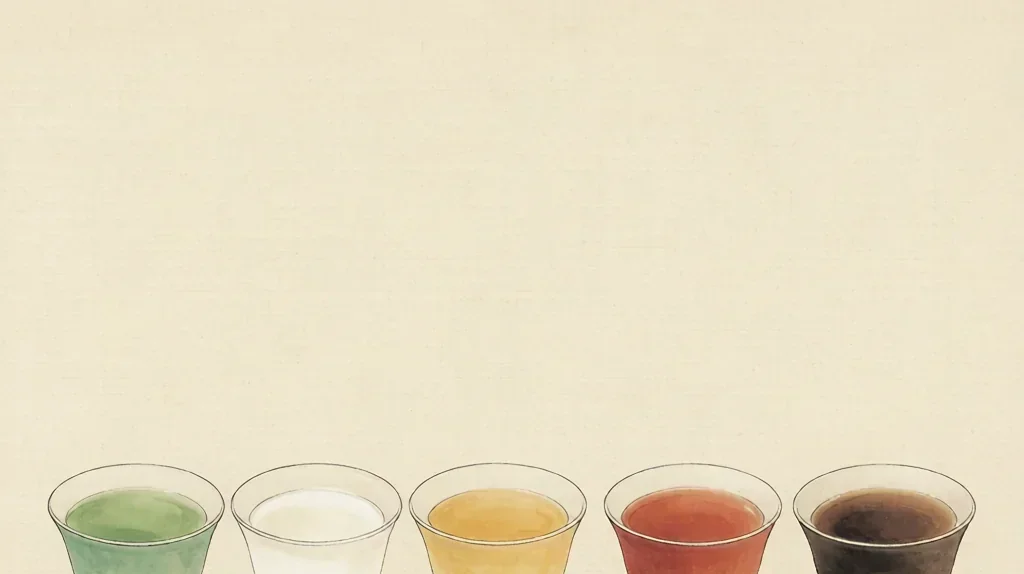
Chinese tea culture stretches back over four thousand years, making it one of the world's oldest and most sophisticated beverage traditions. At the heart of this tradition lies a classification system that divides all Chinese teas into six major categories (六大茶类, Liù Dà Chá Lèi): Green Tea (绿茶, Lǜ Chá), White Tea (白茶, Bái Chá), Yellow Tea (黄茶, Huáng Chá), Oolong Tea (青茶, Qīng Chá), Black Tea (红茶, Hóng Chá), and Dark Tea (黑茶, Hēi Chá). What distinguishes these categories from one another is not the tea plant itself — all come from the same species, Camellia sinensis — but rather the processing method, specifically the degree of oxidation (发酵, fāxiào) the leaves undergo after harvesting. Chinese tea artisans discovered over centuries that by manipulating variables such as withering time, rolling technique, heating temperature, and aging conditions, they could produce an astonishing spectrum of flavors, aromas, colors, and health properties from a single plant. This six-category system, formalized in the 1970s by tea scholar Chen Chuan (陈椽), has become the standard framework for understanding Chinese tea worldwide.
Green Tea (绿茶, Lǜ Chá): The Unoxidized Classic
Green tea is the most ancient and widely consumed tea category in China, accounting for approximately 60% of domestic tea production. Its defining characteristic is minimal oxidation — the freshly picked leaves are heated almost immediately after harvesting through a process called 'kill-green' (杀青, shāqīng), which deactivates the oxidation enzymes and preserves the leaf's natural green color and fresh, vegetal character. Chinese green teas employ two primary kill-green methods: pan-firing (炒青, chǎo qīng), where leaves are tossed in large woks over heat, producing a nutty, chestnut-like aroma; and steaming (蒸青, zhēng qīng), an older method preserved primarily in Japanese tea culture and in the Chinese tea Enshi Yulu (恩施玉露). The resulting tea liquor ranges from pale jade to bright yellow-green, with flavor profiles spanning from sweet and floral to grassy and umami-rich. Famous green teas include Longjing (龙井, Dragon Well) from Hangzhou's West Lake, prized for its flat, sword-shaped leaves and chestnut sweetness; Biluochun (碧螺春, Green Snail Spring) from Jiangsu, with its delicate spiral shape and fruity fragrance; and Huangshan Maofeng (黄山毛峰, Yellow Mountain Fur Peak) from Anhui, known for its orchid-like aroma. Green tea is also celebrated for its high concentration of catechins, particularly EGCG (epigallocatechin gallate), a powerful antioxidant associated with numerous health benefits.
White Tea (白茶, Bái Chá): The Minimalist's Brew
White tea represents the least processed of all tea categories — leaves and buds are simply withered under controlled conditions and then dried, with no rolling, shaping, or kill-green step involved. This minimal intervention allows the tea to retain its natural appearance, characterized by the silvery-white downy hairs (毫, háo) that cover young tea buds and give the category its name. White tea originates from Fujian Province, specifically the Fuding (福鼎) and Zhenghe (政和) regions, where the local 'Da Bai' (大白, Big White) and 'Da Hao' (大毫, Big Down) cultivars produce exceptionally large, fuzzy buds ideal for white tea production. The flavor profile is subtle, nuanced, and delicately sweet, often described with notes of honey, melon, hay, and fresh meadow flowers. White tea is categorized into several grades: Baihao Yinzhen (白毫银针, Silver Needle), composed entirely of unopened buds and considered the pinnacle of white tea; Bai Mudan (白牡丹, White Peony), which includes both a bud and one or two young leaves; and Shou Mei (寿眉, Longevity Eyebrow), made from more mature leaves and offering a stronger, fuller-bodied brew. In traditional Chinese medicine, white tea is valued for its cooling properties (凉性, liáng xìng) and is believed to help clear heat and detoxify the body. Modern research has confirmed that white tea contains exceptionally high levels of antioxidants, with some studies suggesting it may have even greater free-radical-scavenging capacity than green tea due to the preservation of natural polyphenols through minimal processing.
Yellow Tea (黄茶, Huáng Chá): The Forgotten Treasure
Yellow tea is the rarest and least known of the six major tea categories, produced through a unique additional step called 'menhuang' (闷黄, sealed yellowing) or 'sweltering.' After the kill-green step, the still-warm leaves are wrapped in cloth or paper and allowed to rest for hours or even days in a warm, humid environment. This controlled, non-enzymatic oxidation process — distinct from the enzymatic oxidation used in oolong and black tea production — gently transforms the leaf's chemical composition, mellowing the grassy notes characteristic of green tea and developing a smoother, sweeter, more rounded flavor with hints of chestnut, bamboo, and toasted grain. The leaves take on a distinctive yellowish hue, and the brewed liquor ranges from pale golden to amber. Historically, yellow tea was produced as tribute tea (贡茶, gòng chá) for the imperial court, and its labor-intensive production process meant it was never widely commercialized. During the upheavals of the 20th century, the techniques for making many yellow teas were nearly lost, and today only a handful of producers maintain the tradition. The most famous yellow teas include Junshan Yinzhen (君山银针, Jun Mountain Silver Needle) from Hunan's Junshan Island in Dongting Lake, whose needle-like buds dance vertically in the cup when brewed — rising and falling three times in a phenomenon known as 'Three Ups and Three Downs' (三起三落); Mengding Huangya (蒙顶黄芽, Mengding Yellow Bud) from Sichuan's Mount Mengding, one of China's oldest tea-growing regions; and Huoshan Huangya (霍山黄芽, Huoshan Yellow Bud) from Anhui, prized since the Tang Dynasty. The near-extinction and recent revival of yellow tea makes it a fascinating example of living cultural heritage.
Oolong Tea (青茶, Qīng Chá): The Art of Partial Oxidation
Oolong tea, known in Chinese as qīng chá (literally 'blue-green tea'), occupies the middle ground between unoxidized green tea and fully oxidized black tea, with oxidation levels ranging from approximately 10% to 70%. This broad spectrum makes oolong the most diverse tea category, encompassing everything from lightly oxidized, floral teas reminiscent of green tea to deeply oxidized, roasted teas approaching the character of black tea. Oolong production is the most complex and labor-intensive of all tea categories, involving repeated cycles of withering, bruising (through shaking or tumbling the leaves to initiate oxidation), fixation (heating to stop oxidation), rolling, and drying — a process that can take several days from start to finish. The two most famous oolong-producing regions are Fujian and Guangdong provinces in southern China, and Taiwan. Fujian's Wuyi Mountains produce the legendary 'Rock Teas' (岩茶, Yán Chá), including the revered Da Hong Pao (大红袍, Big Red Robe), which grows on the cliffs of the Wuyi scenic area and was once reserved exclusively for the imperial family. These teas are characterized by a distinctive mineral quality known as 'rock rhyme' (岩韵, yán yùn). Fujian's Anxi County is famous for Tieguanyin (铁观音, Iron Goddess of Mercy), one of China's most popular oolongs, known for its orchid fragrance and creamy mouthfeel. From Guangdong's Phoenix Mountain comes Fenghuang Dancong (凤凰单丛, Phoenix Single Bush), where each tea bush — some over 600 years old — produces leaves with distinct aromatic profiles, including the sought-after 'Mi Lan Xiang' (蜜兰香, Honey Orchid Fragrance). Taiwan's high-mountain oolongs, such as Alishan (阿里山) and Lishan (梨山), grown at elevations above 1,000 meters, are celebrated for their buttery texture and floral complexity. The art of oolong tea is perhaps best embodied in the Gongfu tea ceremony (工夫茶, Gōngfū Chá), a meticulous brewing method using small Yixing clay teapots and tiny cups, originating from the Chaozhou region of Guangdong.
Black Tea (红茶, Hóng Chá): China's Gift to the World
Despite being called 'black tea' in English, this category is known in Chinese as hóng chá — literally 'red tea' — referring to the deep reddish-amber color of the brewed liquor. Black tea undergoes full oxidation, where the tea leaves are withered, rolled to break their cell walls, and then allowed to oxidize completely in a warm, humid environment, transforming their chemical composition dramatically. The green catechins polymerize into theaflavins and thearubigins, which give black tea its characteristic color, briskness, and body. Chinese black teas are generally less astringent and more subtly complex than their Indian or Sri Lankan counterparts, often featuring notes of chocolate, dried fruit, malt, honey, and sweet potato. The category originated in Fujian Province's Wuyi Mountains, where Lapsang Souchong (正山小种, Zhèngshān Xiǎozhǒng) — the world's first black tea — was created in the late Ming Dynasty (around 1600 CE) when tea producers, seeking to meet growing European demand, discovered that fully oxidizing and smoke-drying tea leaves over pinewood fires produced a robust, long-lasting tea ideal for long sea voyages. This tea became immensely popular in Britain and catalyzed the global tea trade. Other renowned Chinese black teas include Keemun (祁门红茶, Qímén Hóngchá) from Anhui, one of the three most fragrant teas in the world alongside Darjeeling and Uva, known for its wine-like, orchid-scented aroma; Dianhong (滇红, Yúnnán Hóngchá) from Yunnan, made from the large-leaf Assamica variety and prized for its golden tips and malty sweetness; and Jin Jun Mei (金骏眉, Golden Steed Eyebrow), a relatively recent innovation from Wuyi, made entirely from young buds and commanding prices that can exceed thousands of dollars per kilogram.
Dark Tea (黑茶, Hēi Chá): The Fermented Legacy
Dark tea, the final category of the six major types, is unique in undergoing true microbial fermentation (后发酵, hòu fāxiào) — a post-production aging process in which beneficial microorganisms transform the tea's chemical composition over months, years, or even decades. This is fundamentally different from the enzymatic oxidation that produces black tea, and it gives dark teas their characteristic earthy, woody, and sometimes mushroom-like flavor profiles. The most famous dark tea is undoubtedly Pu'er (普洱, Pǔ'ěr) from Yunnan Province, which is so significant in Chinese tea culture that some consider it a category unto itself. Pu'er is divided into two types: Sheng Pu'er (生普, raw Pu'er), which undergoes a slow, natural fermentation over many years, gradually transforming from a green-tea-like character to a complex, aged depth; and Shou Pu'er (熟普, ripe Pu'er), invented in 1973 to accelerate the aging process through controlled wet-piling (渥堆, wò duī) fermentation, producing a tea that is immediately dark, smooth, and earthy. Beyond Pu'er, China produces many other distinguished dark teas, including Hunan's Fu Zhuan Cha (茯砖茶, Fu Brick Tea), notable for the golden fungal colonies (金花, jīn huā, literally 'golden flowers') of Eurotium cristatum that bloom on its surface during aging and are prized for their digestive health benefits; Guangxi's Liubao Tea (六堡茶, Liùbǎo Chá), with its distinctive betel-nut aroma; and Sichuan and Hubei's border-sale teas (边销茶, biānxiāo chá), traditionally compressed into bricks for trade with Tibet and other frontier regions. The compressed forms of dark tea — cakes (饼, bǐng), bricks (砖, zhuān), and tuos (沱, tuó, bowl-shaped nests) — are not merely practical for storage and transport but have become objects of aesthetic appreciation and speculative investment, with rare vintages of aged Pu'er fetching astronomical prices at auction.
Understanding the six major tea categories opens a window into the depth and sophistication of Chinese tea culture. Each category represents not just a different processing technique but a distinct philosophy — from the immediacy of green tea's captured spring freshness to the patient transformation of dark tea over decades. Together, they form a complete spectrum that has been refined over millennia, demonstrating how a single plant, in the hands of skilled artisans, can produce an almost infinite variety of sensory experiences. For the tea enthusiast, the journey through the six categories is a lifelong exploration, with each cup offering new discoveries in taste, aroma, and the rich cultural heritage of China's most beloved beverage.