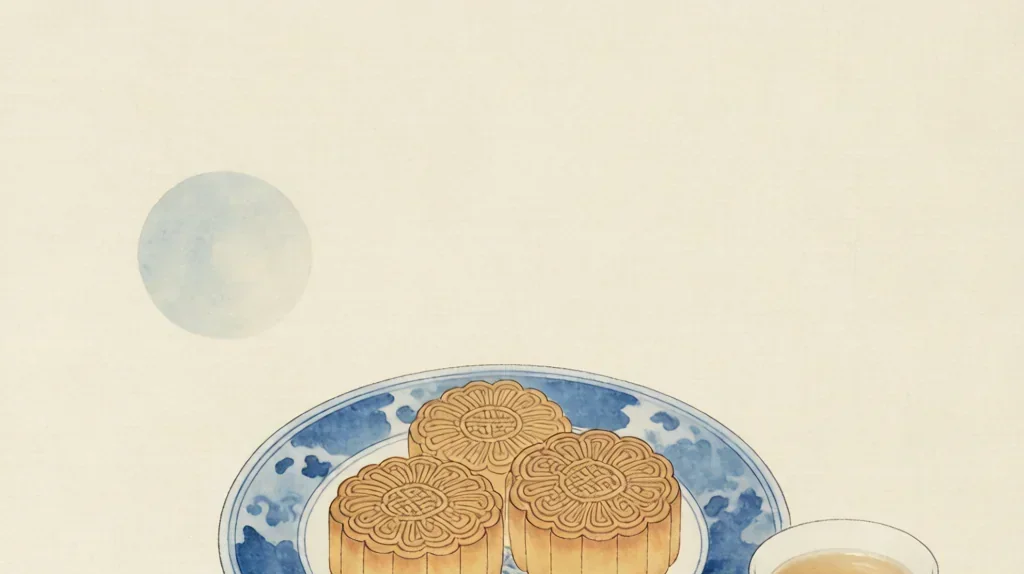
Mooncakes are the most famous edible symbol of the Mid-Autumn Festival, and they are unlike almost any other Chinese food in both form and feeling. In Mandarin they are yuè bǐng, written 月饼 — literally "moon cake." They are small, dense, round pastries with a tender, slightly chewy crust enclosing a sweet, rich filling, most classically a salted egg yolk nestled in lotus seed paste to evoke the full moon. Once a year, as the harvest moon rises fat and bright, families across China and the Chinese world share mooncakes and gaze at the sky. This article explores the mooncake's history, its many regional faces, how it is made, and why a single rich bite carries so much meaning.
Origins and the Moon Festival
Mooncakes are tied to the Mid-Autumn Festival (Zhōngqiū jié), held on the fifteenth day of the eighth lunar month, when the moon is at its fullest and brightest. The festival's roots reach back over a thousand years, blending moon worship, harvest gratitude, and the ideal of family reunion. Legend also links mooncakes to the late Yuan dynasty, when rebels allegedly hid messages coordinating an uprising inside the cakes — a story more folklore than fact, but one that adds a frisson of intrigue to the pastry.
What is certain is that by the Ming and Qing dynasties mooncakes were established festival gifts, exchanged among relatives, friends, and business associates. The round shape mirrors the full moon and the Chinese word for reunion (tuányuán), so sharing a round cake is a wish for the family to be whole. The cakes are therefore as much about relationship as they are about taste — a edible social bond delivered once a year.
Regional Varieties Across China
China's regional cuisines each claim a mooncake style, and the differences are striking. The Cantonese style, now the most internationally famous, has a glossy, golden-brown crust and fillings like lotus seed paste, red bean, or white lotus with one or two salted yolks. The Suzhou style is flaky and layered, almost like a shortbread, with savory-sweet fillings. Beijing mooncakes tend to be harder and plainer, sometimes filled with rock sugar and nuts (zǐsuāngāo).
Further afield, Yunnan mooncakes use ham and flower petals; Chaoshou style frames the yolk in a crisp, spiral crust. In recent decades "snow skin" mooncakes — chilled, mochi-like, brightly colored — have become fashionable, especially in Hong Kong and among younger eaters. The variety shows how a single festival food can be endlessly reinterpreted while keeping its core identity as a round, shared token of the moon.
Ingredients: Crust, Paste, and Yolk
The classic Cantonese mooncake begins with a golden syrup-based dough: flour, inverted sugar syrup, alkaline water, and oil, which gives the crust its characteristic sheen, soft chew, and faint caramel color. The filling is traditionally smooth lotus seed paste (liánróng), slowly cooked with sugar and oil until dense and glossy. At its center sits a salted duck egg yolk, cured and dried, whose round, amber form is the "moon" inside the cake.
Other fillings include red bean paste, taro, black sesame, or modern innovations like custard, chocolate, ice cream, and even truffle. Many traditional cakes also contain candied melon, sesame, or watermelon seeds for texture. A stamp pressed into the top before baking imprints the maker's name or a festive phrase in Chinese characters — an edible seal that doubles as decoration and branding.
How Mooncakes Are Made
Traditional mooncakes are a baker's discipline. The dough is rested, then portioned and flattened into a disc. A ball of filling (with yolk embedded) is placed in the center, and the dough is wrapped around it and sealed, producing a sphere that is pressed into a wooden or plastic mold. The mold imprints the top design and shapes the cake into its tidy, domed square or round.
Before baking, the surface is brushed with an egg wash for shine. The cakes bake at moderate heat until golden, then cool — during which the crust softens to its proper chewy texture. Crucially, fresh mooncakes are a bit hard; they are meant to "return oil" (huí yóu), resting a few days so the filling's fats bloom into the crust, making it tender and fragrant. They are eaten in small wedges, never a whole cake at once, usually with tea to cut the sweetness.
Cultural Meaning: The Full Moon, the Full Family
The mooncake's deepest meaning is reunion. The Mid-Autumn Festival is sometimes called "China's thanksgiving," a time when families gather under the moon, and the round cake is its edible emblem. To cut a mooncake and share it is to enact togetherness; even those far from home eat one and think of the family they cannot reach. Poems and songs across a thousand years link the full moon to human partings and hopes, and the cake is the physical form of that sentiment.
There is also a civic and commercial dimension. Exchanging ornate mooncake boxes is a major social ritual in Chinese business culture, a way to maintain guānxi (relationships). Yet at heart the cake remains domestic: a grandmother breaking one open for her grandchildren, the yolk moon revealed, the tea poured. In that small act the ancient festival lives.
When and How They Are Eaten
Mooncakes appear in the weeks before and during the Mid-Autumn Festival, typically in September or early October. They are not an everyday snack; their richness means a single cake is divided among several people, each taking a wedge with a cup of tea — oolong or pu-erh being traditional choices that balance the sweetness. In Chinese communities worldwide, gift boxes of mooncakes circulate as eagerly as any holiday present.
For the first-time eater, the mooncake can be surprising: dense, sweet, and almost confection-like, with the savory yolk as a salty counterpoint. Eaten slowly, in company, under a bright autumn moon, it is less a dessert than a small ritual — a taste of home, history, and the round, unbroken circle of family.
The Art of the Mooncake Mold
Every traditional mooncake begins in a mold, and the mold is itself a small work of folk art. Carvers shape wooden or plastic forms with a domed cavity and an engraved top plate that presses a design into the dough as the cake is formed. The imprint might show the bakery's name, a rabbit or osmanthus motif, or a phrase wishing reunion and good fortune. A single confident press both shapes the cake and stamps its message, so the maker needs no extra decoration. Collectors value antique molds for their worn, intricate patterns, and some families keep a treasured mold across generations. In an age of factory uniformity, the hand-carved mold remains a quiet reminder that the mooncake is as much a printed wish as it is a pastry.
Modern Flavors and Reinvention
Mooncakes have changed faster in the last few decades than in the previous century. Health-conscious bakers now offer low-sugar pastes and whole-grain crusts, while pastry chefs experiment with custard, matcha, and fruit fillings that appeal to younger eaters. Snow-skin versions arrive in vivid colors and chill rather than bake, broadening the cake beyond its autumn roots. Luxury brands package them in lacquered boxes with champagne or truffle centers, turning the gift into a status object. Even so, the classic lotus-and-yolk round still anchors the festival, and most families keep one traditional cake on the table. The reinventions show a festival food negotiating between reverence for custom and the appetite of a changing market. Abroad, bakeries in Singapore, Hong Kong, and North America stage elaborate seasonal displays, and waiting lists for the most coveted boxes now begin weeks before the holiday itself.
❓ Frequently Asked Questions
📝 Chinese Vocabulary
月饼 — : Mooncake, the round festive pastry of the Mid-Autumn Festival.
中秋节 — : The Mid-Autumn Festival, held on the full-moon night of the eighth lunar month.
莲蓉 — : Lotus seed paste, the classic sweet mooncake filling.
团圆 — : Reunion, the ideal of family togetherness the round cake symbolizes.
蛋黄 — : Egg yolk, the salted center representing the full moon.
广式 — : Cantonese style, the most internationally common type of mooncake.
苏式 — : Suzhou style, a flaky, layered mooncake crust distinct from the glossy Cantonese form.
冰皮 — : 'Snow skin,' the chilled, mochi-like modern mooncake that must be served cold.
🎉 Fun Facts
- The legend of rebels hiding uprising messages in mooncakes is popular but almost certainly apocryphal.
- A traditional Cantonese mooncake can be surprisingly calorie-dense; a single cake may equal several hundred calories.
- "Snow skin" mooncakes are a late-twentieth-century Hong Kong invention and must be served chilled.
- The cakes are traditionally cut into wedges like a pizza and shared, never eaten whole by one person.
- During the Mid-Autumn Festival, bakeries release limited-edition mooncake flavors ranging from ice cream and chocolate to truffle and even savory cheese.
- In some overseas Chinese communities, mooncakes are now paired with coffee or milk tea rather than the traditional oolong or pu-erh.