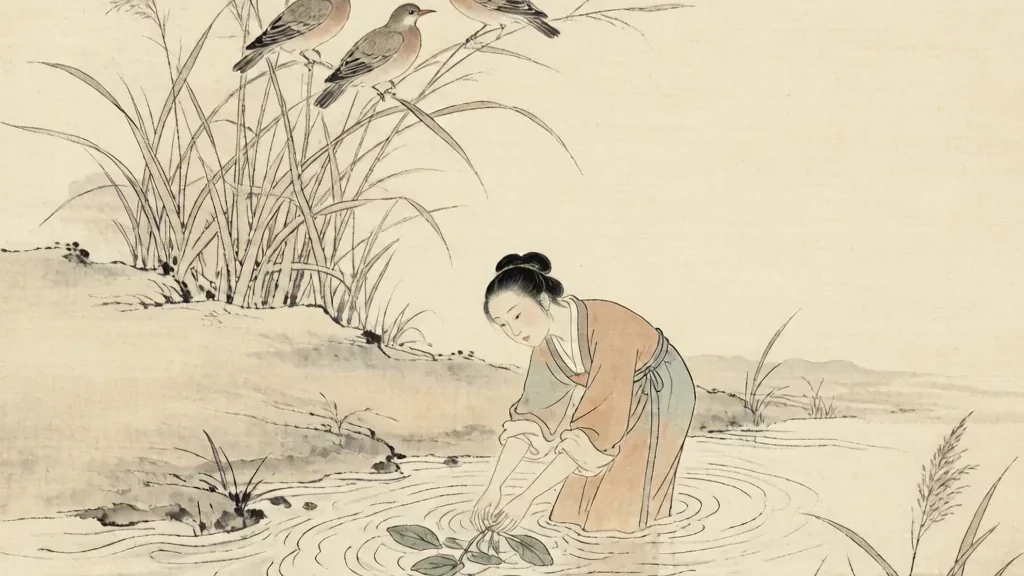
Before the Tang poets perfected the quatrain, before the Song lyricists set words to music, before any of the literary traditions we now call "Chinese" had taken shape, there was the Shijing (诗经) — the Book of Songs. This collection of 305 poems, dating from the eleventh to the seventh centuries BCE, is the fountainhead of Chinese poetry. Its verses have been memorized, recited, and studied continuously for three thousand years, making it one of the oldest living literary traditions on earth. If Homer stands at the beginning of Western literature, the Book of Songs occupies the same foundational position for East Asia.
The poems themselves come from a world almost unimaginably distant from our own — a world of bronze-age agriculture, ancestral sacrifices, feudal lords, and courtship rituals governed by elaborate codes of propriety. Yet their emotional immediacy is startling. A soldier homesick at the frontier, a woman longing for her absent lover, a farmer celebrating the harvest — these voices speak across three millennia with undiminished power. The Book of Songs reminds us that the fundamental human experiences — love, grief, joy, longing — have not changed.
Confucius and the Canonization of the Songs
Tradition holds that Confucius (孔子, 551-479 BCE) selected the 305 poems from a larger body of some three thousand, editing and arranging them as a teaching text for his disciples. Modern scholarship questions whether Confucius personally performed this editorial work, but his role in establishing the collection's canonical status is undisputed. In the Analects, he repeatedly urges his students to study the Songs, declaring: "If you do not study the Songs, you will have nothing to say" (不学诗,无以言).
Confucius's praise of the collection is characteristically practical. He values the Songs not merely as aesthetic objects but as instruments of moral education and social competence. In one famous passage, he summarizes their utility: "The Songs can stimulate the mind, train observation, encourage sociability, and express grievances. At home, they teach you to serve your father; abroad, to serve your ruler. And they acquaint you with the names of birds, beasts, plants, and trees."
This encyclopedic function is real. The poems mention over a hundred species of plants and animals, providing a rich record of the natural world as perceived by ancient Chinese farmers and hunters. To read the Book of Songs is to enter a landscape of mulberry groves and millet fields, of rivers where waterfowl call and mountains where deer roam — a world at once familiar and enchanted.
The Three Sections: Airs, Odes, and Hymns
The collection is traditionally divided into three sections, each representing a different social context and poetic mode.
The Airs of the States (国风, Guo Feng), comprising 160 poems, form the heart of the collection and are generally considered its finest portion. These are folk songs from fifteen different regions of ancient China, collected — according to tradition — by royal officials who traveled the kingdom recording the songs of the common people. The theory was that by listening to these songs, the king could gauge the moral condition of his realm — a kind of ancient opinion poll.
The Airs are overwhelmingly concerned with love, courtship, and the rhythms of agricultural life. They are direct, sensuous, and often startlingly candid by later Confucian standards. "Please, Zhongzi," one young woman pleads, "don't come into my village, don't break my willow trees. It's not that I care about the willows — I'm afraid of my father and mother. Zhongzi, I do love you, but I'm afraid of what my parents will say." The poem captures the tension between desire and social constraint with an economy that anticipates the best of later Chinese poetry.
The Lesser and Greater Odes (小雅, 大雅, Xiao Ya and Da Ya), totaling 105 poems, represent the poetry of the aristocracy. These are more formal than the Airs, often longer, and deal with the concerns of the ruling class: banquets, hunts, military campaigns, and the proper conduct of government. Some of the most powerful poems in the collection belong to this section — particularly the laments of ministers warning their rulers against corruption and tyranny.
The Hymns (颂, Song), 40 poems, are the most archaic portion of the collection — ritual songs and dances performed at ancestral temples during sacrifices to the royal ancestors. Their language is the most difficult, their concerns the most remote from modern sensibility. Yet they preserve the oldest stratum of Chinese poetry, and their solemn, incantatory rhythms convey the gravity of ancient religious ceremony.
Themes: Love, Nature, and the Soldier's Lament
The thematic range of the Book of Songs is remarkably broad for so early a collection. Love and courtship dominate the Airs, treated with a freshness that later, more inhibited ages would find almost embarrassing. "The Banks of the Ru" describes a tryst: "Along the banks of the Ru, I cut down branches. I have not yet seen my lord; my heart is hungry as the morning." The erotic charge is unmistakable, yet expressed with a delicacy that avoids crudeness.
Nature is omnipresent, but almost never as mere description. The poems employ what Chinese critics call xing (兴) — an "evocative image" drawn from the natural world that sets the emotional tone for what follows. The most famous example opens the very first poem of the collection, "The Ospreys Cry" (关雎): "Guan, guan cry the ospreys on the river islet. The gentle, modest girl — a fine match for the lord." The calling birds suggest the mating instinct, which introduces the theme of courtship. This technique — natural image opening onto human emotion — would become the defining gesture of Chinese poetry for the next three millennia.
War and separation produce some of the collection's most haunting poems. "Pick Plantain" describes soldiers on campaign, separated from their families: "We pick ferns, we pick ferns, but the ferns have stopped sprouting. When shall we go home? The year will soon be over. No house, no home, all because of the Xianyun tribes." The accumulation of simple details — the ferns that won't grow, the endless marching, the thought of home — creates an overwhelming sense of exhaustion and longing.
Poetic Technique: The Four-Character Line
The dominant verse form of the Book of Songs is the four-character line — a brevity that imposes severe compression. With only four syllables to work with, the poet must choose each word with extraordinary care. This constraint produces a characteristic rhythm: short, balanced, incantatory, well-suited to oral recitation and memorization.
The poems also employ extensive repetition and formulaic phrasing — techniques associated with oral composition. A poem might repeat an entire stanza with only a single word changed, creating incremental variation that builds emotional intensity. This technique, found in folk poetry worldwide, connects the Songs to a pre-literate bardic tradition even as their written form preserves them for literate study.
For modern readers encountering the Book of Songs in translation, the experience can initially feel alien. The four-character lines, the archaic imagery, the unfamiliar social world — all can create distance. But persistence is rewarded. Beneath the strangeness lies a directness of emotion, a clarity of image, and a rhythmic power that transcends cultural and temporal barriers.
The Legacy: Three Thousand Years of Influence
The influence of the Book of Songs on Chinese civilization can hardly be overstated. For two millennia, it was one of the Five Classics — the core texts of Confucian education — and every educated person in China was expected to know it by heart. Its phrases permeate the Chinese language as proverbs and allusions. Its poems have been set to music, calligraphed on scrolls, and recited at every level of society from the imperial court to the village school.
Beyond China, the collection's influence spread throughout the Sinosphere. Korean, Japanese, and Vietnamese poets studied the Book of Songs as a model of poetic craft. The xing technique — natural image as emotional trigger — became a standard device in all East Asian poetry.
Perhaps the deepest legacy of the Book of Songs is the connection it establishes between poetry and moral cultivation. Confucius's insistence that poetry is not merely entertainment but an essential component of the good life — that learning to feel and express the right emotions in the right way is fundamental to becoming a fully human being — has shaped Chinese attitudes toward literature for three thousand years. In a world that increasingly treats poetry as a marginal pursuit, the Book of Songs stands as a monument to the opposite conviction: that poetry is one of the most important things human beings do.
The Songs in Ritual and Court Life
In the Zhou world the Songs were not quiet reading but performance embedded in ceremony. At sacrifices the Hymns honored the royal ancestors; at banquets the Odes marked rank and occasion; in the countryside the Airs were sung at work and festival. To know the right poem for the right moment was a mark of breeding, and a well-chosen line could compliment a host or warn a ruler without open confrontation. This social use explains the collection's authority: it was the shared script of an educated class across many states. When Confucius later made the Songs a text of moral training, he was building on a practice already central to court and community life, turning a living songbook into the foundation of classical learning.
Music and the Performance of the Songs
The Book of Songs began as words joined to music, and its order and feeling were shaped by that bond. The Airs in particular were dance and song of the people, while the Hymns accompanied temple ritual with drum and bell. Although the tunes were lost centuries ago, the poems still show their musical origin in repeated refrains, balanced lines, and the rise and fall of voice suited to singing. Early readers knew the Songs by ear before they knew them by eye, and mastery meant being able to chant them correctly. The loss of the melodies is a real gap, yet the rhythmic bones of the verses preserve something of the music, which is why the collection feels sung even on the silent page.
The Book of Songs and the Five Classics
As one of the Five Classics, the Book of Songs anchored the Confucian curriculum that trained China's rulers and scholars for two thousand years. Its phrases became a treasury of allusion quoted in essays, edicts, and conversation, and its plants and birds supplied a shared natural vocabulary. Because the Songs were memorized young, they shaped how educated Chinese heard emotion and propriety alike, and their influence reached Korea, Japan, and Vietnam through the same classical schooling. The collection's place among the Classics also meant that its interpretation was contested: each era read its own concerns into the poems. That standing turned a folk and court songbook into the poetic cornerstone of an entire civilization's self-education.
❓ Frequently Asked Questions
📝 Chinese Vocabulary
- 诗经 (Shī Jīng) — The Book of Songs or Classic of Poetry; the oldest collection of Chinese poetry
- 国风 (Guó Fēng) — "Airs of the States"; the folk song section, comprising 160 poems from fifteen regions
- 兴 (xìng) — "Evocative image"; the poetic technique of opening with a natural image that sets the emotional tone
- 不学诗,无以言 (Bù xué shī, wú yǐ yán) — Confucius's dictum: "If you do not study the Songs, you will have nothing to say."
- 四言诗 (sì yán shī) — Four-character verse; the dominant poetic form of the Book of Songs
🎉 Fun Facts
- Scholars once believed the Book of Songs was compiled by officials sent to collect folk songs so the king could gauge public opinion. Modern research suggests the collection process was more complex, involving multiple hands over centuries.
- The collection originally contained 311 poems, but six of these survive only as titles with no text — leaving the canonical 305 that we have today. The number 305 became sacred in itself.
- Many Chinese family names, place names, and personal names originate from phrases in the Book of Songs. It was common practice for scholars to name their children after elegant phrases from the collection — a tradition that continues in some families today.
- In the Zhou court, diplomats and envoys were expected to quote the Songs to imply praise or criticism; not knowing them was a social embarrassment, which is why Confucius stressed studying them.
- The very first poem, Guanju, was later read by Confucian commentators as a celebration of proper, restrained marriage between a lord and a modest lady.
- The version that survives today comes from the Mao commentary tradition, which became standard after the Han and shaped how the poems were read for two thousand years.