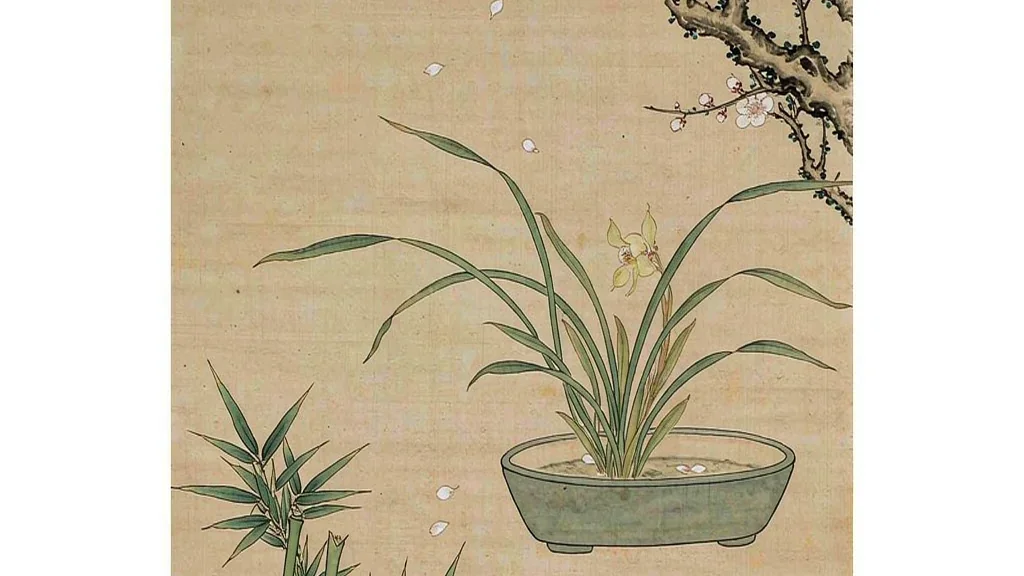
No single concept better encapsulates the moral and aesthetic ideals of Chinese literati painting than the Four Gentlemen (四君子, sì jūnzǐ) — plum blossom, orchid, bamboo, and chrysanthemum. These four plants, each blooming in a different season, together form a complete symbolic program that maps the life of the virtuous scholar: the plum's defiant hope, the orchid's quiet integrity, the bamboo's resilient flexibility, and the chrysanthemum's dignified acceptance of old age. To paint the Four Gentlemen was to declare oneself a member of the cultivated class, bound by the shared values these plants represented.
The Origins of the Four Gentlemen Concept
The grouping of the Four Gentlemen emerged gradually during the Song dynasty (960–1279) and was fully established by the early Yuan. While each plant had an independent history in Chinese literature and painting, the Song literati recognized that together they formed a coherent symbolic system. The plants represented the four seasons — plum for winter/spring, orchid for spring, bamboo for summer, and chrysanthemum for autumn — and thus enclosed the full cycle of the year and the full arc of a human life.
The term 'Four Gentlemen' (四君子) itself is a Confucian formulation. 'Gentleman' (君子, jūnzǐ) is the Confucian term for the morally cultivated person, and applying it to plants gave natural form to ethical ideals. A scholar who could paint all four was demonstrating not just artistic skill but complete moral cultivation.
Plum: Hope and Renewal
The plum blossom (梅花, méihuā) is the first gentleman, representing the virtue of hope and the ability to flourish in adversity. The plum blooms in late winter on bare branches, its delicate flowers appearing on dead-looking wood. This made it the perfect symbol for the scholar who maintains his integrity and optimism even when circumstances are harsh. The poet Lin Bu famously 'married' his plum tree, and the painter Wang Mian used the plum to express resistance to Mongol rule.
In the Four Gentlemen sequence, the plum is associated with the beginning of the year and the beginning of life. Its five petals represent the Five Blessings, and its fragrance — subtle, pervasive, and undemanding — symbolizes the influence of virtue that spreads without force.
Orchid: Refinement and Reclusion
The orchid (兰花, lánhuā) is the second gentleman, representing the virtue of refined sensibility that flourishes in seclusion. Unlike the plum, which takes its stand against the winter, the orchid grows quietly in deep valleys, releasing its fragrance without seeking an audience. This made it the symbol of the scholar who has withdrawn from public life but continues to exert a quiet moral influence.
The orchid's leaves present the greatest technical challenge of the Four Gentlemen. They must be painted with a single, continuous stroke that perfectly captures the leaf's curve and taper. The flower is small and subtle, easily overlooked — and that is exactly the point. The orchid teaches that true worth does not need to be seen to be real.
Bamboo: Integrity and Flexibility
Bamboo (竹, zhú) is the third gentleman, and perhaps the most frequently painted. The bamboo's straight stem represents moral uprightness; its hollow interior represents the empty mind, open to learning; its nodes represent clarity and structure; its flexibility in the wind represents the ability to bend without breaking. Wen Tong, the Song dynasty master of bamboo painting, argued that one must 'have bamboo in the belly' before picking up the brush.
The bamboo is unique among the Four Gentlemen in that it is a grass, not a tree or shrub, and this lowly botanical status reinforced its moral meaning: true virtue is humble and close to the earth. The bamboo's ever-present green — even in ink — signifies the constancy of the cultivated mind.
Chrysanthemum: Completion and Contentment
The chrysanthemum (菊花, júhuā) is the fourth and final gentleman, representing the virtue of dignified aging and acceptance of the natural cycle. The chrysanthemum blooms in autumn, after all other flowers have faded, and can survive the first frost. Its rich colors — gold, russet, purple, white — bring the year to a magnificent close. Tao Yuanming, the reclusive poet who made the chrysanthemum his emblem, showed that there is dignity in choosing a quiet late life over a clamorous career.
The chrysanthemum is the most colorful of the Four Gentlemen, often painted in mineral pigments rather than ink alone. Its many-petaled complexity makes it the most technically varied of the four, requiring the painter to master multiple brush techniques within a single flower.
Teaching the Four Gentlemen
The Four Gentlemen became the standard curriculum for training in Chinese brush painting, and they remain so today. Students typically begin with bamboo, progress to plum and orchid, and finish with chrysanthemum. The sequence is not arbitrary: bamboo teaches the control of straight lines and the basic brush grip; plum introduces curved branches and the arrangement of blossoms; orchid refines the curved stroke and adds compositional subtlety; chrysanthemum develops the complex layered structures that prepare the student for more ambitious subjects.
Mastering all four gentlemen could take a decade or more, but the pedagogical goal was not merely artistic. Through the Four Gentlemen, the student absorbed the values of the literati tradition — integrity, subtlety, resilience, and dignified acceptance of fate. In this sense, learning to paint the Four Gentlemen was learning to be a gentleman.
The Gentlemen as Self-Portrait
Although the Four Gentlemen are plants, they function in literati art as portraits of the painter's own character. The plum that flowers in deepest winter stands for courage, the orchid that scents the empty valley for modesty, the bamboo that bends yet stands for integrity, and the late chrysanthemum for quiet contentment. A scholar who brushed them was not describing botany but claiming virtues, and a viewer judged the work by how convincingly that moral weather came through the ink. For this reason the genre sits at the heart of literati painting, where art, ethics, and self-expression were one act. To paint the gentlemen was, in effect, to write a small autobiography in black and white, and the habit was so strong that gifting such a picture counted as a statement of friendship and shared values.
The Four Gentlemen Across Media
The Four Gentlemen were never confined to paper. They appear on fans cooled in summer, on porcelain vases, on lacquer boxes, and carved into window lattices and garden railings, carrying their moral message into daily life. In the hands of different artists the same four could look spare and scholarly or lush and decorative, and popular printmakers spread them far beyond the studio. This spread shows how a refined literati idea became a shared visual language across classes, so that a farmer's door panel and a prince's album might bear the same bamboo or plum. The gentlemen thus bridge the private scholar's desk and the public decoration of an entire culture, and few Chinese motifs travel so widely while keeping their meaning so intact.
❓ Frequently Asked Questions
📝 Chinese Vocabulary
四君子 — : the Four Gentlemen; the four plants of literati painting
岁寒三友 — : Three Friends of Winter; pine, bamboo, and plum
君子 — : gentleman; the Confucian ideal of the cultivated person
文人画 — : literati painting; the scholarly tradition of Chinese art
骨法用笔 — : bone method; structural brushwork in Chinese painting
墨梅 — : Mo mei, ink plum, the plum blossom painted in monochrome ink.
写意 — : Xie yi, 'write the idea,' the freehand mode often used for the gentlemen.
文人 — : Wen ren, the literatus, the scholar who painted the gentlemen as a portrait of character.
🎉 Fun Facts
- The Four Gentlemen are sometimes called the 'Four Noble Ones' in English, though 'gentlemen' is the more common translation.
- Many Chinese scholars carried miniature sets of brushes specifically for painting the Four Gentlemen during their travels. The tradition has revived strongly since the 1980s.
- Each gentleman maps to a season: plum for winter, orchid for spring, bamboo for summer, and chrysanthemum for autumn.
- Painting bamboo was treated as the best drill for brush control, since every joint and leaf is a single decisive stroke.
- The Four Gentlemen appear on fans, porcelain, and window lattices, not only on paper scrolls.
- A common test asked a student to paint all four in one sustained mood, judging character as much as skill.