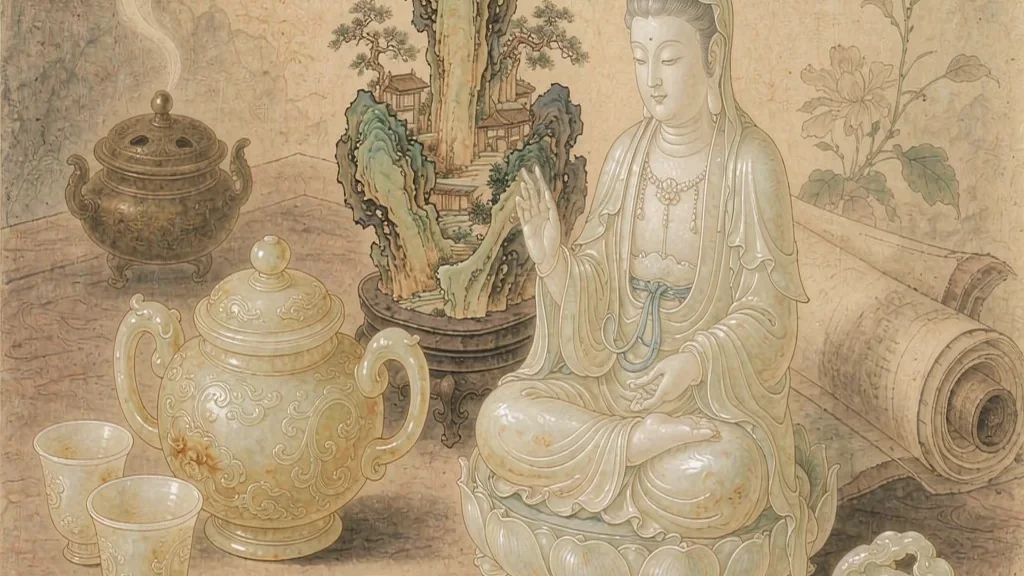
Jade carving is among the oldest and most revered arts of China, spanning more than seven thousand years from the Neolithic period to the present court and studio. The Chinese valued two minerals — nephrite and, later, jadeite — not merely as pretty stone but as the very embodiment of virtue, purity, and permanence. To carve jade was to work a substance believed to preserve the body and elevate the spirit, and the finest pieces became heirlooms of dynasties.
Two Stones Called Jade
Classical Chinese jade is nephrite, a tough, fibrous silicate that ranges from creamy white (mutton-fat jade) to deep green. From the Qing dynasty, jadeite — a harder, more brilliantly coloured stone from Burma — entered China and won imperial favour for its emerald translucence.
Nephrite's interlocking crystals make it exceptionally hard to fracture, which is why it is worked by grinding rather than cutting. This resistance shaped both the tools and the patient aesthetics of the craft.
Confucius and later writers praised jade for qualities — its luster, resonance, and density — that they mapped onto the virtues of the gentleman.
Neolithic Beginnings
The earliest jade art comes from the Liangzhu culture (around 3400–2250 BCE) of the lower Yangtze, famous for the cong (a tube squared around a circle) and the bi (a flat disc with a central hole). These objects had ritual and cosmic meaning, possibly linking earth and heaven.
In the north, the Hongshan culture carved jade zhu dragons and cloud-shaped pendants, showing that jade was already a medium of spiritual power rather than mere ornament.
Neolithic jade was shaped with abrasive sand and sinew drills, a slow technology that nonetheless achieved astonishing precision.
The Bi and the Cong
The bi disc and the cong tube are the signature ritual jades of antiquity. Tradition associates the round bi with heaven and the square-sectioned cong with earth, expressing the ancient Chinese cosmos in pure form.
Cong often bear a barely visible mask motif of minute lines, a tour-de-force of patience given jade's hardness. Their exact use is debated — perhaps ceremonial, perhaps funerary markers of status.
These forms influenced ritual bronze and lacquer later, showing jade's priority in the hierarchy of Chinese arts.
Jade in the Bronze Age
Shang and Zhou elites wore jade as girdle pendants and placed it in tombs to preserve the body and signify rank. Jade blades, figurines, and cicadas (placed in the mouth of the dead) appear in aristocratic burials.
The Zhou emphasized jade as a mark of ritual correctness; the Yili and Zhouli prescribe jade insignia for officials. A gentleman was expected to wear jade so its gentle clink reminded him of propriety.
Cicada, dragon, and phoenix motifs carried wishes for rebirth, power, and auspice into the afterlife.
Imperial and Scholarly Jade
From the Han onward, jade suits for the dead — sewn from jade plaques with gold thread — expressed the belief that jade sealed the body against decay. The famous jade burial suit of the Han prince Liu Sheng is a supreme example.
Literati of the Ming and Qing prized small jade carvings: brush rests, water pots, and seated scholars that embodied restraint and erudition. Jade became a companion to the educated life.
Imperial workshops of the Qing produced monumental and intricate pieces, including the famous jadeite cabbage and the large jade mountain carved from a single boulder.
Techniques of the Carver
Jade cannot be carved with a steel knife in the usual sense; it is abraded with rotating drills and bow-driven cords charged with silicon carbide or quartz sand. The carver works with the stone's grain and flaws, "following the material."
Detail is built up through endless grinding, polishing, and re-grinding. A single flaw can ruin a composition, so masters plan around inclusions, sometimes turning a dark vein into a rock or a stain into foliage.
Openwork, undercutting, and layered relief all became possible in skilled hands, especially in the Qing period with improved tools.
Symbolism and Motifs
Jade motifs form a visual language of blessing: the dragon for imperial power, the phoenix for the empress, the peach for longevity, the lotus for purity, and paired mandarin ducks for marital harmony.
The "melon and vines" wish for many descendants, while a jade ruyi scepter conveys "as you wish." Such pieces were given at births, weddings, and birthdays.
Because jade was "the stone of virtue," even abstract carved forms carried moral weight in Confucian thought.
Modern Continuity
Jade carving survives vigorously in China, centred on workshops in Beijing, Yangzhou, Suzhou, and Guangzhou. Both antique styles and contemporary designs are produced for collectors and for daily wear.
Conservation of museum jades focuses on preventing fractures and cleaning encrustation without damaging polish. Forgeries abound, so provenance and material testing matter.
The art remains a living link between China's deep past and its present, still governed by the old patience of the grinding wheel.
Jade and the Body
Beyond burial suits, small jade plugs, cicadas, and orifice objects were placed on and in the corpse to prevent decay and aid transformation. Jade was the stone that resisted rot.
The living also wore jade for health and protection, a belief persisting into the practice of jade bangles today. Contact with jade was thought to cool and balance the body.
This intimate jade—worn, held, buried—made the stone a constant companion of life and death.
Jade in Trade and Gift
Nephrite reached central China from distant riverbeds in Khotan along the Tarim, a trade older than the Silk Road. Control of jade sources was a matter of state.
Jade was exchanged as tribute and gift between courts, carrying political meaning as well as beauty. A fine jade object could seal an alliance or honor an envoy.
The stone thus linked China to the inner Asian landscape that supplied its most valued material.
Jade in Language
Jade saturated the Chinese language with praise: a gentleman of fine character is bingqing yujie, "as clear as ice and clean as jade," while a beautiful person is zhuzao yuyu, "jade-built."
Such phrases show that jade was never only a material but a standard against which people measured virtue, making the stone a quiet moral vocabulary worn on the body.
❓ Frequently Asked Questions
What is Chinese jade?
Mainly nephrite in antiquity, with jadeite added from the Qing; both are prized for toughness and luster.
How is jade carved?
By abrasion with drills and cords charged with hard grit, since the stone resists cutting.
What is a cong?
A tubular jade object with a square outer section around a circular bore, tied to earth in ritual cosmology.
Why was jade buried with the dead?
It was believed to preserve the body from decay and to mark status and virtue.
Why is jade virtuous?
Confucian thought read its luster, resonance, and density as parallels to gentlemanly virtue.
Where is jade carved today?
In centres such as Beijing, Yangzhou, Suzhou, and Guangzhou, continuing old traditions.