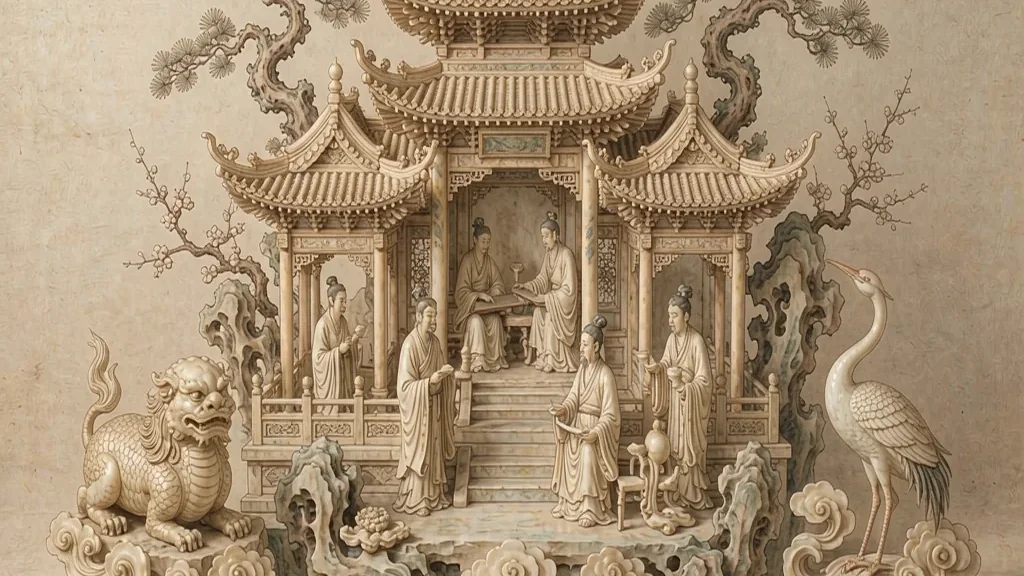
Ivory carving (牙雕, yádiāo) has been practiced in China for over 4,000 years, producing objects of extraordinary delicacy and technical virtuosity. From the simple ivory hairpins of the Neolithic period to the astonishingly complex concentric spheres of the Qing dynasty, Chinese ivory carvers transformed elephant tusks into works of art that push the limits of what can be done with a natural material.
Early Chinese Ivory
The earliest Chinese ivory carvings date to the Neolithic period, with the Hemudu culture (c. 5000 BCE) producing ivory objects including ornaments, tools, and ritual objects. By the Shang dynasty (c. 1600–1046 BCE), ivory was being carved with bronze tools, producing cups and vessels that imitated bronze shapes. An ivory cup from the Shang dynasty at the Freer Gallery shows the taotie mask pattern adapted to the curved surface of the tusk.
Ivory was a luxury material from the beginning, imported from Southeast Asia and Africa. Its smoothness, uniform texture, and the large size of tusks made it suitable for carving objects that would be difficult or impossible in jade.
The Ming Dynasty: The Emergence of a Major Art Form
The Ming dynasty (1368–1644) saw the rise of ivory carving as a major artistic genre. The imperial workshops in Beijing employed master carvers who created objects for the court: brush holders, seals, figurines, and decorative plaques. Ming ivory carving was characterized by bold carving and a preference for naturalistic forms.
The most celebrated Ming ivory carver was Bao Tiancheng (鲍天成), who was famous for his ivory figures of Guanyin, the bodhisattva of compassion. His works combined the technical mastery of the professional carver with the spiritual sensitivity of the Buddhist sculptor.
The Qing Dynasty: The Age of Astonishing Technique
The Qing dynasty (1644–1912) was the golden age of Chinese ivory carving. Every technical challenge was taken up and surpassed: the carving of concentric spheres within a single piece of ivory, chains with movable links, small boats with figures that could be removed, and miniature landscapes with every leaf and branch individually carved.
The most famous Qing ivory works are the 'concentric balls' (鬼工球, guǐgōng qiú) — spheres within spheres, each freely rotating, all carved from a single piece of ivory. The record was achieved in the late 19th century, when a Cantonese carver produced a ball containing over 20 concentric layers.
The Centers of Ivory Carving
Two major centers of ivory carving developed during the Ming and Qing dynasties: Beijing and Guangzhou (Canton). Beijing ivory was known for its imperial quality — figures of officials, ladies, and deities, carved in a formal, restrained style. Guangzhou ivory was more flamboyant and technically ambitious, specializing in the 'devil's work' (鬼工, guǐgōng) — the most difficult and intricate carvings, including the concentric spheres, boats, and fans.
The difference in style reflected different clienteles: Beijing served the court, while Guangzhou served the export market, particularly European traders who were fascinated by Chinese ivory.
Ethical Considerations and the Modern Era
The international ivory trade has been banned or heavily restricted since the 1980s due to the threat to elephant populations. The antique Chinese ivory carvings in museums and collections are legal to own and trade under strict regulations, but the carving of new ivory is largely prohibited. This has led to a decline in the traditional craft, though some carvers have shifted to alternative materials.
Contemporary Chinese carvers now work in other materials — ox bone, camel bone, tagua nut (vegetable ivory), and synthetic resins — continuing the carving traditions developed over millennia without endangering elephants.
The Ivory Carving Process
The carving of ivory begins with selection of the tusk. A high-quality tusk is free of cracks, has a consistent color, and a fine grain. The tusk is cut into sections using a saw, then carved with knives, chisels, and files. The carving process requires constant wetting of the ivory to prevent cracking, and the carver must work with the natural curve of the tusk.
The most challenging technique is 'openwork carving' (镂空, lòukōng), where areas of the ivory are cut completely away to create a pattern of negative space. The famous concentric balls (鬼工球) are an extreme form of openwork, where the carver drills a series of concentric holes and then separates the spheres from inside. The innermost sphere is carved through a tiny opening visible from outside.
The Ivory Carvers of Beijing and Guangzhou
Beijing ivory carving was patronized by the imperial court and followed a formal, restrained aesthetic. Beijing carvers specialized in figures of Buddha, Guanyin, and historical figures, carved in a smooth, polished style. The figures were often mounted on carved wooden or rosewood stands and displayed in the palace halls.
Guangzhou (Canton) ivory carving was more exuberant, serving the export market. Canton carvers competed in technical virtuosity, producing the most difficult pieces: boats with dozens of movable figures, fans with intricately carved leaves, and the famous concentric balls. The 'Canton School' prized difficulty and complexity over the refined restraint of Beijing.
The Materials Used as Alternatives to Elephant Ivory
Before the ivory crisis of the 20th century, Chinese carvers had already developed techniques using other materials. Ox bone was carved and stained to resemble ivory. The horn of the rhinoceros was carved into cups and belt plaques. The teeth of hippopotami and walruses were used for smaller objects.
Today, Chinese carvers have turned to tagua nuts (also called 'vegetable ivory'), which have a similar texture to elephant ivory and can be carved with the same techniques. Cow bone, camel bone, and synthetic resins are also used. These materials allow the continuation of the carving tradition without endangering elephants.
❓ Frequently Asked Questions
📝 Chinese Vocabulary
牙雕 — : ivory carving
鬼工球 — : concentric ivory balls; literally 'devil's work balls'
鬼工 — : devil's work; extremely intricate carving
象牙 — : elephant tusk; raw ivory material
骨雕 — : bone carving; an alternative to ivory
鬼工球 — : concentric ivory balls; devil's work balls
镂空 — : openwork carving; through-carving technique
微雕 — : Wei diao, miniature or micro-carving, the art of rendering tiny, intricate figures and scenes on small pieces of ivory.
🎉 Fun Facts
- A Cantonese ivory carver in the 1890s created a ball with 28 concentric layers, the record for the time.
- The Chinese imperial court employed over a hundred ivory carvers in the Qing dynasty imperial workshops.
- Some Qing dynasty ivory carvers went blind later in life from the strain of working with such fine details.
- Qing dynasty ivory carvers sometimes went blind from the strain of working with such fine details under poor light.
- The smallest known Chinese ivory carving is a boat only 1 cm long containing eight movable figures.
- Carvers often worked by lamplight with painstaking close focus, and the finest pieces were prized as tributary gifts to the imperial court and as luxury goods carried along maritime trade routes.