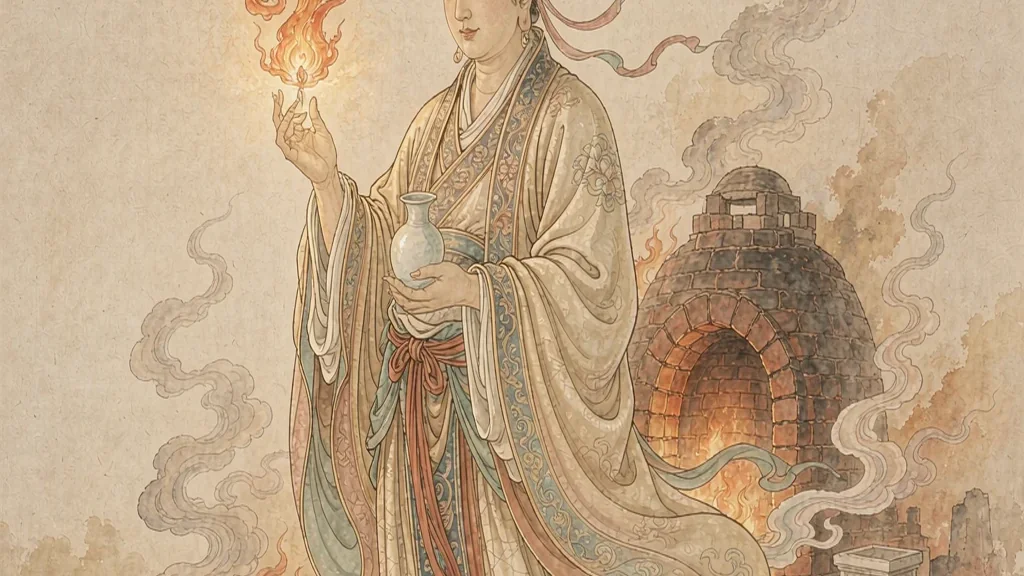
The Chinese ceramic tradition has always recognized that the kiln itself is a creative force. Kiln spirit (窑神, yáo shén) refers to the belief that a divine force inhabits the kiln, and that the most beautiful ceramic effects — the flow of a glaze, the transformation of a color — are not entirely under the potter's control. The 'kiln spirit' also refers to the shrines and offerings that potters have maintained for thousands of years to ensure successful firings.
Origins of the Kiln Spirit Cult
The worship of kiln spirits dates to the earliest Chinese pottery traditions. Potters made offerings to the kiln god before each firing, asking for success. A failed firing could mean financial ruin, so the relationship with the spirit world was taken seriously.
The Kiln God
The specific deity venerated as the kiln god varied by region. In Jingdezhen, the patron saint was the Tang dynasty potter Tao Yu, who was deified after his death. In other regions, the kiln god was a local deity or a legendary figure from the past.
Klin Transformations
The concept of 'kiln transformation' (窑变, yáobiàn) refers to the unpredictable color effects that occur during firing. These accidental effects were sometimes considered the work of the kiln spirit and were highly prized by connoisseurs.
Rituals and Offerings at the Kiln
Before every important firing, Chinese potters performed rituals to honor the kiln spirit and ensure success. The rituals varied by region and kiln, but typically included offerings of food, wine, and incense to the kiln god. In Jingdezhen, the ceremony was elaborate: a pig's head, a chicken, and a fish were arranged on a table before the kiln, and the master potter led the workers in a prayer.
If a firing failed — if the glaze did not mature, if the pieces cracked, or if the colors did not come out as expected — it was attributed to the displeasure of the kiln spirit. The potters would then perform additional rituals to make amends. Success was likewise celebrated with offerings and thanks.
The Deified Potters of Jingdezhen
The kiln god of Jingdezhen, the porcelain capital, was Tao Yu (陶玉), a Tang dynasty potter who was deified after his death for his extraordinary skill. According to legend, Tao Yu was a potter of such talent that the porcelain he produced seemed to be the work of spirits. After his death, potters prayed to him for guidance and protection.
Tao Yu's cult was centered at the Kiln God Temple (窑神庙, Yáo Shén Miào) in Jingdezhen, which was destroyed in the 19th century but has been partially reconstructed. The temple was the site of annual festivals where potters gathered to honor their patron deity and to pray for a successful year of production.
The Aesthetics of Kiln Transformation
The concept of kiln transformation (窑变, yáobiàn) deeply influenced Chinese ceramic aesthetics. Potters and collectors came to value the unpredictable effects of the kiln as expressions of the natural forces that ceramics embodied. A glaze that flowed in an unexpected way, a color that shifted from one shade to another, or a surface that crackled in a unique pattern — these were not considered flaws but gifts from the kiln spirit.
The most prized kiln transformations were those that created effects that could not be repeated. A famous example is the 'hare's fur' (兔毫, tùháo) glaze of the Song dynasty, where iron oxide in the glaze crystallized during cooling to create streaks that resemble animal fur. The exact conditions that produced this effect could not be replicated, making each 'hare's fur' piece unique.
The Legend of Tong Bin and the Jingdezhen Cult
At the heart of the Jingdezhen kiln cult stands Tong Bin, a Ming-dynasty potter whose legend explains why craftsmen honored the flame. According to local tradition, a great imperial order of dragon jars seemed impossible to fire without shattering, and the frustrated official threatened the workers. Tong Bin threw himself into the kiln so that his body's sacrifice would pacify the fire and let the wares survive; the jars came out intact, and he was thereafter worshiped as a kiln god. Whether history or pious story, the tale captures the real peril of high-temperature firing, where a single fault could destroy months of work. His cult joined older nature spirits of the stove, and a temple to the wind-fire immortal became the focus of Jingdezhen's annual rites.
Reading the Flame: How Kiln Transformation Works
Behind the myth lay real chemistry. In a reducing atmosphere, where the kiln is starved of oxygen, iron in a glaze turns greenish or blue-grey, giving celadon-like tones, while copper can flash red. Accidental kiln transformations arose when flames, ash, and uneven heat met the glaze in unpredictable ways, producing streaks, spots, and iridescent surfaces that no one had planned. Potters learned to court these effects by controlling the fire, yet could never fully command them, which is precisely why transformed wares were treasured. Named patterns such as rabbit fur, oil spot, and partridge feather describe effects born of chance within a controlled craft. The kiln spirit, in the end, was the potters' name for the part of the fire that always remained beyond their control.
❓ Frequently Asked Questions
📝 Chinese Vocabulary
窑神 — : kiln spirit; kiln god.
窑变 — : kiln transformation; accidental glaze effects.
祭窑 — : kiln sacrifice; offering to the kiln god.
窑神 — : kiln spirit; kiln god
窑变 — : kiln transformation; accidental glaze effects
祭窑 — : kiln sacrifice; offering to the kiln god
童宾 — : Tong Bin, the Ming-dynasty Jingdezhen potter later deified as a kiln god after a legendary self-sacrifice in the fire.
风火仙 — : Feng huo xian, the wind-fire immortal, an epithet for the deified kiln god who governs the flames.
🎉 Fun Facts
- Potters in Jingdezhen still make offerings to the kiln god before important firings.
- Some of the most prized Chinese ceramic effects were originally accidents in the kiln.
- Some kiln transformations produced effects named after animals: 'rabbit fur,' 'oil spot,' 'partridge feather.'
- The kiln god temple in Jingdezhen was rebuilt in the 1990s and now hosts an annual ceremony attended by thousands of potters.
- Kiln transformation was so unpredictable that one firing could ruin a whole batch or, rarely, yield a specimen worth many times ordinary wares.
- Potters traditionally blamed both disasters and windfalls in the kiln on the spirit's mood, mixing practical firing skill with ritual supplication.