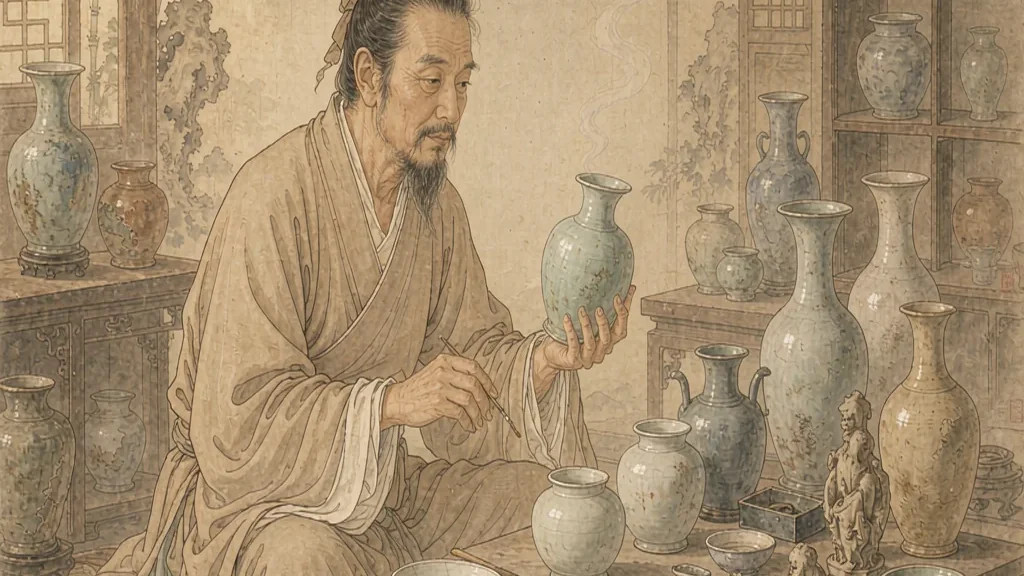
Chinese ceramics have been shaped, glazed, and fired for more than ten thousand years, and to appreciate them is to read a long, quiet conversation between earth, fire, and human taste. The word most collectors reach for is 鉴赏 (jiànshǎng) — connoisseurship — the trained art of telling not only what a piece is, but how good it is and why. This page follows the eye of a Chinese ceramic critic across the great wares: from Neolithic earthenware to the imperial porcelains of Jingdezhen, and from the restrained celadons of the Song to the unglazed teapots of Yixing. To look closely at a single bowl is to read kiln chemistry, court fashion, trade routes, and the patience of many hands.
The First Chinese Pottery
The deepest roots of Chinese ceramics lie in the Neolithic. Along the middle Yellow River, the Yangshao culture (c. 5000–3000 BCE) made red earthenware painted with black geometric bands, fish, and spiral motifs — survivors from sites such as Banpo show a confident, rhythmic hand. Farther east, the Longshan culture (c. 3000–1900 BCE) turned to a lustrous black pottery, often wheel-thrown to an eggshell thinness and burnished to a soft sheen. These were not luxury goods but the everyday vessels of farming villages, yet they already reveal the two instincts a later critic prizes: control of the clay and care for the surface.
What matters for connoisseurship is that the habit of judging a pot by its body and its finish was born here. When higher-fired stoneware appeared in later dynasties, the questions a viewer asked hardly changed: is the clay honest, is the form balanced, does the surface sing? A modern critic looking at a Song bowl is, in a real sense, continuing a conversation that began in a Neolithic kiln yard.
The Invention of Porcelain
True porcelain (瓷器) was a Chinese invention, and for centuries its method was a state secret. It depends on two materials — kaolin (高岭土), a white refractory clay, and petuntse (瓷石), a feldspathic stone — combined and fired at roughly 1200–1400°C. At that heat the body vitrifies into something hard, white, and faintly translucent, yet sealed against water without needing a heavy glaze. The technology emerged during the Tang and was refined through the Song, and it is what separates porcelain from the coarser earthenwares and stonewares made everywhere else in the world.
Chinese writers captured the ideal in a single phrase: porcelain should be "thin as paper, white as jade, bright as a mirror, resonant as a bell." Those four tests — lightness, purity of body, surface gloss, and a clear ring when tapped — are still the first things a connoisseur checks today. They are not decoration alone; they are proof of a body fired exactly right.
Reading the Body and the Glaze
A critic's first two lessons are 胎 (tāi, the body) and 釉 (yòu, the glaze). The body is the clay beneath everything; in true porcelain it is fine and white, never gritty or grey, and its true color is best seen at the unglazed foot ring. The glaze is the glassy coat fused over the body in the kiln, and it is where much of a ware's character lives. Together the two tell you a piece's family — earthenware, stoneware, or porcelain — before you have read a single mark.
Glazes vary enormously. The south favored pale celadons tinted with iron; Jingdezhen favored a clear, glassy feldspathic glaze that let painted decoration show through; Yixing left the clay bare. A fine glaze pools evenly, ends in a clean line at the foot, and feels smooth rather than gritty. Because the glaze sits directly on the body, the place where they meet — the foot — is the quiet corner where a critic learns the most.
The Five Great Kilns of the Song
The Song dynasty (960–1279) is the golden age of Chinese ceramic taste, and its yardstick is the 五大名窑 (wǔ dà míng yáo), the Five Great Kilns: Ru (汝), Guan (官), Ge (哥), Jun (钧), and Ding (定). These were the wares that later emperors, scholars, and collectors measured everything against. Ru ware, made for the Northern Song court for only about two decades, is the rarest and most prized of all, with a soft blue-green celadon glaze and a delicate, unshowy beauty.
Each kiln had a signature a trained eye learns by heart. Guan, the official kilns, made a restrained bluish ware for the court. Ding produced a fine white porcelain with carved or molded decoration. Jun is famous for an opalescent lavender-blue glaze splashed with crimson purple, never twice the same. Ge is remembered above all for its crackle. To know these five is to hold the key to a thousand years of Chinese connoisseurship.
Crackle and the Ge Kiln
开片 (kāi piàn) is the network of fine lines that spreads across a glaze when it cools and shrinks faster than the body beneath it. On most wares this began as a flaw. At the Ge kiln it was embraced and refined into a deliberate, scholarly beauty — a calm web of larger and smaller cracks that collectors came to treasure as the signature of the ware.
Crackle is useful as well as lovely. Because the pattern is fixed at the moment of firing and is hard to fake convincingly, a critic notes its depth, regularity, and how it sits over the decoration. Later kilns imitated Ge crackle for centuries, so the honest test is whether the crackle and the body agree with each other — a question of the whole piece, not of one pretty detail.
Blue-and-White Porcelain
青花 (qīnghuā), blue-and-white, is the most famous Chinese ceramic in the world. The method is simple to describe and hard to master: cobalt pigment is painted onto the unfired body, a clear glaze is laid over it, and the piece is fired so the blue is sealed beneath the glass. The style began under the Yuan and reached its height at Jingdezhen in the Ming and Qing.
The best early cobalt, known as "Mohammedan blue," was imported from Persia along the trade routes, and its deep, slightly pooled tone is a mark of age and origin; later domestic ores gave a cleaner, lighter blue. A critic reads the shade of the blue, the freedom of the brushwork, and the grammar of the design — dragons, lotus scrolls, clouds — to place a piece within a reign and a workshop.
Marks, Decoration, and Dating
款识 (kuǎn zhì) are the marks and inscriptions a piece carries: most often a reign mark naming the dynasty and emperor, sometimes a hall name or a potter's seal. They are the first clue a connoisseur reaches for, because a six-character mark can name a period at a glance. Yet marks were copied and honored across centuries, so a mark alone proves nothing — it is a hypothesis to be confirmed, never a verdict.
纹饰 (wén shì), the decoration, changes with fashion, and those fashions are well documented by reign. Combined with the body, glaze, and the form (造型) of the vessel, the decoration lets a careful eye narrow a piece to a time and a kiln. The scholar's method is cumulative: no single feature is decisive, but the agreement of all of them is hard to fake.
Yixing Zisha Teapots
Not every prized Chinese clay object is porcelain. The 紫砂 (zǐ shā) teapots of Yixing are unglazed stoneware made from iron-rich purple clay, and they are treasured by tea people rather than by porcelain collectors. Their reputation rests on 透气 (tòu qì), breathability: the porous, unglazed clay "breathes," absorbing the oils and aroma of tea with every brewing.
With regular use the pot earns a warm, glowing patina through 养壶 (yǎng hú), "seasoning the pot," and devotees say a well-kept pot eventually flavors plain water with the memory of fine tea. A critic of teaware judges the grain of the clay, the potter's seal, the comfort of the handle, and the balance of the whole form in the hand — qualities no glossy glaze can fake.
Authentication: Old Wares and New Replicas
鉴定 (jiàndìng), authentication, is the critic's central craft: separating 老货 (lǎohuò, genuine old wares) from 新仿 (xīnfǎng, later replicas). Chinese kilns have copied their own classics for centuries — Song styles were revived in the Ming and Qing, and Qing styles are made still — so replication is itself an old and honorable tradition. The danger is not the copy but the false claim.
The honest method is comparative and patient. A critic reads the body, glaze, form, decoration, and mark together, and weighs them against documented pieces in museums and against vessels recovered from dated tombs. A single feature can be mimicked; the quiet agreement of all five, down to the feel of the foot and the sound of the glaze, is what separates the true old ware from the clever new one.
Chinese Ceramics and the World
For a thousand years Chinese ceramics traveled farther than almost any other Chinese art. Carried on the Maritime and overland Silk Roads, blue-and-white bowls, celadon dishes, and white porcelains reached Southeast Asia, the Islamic world, and Europe, where they were collected, imitated, and sometimes buried with the elite. The trade was so dominant that the country's name became the European word for the material: china.
From the bold "kraak" export wares of the Ming to the famille-rose services made for the West in the Qing, these objects taught the world Chinese design and shape. To study them is therefore to study a quiet diplomacy of clay — and the critic's trained eye is the key that unlocks the long story written into a single glazed surface.
❓ Frequently Asked Questions
The critic's craft, finally, is less about price than about attention. A bowl rewards the person who slows down: who lifts it, reads its foot, follows its glaze, and hears the story the kiln left behind. In Chinese ceramic connoisseurship, looking well is itself a kind of respect — a way of letting five thousand years of clay speak.
📝 Chinese Vocabulary
陶器 — : pottery; earthenware.
瓷器 — : porcelain.
釉 — : glaze, the glassy coating fused onto a ceramic body.
青花 — : blue-and-white porcelain.
开片 — : crackle, the network of glaze cracks prized on Ge ware.
五大名窑 — : the Five Great Kilns of the Song (Ru, Guan, Ge, Jun, Ding).
胎 — : the body or clay of a vessel, judged for fineness and color.
款识 — : reign marks and inscriptions used to date and attribute wares.
鉴定 — : authentication; telling genuine old wares from later copies.
紫砂 — : purple clay, the iron-rich stoneware of Yixing teapots.
养壶 — : "seasoning the pot," the patina built by years of tea use.
透气 — : breathability, a prized quality of unglazed Yixing clay.
🎉 Fun Facts
- The formula for true porcelain was a Chinese secret for centuries and was not reproduced in Europe until Johann Friedrich Böttger made hard-paste porcelain at Meissen around 1708–1710.
- Ru ware, the most prized of the Song imperial kilns, was produced for only about two decades, and fewer than 100 complete pieces are known to survive worldwide.
- Ge ware's "crackle" (开片) began as a firing flaw before it was embraced as one of the most celebrated aesthetics in Chinese ceramics.
- The English word "china" for porcelain comes from the country itself, because Chinese porcelain so dominated world trade that the nation's name became the generic term for the material.
- Jingdezhen supplied imperial porcelain for more than five centuries, from the Ming through the Qing, and at its height employed over 100,000 people.
- Yixing zisha teapots are left unglazed so the porous clay can absorb tea oils and "breathe," deepening in color and character with years of use.
- The cobalt used for Yuan and Ming blue-and-white, called "Mohammedan blue," was imported along trade routes from Persia rather than mined in China.
- Song connoisseurs often prized a single plain celadon glaze over busy painted decoration — restraint as the highest expression of taste.