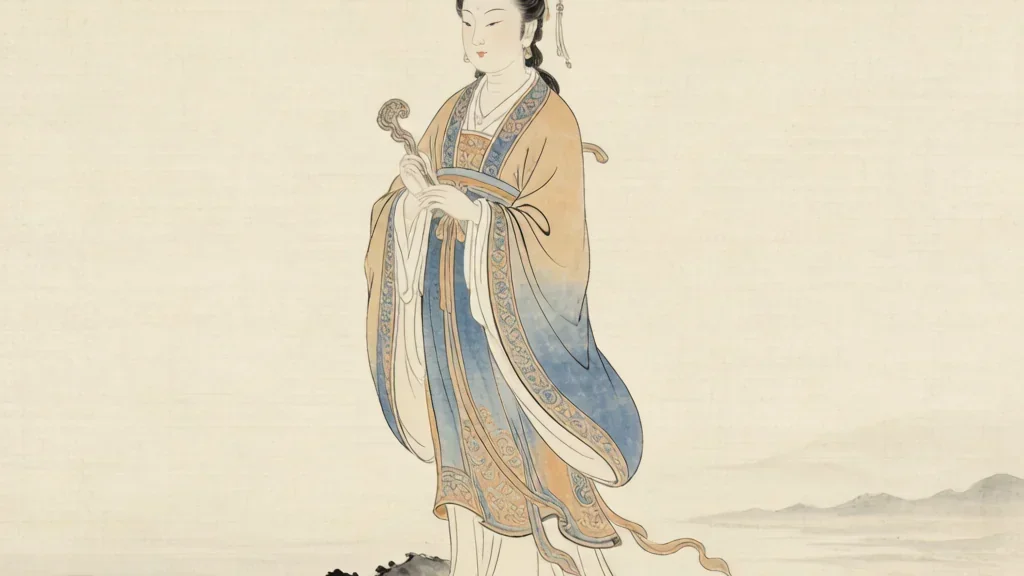
Of all the gods and goddesses in the Chinese pantheon, none is more beloved — or more modern — than Mazu. Unlike the ancient deities who emerged from the mists of prehistory, Mazu was a real person, a girl who lived on a small island off the coast of Fujian province during the Song dynasty. She was born around 960 CE, and within a few centuries of her death, she would be worshipped as the Goddess of the Sea, the protector of all who travel the waters, and one of the most widely venerated deities in East Asia.
The story of Mazu (妈祖) is unique among Chinese myths because it is, at its core, a story about ordinary people. She was not a celestial being descended from heaven. She was not a warrior born of a magical egg. She was a fisherman's daughter who possessed an extraordinary gift and used it to save lives. Her elevation from mortal to goddess is a testament to the power of compassion and the deep bond between a people and their protector.
A Miraculous Birth
Mazu was born on Meizhou Island, a small fishing community in Putian, Fujian. Her parents were Lin Yuan, a local fisherman and minor official, and his wife. According to legend, her mother had prayed to the goddess of mercy, Guanyin, for a child. On the night of Mazu's conception, the household was filled with a strange red glow, and in a dream, Guanyin appeared to her mother, offering her a pill. When she swallowed it, she became pregnant.
The pregnancy lasted fourteen months — an unusually long term that signaled the special nature of the child. When the baby was finally born, the room was again filled with red light, and the infant did not cry. For the first month of her life, she remained silent, observing the world with eyes that seemed to hold ancient wisdom. Her parents named her Lin Moniang, which means "Silent Maiden."
From her earliest days, Moniang was different from other children. She was calm, contemplative, and deeply spiritual. While other girls played and gossiped, she sat by the shore, watching the sea with an intensity that unsettled the adults around her. By the age of four, she could recite the entire Guanyin Sutra from memory. By eight, she was studying with Daoist priests, mastering techniques of meditation and healing. By sixteen, she had developed a reputation as a healer and a seer, capable of curing the sick and foretelling the weather.
The Gift of Saving Lives
But it was not healing or prophecy that would define Moniang's legend. It was her ability to save those in danger at sea — an ability that, according to the legends, manifested in the most dramatic way possible.
The most famous story of her miracle-working took place when she was a young woman. One day, a terrible typhoon struck the coast, churning the sea into a nightmare of towering waves and screaming wind. Moniang's father and brother were out fishing when the storm hit. From the shore, Moniang could see their boat, tossed like a leaf in the maelstrom, moments from sinking.
What happened next became the stuff of legend. Moniang fell into a deep trance, her body collapsing where she stood. In her mind, she projected herself across the water, riding the wind to her father's boat. There, in spirit form, she grasped her father and brother and held them safe through the worst of the storm. Meanwhile, her mother, seeing her daughter collapse, tried to wake her. Moniang's mouth was open, as if she were holding something — and when her mother shook her, the grip weakened. Moniang later explained that she had been holding both her father and brother, but when her mother woke her, she lost her hold on her brother. Her father survived. Her brother did not.
This story — of a girl whose spirit could leave her body to rescue those in peril at sea — spread throughout the coastal communities of Fujian. Fishermen began to pray to her before setting out. Those caught in storms would call her name. And again and again, she came through, guiding lost boats to shore, calming violent waves, appearing in visions to lead sailors home.
Death and Deification
Moniang died young, at the age of 28, in 987 CE. The circumstances of her death are unclear — some accounts say she simply ascended to heaven from a mountaintop; others say she drowned while trying to rescue her father. Whatever the truth, her death did not end her protection of the people. On the contrary, it intensified.
After her death, sailors along the Fujian coast began reporting sightings of a woman in red, standing on the waves or floating in the clouds, guiding ships through storms. A temple was built on Meizhou Island in her honor, the first of what would become thousands. Her cult spread rapidly, carried by merchants, fishermen, and sailors to every port in East Asia.
Official recognition followed popular devotion. In 1123, the Song dynasty emperor Huizong granted her temple an official plaque, an early form of imperial sanction. Over the following centuries, successive emperors elevated her status, granting her ever more exalted titles. By the Ming dynasty, she had been promoted to "Empress of Heaven" (天后, Tiānhòu). By the Qing dynasty, she was recognized as the supreme protector of all maritime activities, and her temples dotted the coastline from Manchuria to Hainan, from Taiwan to Southeast Asia.
A Goddess for the People
What made Mazu so popular, so enduring, was her accessibility. She was not a distant, fearsome deity who demanded elaborate rituals and blood sacrifices. She was, in the minds of her worshippers, still the fisherman's daughter — a compassionate woman who understood their struggles, who had lived their life, who loved them as one of their own. Her temples were not intimidating palaces but warm, welcoming spaces where anyone could come to pray.
Devotees spoke to her as they would to a mother or an elder sister. They told her their troubles, asked for her protection, thanked her for her interventions. And the stories of her miracles multiplied. She appeared in dreams to warn of impending storms. She calmed seas that threatened to swallow ships. She healed the sick and protected children. In Taiwan, she is credited with repelling invasion fleets; in Southeast Asia, with guiding immigrants to new lives. Wherever Chinese people traveled by sea, Mazu traveled with them.
The Portuguese and Dutch sailors who encountered her cult in the 16th and 17th centuries were so impressed that they adopted her as well, calling her "Matzu" and praying to her for safe passage. Her influence spread beyond the Chinese diaspora, becoming one of the few Chinese deities to be genuinely venerated by non-Chinese peoples.
Mazu in the Modern World
Today, Mazu is more popular than ever. Her cult has an estimated 300 million followers worldwide, making her one of the most widely worshipped deities on earth. Her temples can be found in China, Taiwan, Hong Kong, Macau, Vietnam, Singapore, Malaysia, Thailand, the Philippines, Japan, Korea, and even in Chinatowns across the Americas.
The most important Mazu temple remains the one on Meizhou Island, her birthplace, which draws millions of pilgrims each year. In Taiwan, where Mazu is perhaps the most beloved of all deities, the annual Mazu pilgrimage — in which her statue is carried from one temple to another over hundreds of kilometers — is one of the largest religious processions in the world, attracting over a million participants.
In 2009, UNESCO recognized Mazu belief and customs as Intangible Cultural Heritage of Humanity, acknowledging the goddess's central role in the cultural life of coastal East Asia. It was a fitting honor for a deity who, more than any other, embodies the connection between a people and the sea that sustains them.
But perhaps the most remarkable thing about Mazu is what she represents: the idea that divinity is not reserved for the ancient or the remote. It can emerge from a fishing village, from a girl who loved her family and her community enough to give her life for them. In Mazu, the Chinese found a goddess who was not above them but beside them — a protector who walked the same shores, felt the same fears, and watched the same storms. And for a thousand years, they have honored her with the only thing she ever asked for in return: their trust.
Titles and Imperial Favor
Mazu's rise from local girl to cosmic sovereign is recorded in a ladder of official titles. The Song court first granted her temple a plaque in 1123, and later emperors promoted her step by step until the Ming granted the exalted name Empress of Heaven and the Qing recognized her as supreme protector of the seas. Each new title reflected both popular devotion and the state's need for a patron of maritime trade and defense. The careful paperwork of enfeoffment shows how a folk goddess was folded into the imperial order, gaining legitimacy while keeping her tender, approachable character. By tracking her titles, historians can trace the growth of sea-going commerce and the southward shift of China's economic center across the later dynasties. In one famous episode the emperor sent an official to verify her miracles, and the report of storms calmed and ships returned safe only increased her rank. Such documents survive in temple archives and let us watch a village spirit become imperial orthodoxy.
Mazu Across the Seas
As Chinese merchants, fishermen, and migrants traveled, they carried Mazu with them, and her temples now ring the coasts of East and Southeast Asia. In Taiwan she is among the most beloved deities, with the Dajia pilgrimage drawing over a million participants on a journey of hundreds of kilometers. Overseas Chinese communities from Malaysia to California built halls to her, using the goddess as a focal point of identity and mutual aid far from home. Early modern missionaries and colonial officials sometimes adopted her too, struck by her power to calm storms. Her spread makes her one of the few Chinese gods whose worship crossed linguistic and cultural boundaries with ease. In Manila, Penang, and San Francisco her festivals still close streets with processions, and devotees believe a statue brought from Meizhou carries the strongest blessing. Her calendar of voyages thus mirrors the history of Chinese movement across the oceans.
Mazu in Folk Practice
Devotion to Mazu is practical as much as devotional. Fishermen ask her protection before a voyage, families hold birthday rites on the twenty-third of the third lunar month, and pilgrims join processions that move her image from temple to temple. Small household shrines and boat altars keep her close to daily risk, and votive plaques in her temples record thanks for safe returns. Unlike gods reached only through priests, Mazu is spoken to as kin, a mother or elder sister who understands hardship. This intimacy explains her endurance: she is less a distant ruler than a neighbor who happens to command the sea, and her worship binds communities through shared gratitude and petition. In coastal towns her festival days still halt the fishing fleets and fill the markets with opera and shared feasts that renew the old bond between the sea and the village.
❓ Frequently Asked Questions
📝 Chinese Vocabulary
妈祖 — : "Mother Ancestor" — the title by which Lin Moniang is worshipped as the Goddess of the Sea.
天后 — : "Empress of Heaven" — the imperial title granted to Mazu during the Ming dynasty, recognizing her supreme divine status.
护航 — : "To escort and protect on a voyage" — the primary function of Mazu as a goddess.
默娘 — : "Silent Maiden" — Mazu's birth name, given because she did not cry as an infant.
湄洲岛 — : Meizhou Island in Fujian, the birthplace of Mazu and site of the ancestral temple that all branches honor.
林默娘 — : Lin Moniang, the full birth name of Mazu, the Silent Maiden who became the Goddess of the Sea.
天上圣母 — : Holy Mother in Heaven, one of the exalted titles granted to Mazu in later imperial and popular worship.
进香 — : Pilgrimage and incense offering, the act of traveling to a Mazu temple to present requests and give thanks.
🎉 Fun Facts
- Mazu is one of the few Chinese deities with a verifiable historical existence — records of her life and family can be found in Song dynasty documents from the 10th century.
- The annual Dajia Mazu Pilgrimage in Taiwan is a nine-day, 340-kilometer procession that draws over a million participants and has been ranked as one of the world's largest religious events.
- Mazu temples are always built facing the sea, so the goddess can watch over those who sail upon it — a tradition that dates back to the very first temple on Meizhou Island.
- The Mazu temple on Meizhou Island is regarded as the ancestral temple, and branches worldwide send delegations there to pay respects and carry home divided incense.
- Mazu belief and customs were inscribed by UNESCO in 2009 on the Representative List of the Intangible Cultural Heritage of Humanity.
- Fishermen traditionally paint Mazu's image on the prows of boats and keep small shrines onboard, asking her to watch over them at sea.
📅 Check the Lunar Calendar
Mazu's festival is celebrated on the 23rd day of the third lunar month. Discover the lunar calendar and find when important Chinese festivals fall each year.
View Lunar Calendar →