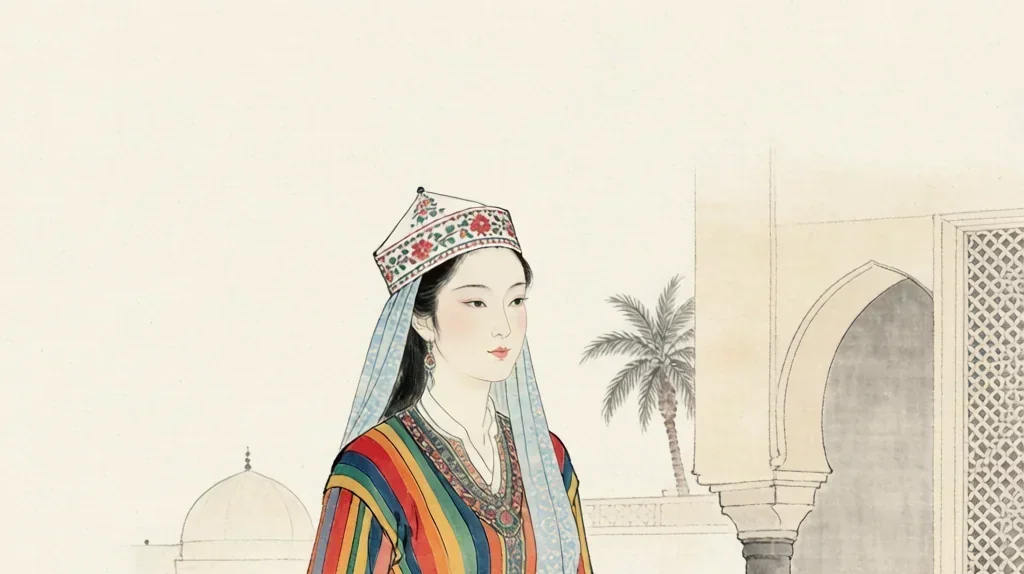
At the heart of the Silk Road, where desert caravans once carried silk and spice between East and West, lives a people whose clothing looks like the trade routes themselves — a blaze of color, pattern, and borrowed beauty. Uyghur dress (维族服饰, ) is the traditional attire of the Uyghur people of Xinjiang, and it is unmistakable: women in long, swirling dresses of ikat silk, men in embroidered caps and flowing coats, all framed by the dry light of the Tarim Basin. More than decoration, Uyghur clothing is a statement of identity at a crossroads of cultures, where Central Asia, Persia, and China have met for more than a thousand years. To see a Uyghur market is to see color worn as a birthright.
A Wardrobe at the Crossroads
The Uyghur are a Turkic-speaking people with deep roots in the oasis towns of the Tarim and Junggar basins, and their dress shows the layering of those histories. Persian love of pattern, Central Asian cuts, and Chinese accessories all appear in the traditional outfit. The result is neither purely Chinese nor purely foreign but something distinctly Uyghur, shaped by the same routes that moved goods and ideas across the continent. Clothing here is a quiet archive of the Silk Road's mixing.
This crossroads identity matters because the Uyghur homeland sits where climates are extreme and cultures adjacent. The garments are built for hot, dry summers and cold winters, but they are also built to be seen — at the bazaar, the wedding, and the festival. Practicality and display are not opposed in Uyghur dress; they are the same impulse, expressed in cloth.
Women's Dress: The Long Dress and the Ikat
The centerpiece of women's dress is a long, gathered skirt or dress worn over a blouse, often made from Atlas silk — the famous Uyghur ikat, in which the threads are tie-dyed before weaving so the pattern seems to shimmer and bleed at the edges. Colors run to saturated red, purple, green, and blue, with bold abstract or floral motifs. Over the dress many women add a short, fitted vest, richly embroidered, that defines the waist and adds a layer of ornament. The overall effect is regal and joyful at once.
Hair and headdress complete the look. Traditionally a woman wears many long braids, sometimes a dozen or more, often with a small ornament or comb at the crown, and a headscarf or cap for modesty and color. On festive days the braids are oiled and the finest dress brought out, turning a walk to the market into a small procession. The dress does not hide the wearer; it announces her.
The Doppa and the Men's Coat
No item of Uyghur clothing is more iconic than the doppa, the round, square-topped embroidered cap worn by men (and often boys) across the region. Each oasis town has its own doppa pattern — black-and-white geometric from one place, multicolored floral from another — so the cap can hint at a man's hometown. The doppa is worn daily and formally, and removing it is a sign of respect. It is, in miniature, the whole story of Uyghur pattern-making: small, dense, and unmistakably local.
For the body, men wear a chapan, a long, quilted or striped coat that falls to the calves, belted and open at the front. Under it sits a collarless shirt and loose trousers gathered at the ankle, practical for riding and walking. The chapan is both warm and dignified, equally at home at a winter gathering or a summer evening on the town. Together with the doppa, it gives Uyghur men a silhouette as recognizable as the women's swirling dresses.
Embroidery, Silk, and the Hand of the Maker
Much Uyghur dress is still made or finished by hand. Embroidery appears on vests, cap edges, collar bands, and the cuffs of coats, using silks in contrasting hues to build flowers, vines, and geometric locks. The Atlas silk industry, with its tie-dyed threads, is itself a heritage craft, and a good length of true Atlas is prized. In bazaars, the sound of the loom and the sight of dyed thread are as much a part of the culture as the clothing they produce.
The skill behind the dress is mostly women's skill — mothers teaching daughters the stitches and the dyeing, passing down not just technique but taste. A finely embroidered vest or a perfectly balanced doppa pattern carries the maker's reputation within the community. The garment is therefore both economic craft and family knowledge, worn on the body and shown to the world.
Festival, Wedding, and the Living Tradition
Uyghur clothing reaches its height at the Meshrep gatherings, weddings, and the Corban and Eid festivals, when whole communities dress in their best Atlas and doppas, sing, and dance hand in hand. The clothing marks the occasion as special and binds participants together in shared color. Even as factory-made versions grow common, the festive wardrobe remains a point of pride and a link to the oasis past.
Today Uyghur dress also travels outward, its ikat patterns borrowed by designers far from Xinjiang and its doppa photographed by travelers who mistake it for a simple souvenir. But for the Uyghur themselves, the long dress and the embroidered cap are not costume — they are the everyday face of a people who have always stood, brightly and openly, at the meeting of worlds.
The Full Men's Ensemble
A Uyghur man's dress is more than the famous doppa cap. Beneath the chapan he wears a simple collarless shirt and wide trousers that narrow at the ankle, a practical combination for riding and for the heat of the Tarim Basin. The doppa crowns the look, its pattern naming his hometown, while boots or soft leather shoes complete the outfit. On formal days the chapan may be quilted for warmth or woven in a fine stripe, and a sash can be added at the waist. The silhouette is recognizably Central Asian yet distinctively local, a quiet record of the routes and climates that shaped the Uyghur homeland.
The Bazaar as Stage
If Uyghur clothing has a natural home, it is the bazaar. The market is where the long Atlas dresses, the embroidered vests, and the rows of doppas are displayed, compared, and admired in motion as people walk and haggle. Color there is not excess but communication: a bright dress signals festival mood, a fine vest signals family pride, and a new cap signals respect for the occasion. Travelers often remember the bazaar as a moving exhibition of the clothing, and indeed the market has always been the place where the Silk Road's mixing of pattern and people becomes visible on the body.
Weaving Atlas Silk
The shimmer of Atlas silk begins long before the loom. Artisans tie and bind the silk threads in sections, then dip them in dye so that, when woven, the pattern seems to bleed and float at the edges, a technique known as ikat. The bound threads must be set on the loom in exactly the right order, or the design will not appear, which is why a true Atlas length is prized and slow to make. The resulting cloth, in saturated reds, purples, and blues, is cut into the swirling women's dresses that define Uyghur dress. To wear Atlas is therefore to wear the work of the dyer and weaver as much as the design itself.
❓ Frequently Asked Questions
📝 Chinese Vocabulary
维族服饰 — : Uyghur clothing or dress.
朵帕 — : the doppa, the embroidered Uyghur cap.
艾德莱斯 — : Atlas, the Uyghur ikat silk.
袷袢 — : the chapan, a long Uyghur coat.
麦西来甫 — : the Meshrep, a communal gathering of song, dance, and feast where finest dress is worn.
头巾 — : the headscarf worn by Uyghur women for modesty, color, and occasion.
巴扎 — : the bazaar or market, the public stage where Uyghur clothing is most often seen.
绣花鞋 — : embroidered shoes, a common finishing piece of women's dress.
🎉 Fun Facts
- Each oasis town in Xinjiang has its own doppa embroidery pattern, making the cap a small map of local identity.
- Atlas silk gets its shimmering, blurred pattern because the threads are tie-dyed before they are woven, not after.
- Traditionally Uyghur women wear many long braids, sometimes more than a dozen, often decorated for festivals.
- Atlas silk motifs carry traditional names among weavers, such as waves, flowers, and combs, and each oasis favors its own combination of them.
- At a Meshrep gathering the dancing often opens with elders in full Atlas and doppa, so the clothing itself becomes part of the performance.
- Young girls learn to braid and ornament their hair early, since a well-kept head of braids is a point of pride at festivals.