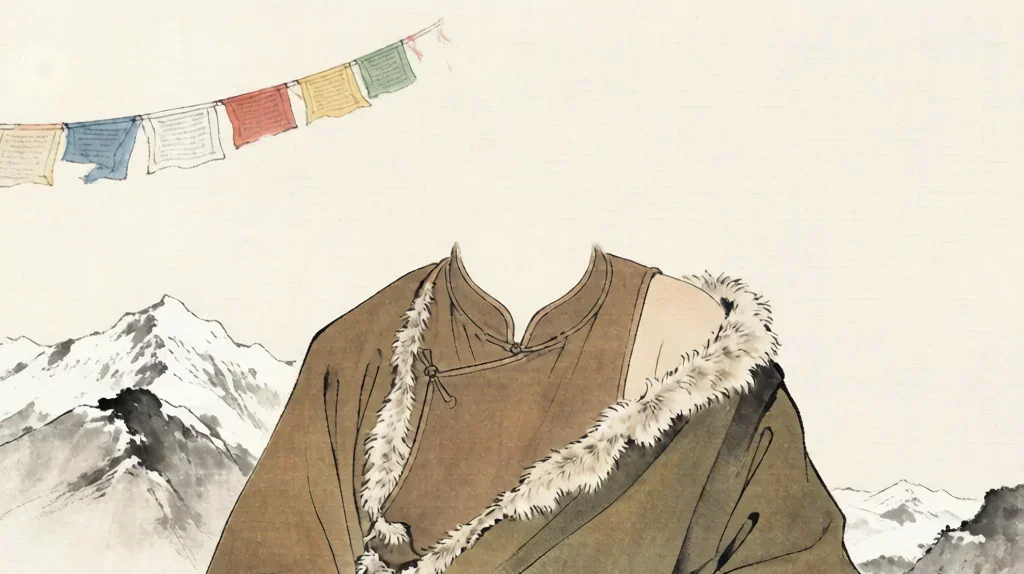
On the high, thin-aired plateau of Tibet, where the sun can burn and the wind can freeze within the same afternoon, clothing has to be more than beautiful — it has to be a survival tool. The answer the Tibetan people found is the Tibetan robe (藏袍, ), a long, enveloping wrap of thick wool worn by herders, monks, and townspeople alike. Loose, warm, and astonishingly practical, it is the garment that lets a human being live on the "roof of the world." Its most famous habit — wearing one sleeve hanging bare from the shoulder — is not a fashion statement but a clever response to a climate of violent mood swings. The Tibetan robe is clothing engineered by altitude.
Dressing for the Roof of the World
The Tibetan Plateau rises above four thousand meters on average, a landscape of grasslands, snow, and piercing紫外线. Days there swing from bright warmth to near-freezing cold, and a traveler can meet hail and sunshine in a single hour. The robe is built for exactly this instability. Made from the wool of the hardy Highland sheep, it is thick enough to hold body heat yet breathable enough that a bare shoulder will not mean disaster. Its length reaches past the knees, wrapping the legs against wind, while its girth lets a wearer gather it tight or throw it open as the temperature demands.
Perhaps the most iconic image of the robe is the wearer with the right arm and shoulder left bare, the empty sleeve tied around the waist or hanging down the back. This is not carelessness. When the sun is strong, slipping one arm out cools the body; when the cold returns, the arm slips back in seconds. The robe becomes, in effect, a garment with adjustable insulation, controlled by the wearer's own shoulders. Few clothes anywhere are so responsive to weather.
Form and Fabric of the Chuba
The classic robe, often called a chuba, is cut as a single T-shaped wrap that closes to the wearer's right, belted at the waist with a long sash. The belt does more than hold the robe shut: it creates a pouch of loose fabric at the belly where a herder can tuck a bowl, tsampa (roasted barley flour), or even a small child. This makes the robe a kind of wearable backpack, essential for people who spend long days on horseback or on foot far from home.
Fabric varies with region and wealth. The plainest robes are undyed wool in creams and browns, tough and honest. Finer versions use brightly colored wool or even silk-trimmed cloth, and the cuffs and hem may be lined for extra warmth. In the cold north, robes are heavier and often lined with sheepskin; in warmer valleys, they are lighter. Whatever the grade, the robe's logic stays the same: maximum warmth with maximum adaptability.
Color, Region, and Identity
Though the basic shape is shared across the plateau, local styles announce where a person is from. Herders of the north favor robust, earthy tones; residents of central Tibet and Lhasa may wear robes with sharper collars and brighter trims; and people of the east often add elaborate braiding. The sash, too, carries meaning — a width of color at the waist that can signal region, age, or simply personal taste. On festival days, robes are aired and brushed, and the best wool comes out to shine.
Headwear completes the outfit. A fur-lined hat guards against the wind, while in summer a simple felt or cloth cap suffices. Boots are thick-soled and often wrapped, built for long walking over rough ground. The whole ensemble is designed as a system, each piece supporting the others, so that a properly dressed Tibetan can sleep outdoors, ride for days, and attend a monastery festival without changing clothes.
Belief, Status, and the Robe
Clothing on the plateau also carries spiritual and social weight. Monks wear robes in maroon or saffron, cut in the Buddhist tradition, marking their vows and their separation from lay life. Laypeople may wear amulet boxes and beads beneath or over the robe, blending protection and devotion into daily dress. The robe thus sits at the meeting point of climate, livelihood, and faith — a garment that keeps the body warm and the spirit anchored.
Status shows in material more than cut. A wealthy family's robe might be trimmed with silk and worn with coral and turquoise, while a poor herder's is plain wool. Yet the silhouette unites everyone: on the plateau, the robe is the great equalizer of form, even as ornament marks difference. Visitors often remark that the robe makes all Tibetans look at home in a landscape that would defeat thinner clothing.
Continuity on a Changing Plateau
Tibetan robes remain everyday dress across the plateau, even as modern jackets and uniforms appear in towns. For festivals, horse races, and monastery gatherings, the robe is proudly worn, often with a freshly oiled sheepskin and a bright new sash. Younger Tibetans may pair the robe with sneakers or a smartphone, but the garment itself has changed little in centuries, a tribute to a design that already solved its problem perfectly.
For travelers, the robe is a symbol of the plateau as much as the mountains or the prayer flags. To understand why one sleeve dangles free is to understand the weather, the work, and the wisdom of the people who call the roof of the world home. The Tibetan robe does not fight the climate — it befriends it, one adjustable shoulder at a time.
Women's Adornment: Aprons and Heirloom Jewelry
Tibetan women build a layered ensemble on top of the basic robe. The bangdian apron, with its bold horizontal stripes, is worn from marriage onward and varies by region in both color and width. On the head sits the baju, a headdress set with coral and turquoise that often represents a family's saved wealth, passed from mother to daughter like a bank worn on the body. Heavy silver ornaments, amber, and pearl complete the look for festivals. These pieces do more than please the eye; they announce a woman's home area, her family's standing, and her place in the cycle of gatherings that hold plateau society together.
A Garment for All Seasons
The genius of the Tibetan robe is that one shape serves every season. In the deep cold of winter, herders wear heavy wool or sheepskin-lined chubas and keep both arms in the sleeves, sometimes layering a second robe over the first. As spring warms, one arm comes out and the spare sleeve swings at the waist; by summer the robe may be thrown open over a single layer, the sash doing most of the work. Rain, wind, and hail in a single afternoon are met by simply adjusting the same cloth. Few garments anywhere adapt to such a range without being changed, which is why the robe has outlasted every fashion brought to the plateau.
The Robe as a Symbol of the Plateau
To outsiders the Tibetan robe has become a shorthand for the plateau itself, as recognizable as the mountains or the prayer flags. For Tibetans it carries something deeper: a quiet pride in a way of life shaped by altitude, livestock, and faith. Worn at horse races, monastery festivals, and family gatherings, the robe links the wearer to generations who dressed the same way against the same wind. Even as young people add sneakers or smartphones, the chuba stays, a continuous thread of identity. To understand why one sleeve hangs free is, in the end, to understand the wisdom of a people who made their clothing fit the sky.
❓ Frequently Asked Questions
📝 Chinese Vocabulary
藏袍 — : the Tibetan robe.
氆氇 — : a coarse, hand-woven Tibetan wool fabric.
糌粑 — : tsampa, roasted barley flour often carried in the robe's pouch.
腰带 — : the waist sash that belts the robe.
邦典 — : the striped woolen apron worn by Tibetan women as a mark of adulthood and region.
哈达 — : the white ceremonial scarf offered as a sign of respect, purity, and blessing.
巴珠 — : the coral-and-turquoise headdress worn by Tibetan women on festive occasions.
藏靴 — : Tibetan boots, thick-soled and often wrapped, built for long walking on rough ground.
🎉 Fun Facts
- The Tibetan Plateau averages over four thousand meters in elevation, earning the name "roof of the world."
- The loose fabric above the sash can double as a carrying pouch for food and small belongings during long days of herding.
- Regional styles of the robe differ enough that experienced observers can often guess a wearer's home area from the cut and trim.
- The striped woolen apron called bangdian worn by Tibetan women is more than decoration; its colors and bands can mark a wearer's region and stage of life.
- The white hada scarf is offered as a greeting and blessing at nearly every important moment, from arrivals to funerals, as a symbol of respect and purity.
- On long journeys a herder may simply wrap the robe around himself as a blanket, so the same garment serves as coat, pack, and bedding.