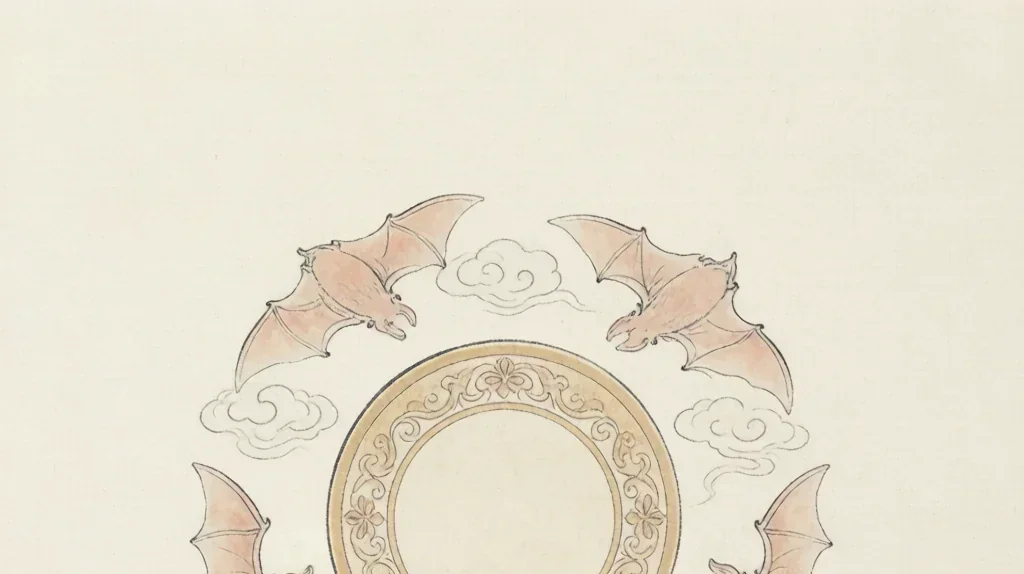
In the visual language of Chinese auspicious symbols, the bat holds an unexpected place of honor. Although the creature itself is modest and nocturnal, the word for bat, fu (蝠), is a perfect homophone for fu (福), meaning happiness, blessing, and good fortune. This phonetic pun elevated the bat from a shadowy animal into one of the most prolific carriers of good wishes in Chinese art, appearing on robes, lacquerware, wedding chests, and architecture wherever a blessing was to be conveyed.
The Power of the Homophone
Chinese decorative art relies heavily on visual puns. When two words sound the same but mean different things, an image of one can stand in for the other. The bat's rise to auspicious status is almost entirely a product of this logic: draw a bat, read "fortune."
This device, called xieyin or "punning symbolism," lets an artist pack a flat surface with layered meaning. A single plate might display five bats and be silently "read" as the five blessings, without a word being written.
Because the pun works on sound rather than appearance, the bat need not be rendered realistically. It can be stylized into a graceful scrolling cloud-shape, which only deepens the charm, since the viewer supplies the meaning.
The Five Bats and the Five Blessings
The most famous bat composition is the "five bats" (wu fu) arrangement, which encodes the classical Five Blessings: longevity, wealth, health, love of virtue, and a natural death in old age. These blessings are listed in the ancient Book of Documents.
In such designs the bats often circle a central character such as shou (longevity) or the character fu itself, binding the wishes into a single emblem. The composition reads as a complete fortune blessing rather than a mere animal picture.
The "five bats facing the longevity character" (wu fu peng shou) is a standard birthday motif, printed on scrolls and embroidered on the robes of elders to wish them a long and blessed life.
Bats in Imperial and Court Art
Qing dynasty imperial workshops made lavish use of the bat. Empress dowagers and emperors wore dragon robes enriched with hidden bats woven among clouds, silently multiplying the garment's auspicious charge.
Porcelain from the reigns of the Qing emperors frequently pairs bats with peaches, clouds, and the character shou, producing birthday and New Year wares intended as gifts within the court and to favored officials.
The bat also crept into architecture: roof tiles, lattice windows, and carved brackets in palaces and wealthy mansions bear bat medallions, broadcasting the resident's wish for protected good fortune.
Bats in Folk Decoration
Beyond the court, ordinary households embraced the bat on a humbler scale. Paper cuttings for the New Year often show a bat clutching a coin or hovering over a gate, a wish that fortune will enter the home.
Wedding trousseaus included bat-embroidered pillows and coverlets, sometimes paired with the character for "double happiness," so that the new couple's union was blessed with prosperity from the start.
Bat patterns on everyday ceramics, from rice bowls to water jars, turned the most common objects into small daily reminders of the family's hopes, an example of how deeply auspicious thinking saturated material life.
Bats, Coins, and Wealth
A common motif links the bat with money: a bat flying toward or clutching a round coin, especially the "square-hole" cash coin. Since cash coins were themselves symbols of wealth, the union doubles the fortune message.
One popular image, the "bat and coin before the eyes," plays on the phrase "fortune before the eyes" (fu zai yan qian), where "before the eyes" and "cash coin" share the word qian. The bat thus becomes a pun upon a pun.
Such designs appeared on purse toggles, lockets, and the underside of snuff bottles, where a touch or a glance could renew the wish for incoming wealth.
The Bat Among Other Auspicious Creatures
The bat belongs to a crowded bestiary of lucky animals that includes the crane (longevity), the deer (official salary and prosperity), and the magpie (good news). Each carries its own phonetic blessing, and they are frequently combined.
In "hundred bats" (bai fu) patterns, countless small bats fill a field to multiply the wish almost quantitatively, the density itself a statement of abundance. The same logic animates "hundred sons" and "hundred butterflies" designs.
Unlike the dragon or phoenix, which signal imperial or cosmic authority, the bat is a thoroughly democratic symbol: anyone, rich or poor, could claim its blessing without overstepping social boundaries.
Bats in Festival and Ritual Context
During Spring Festival, bat imagery surges across door couplets, lanterns, and New Year prints. The creature's association with incoming fortune made it a natural herald of the turning year.
In birthday celebrations, bat-decorated gifts and cakes reinforced the wish for a blessed long life. The bat's night-active nature was no obstacle; its sound-based meaning overrode any unease about darkness.
Even funerary art of the late imperial period used bats to wish the deceased a share in the blessings of the afterlife, showing how the symbol traveled across the boundary between the living and the dead.
Stylization and Aesthetics
Artists rarely painted a zoologically accurate bat. Instead they elongated the wings into scrolling, cloud-like curves, so that a bat reads almost as a piece of abstract ornament. This softened the creature's eerie reputation.
The "ruffled bat" of Ming and Qing decorative arts, with curling wingtips echoing cloud bands, is so stylized that casual viewers may mistake it for a cloud. That ambiguity was part of the pleasure.
By turning a feared nocturnal animal into elegant pattern, Chinese designers performed a small cultural alchemy, converting superstition into beauty and anxiety into blessing.
Legacy in Modern Design
The bat persists in contemporary Chinese graphic design, especially on festive packaging, red envelopes, and holiday merchandise, where its fortune meaning is instantly legible to Chinese consumers.
Outside China the symbol sometimes surprises viewers unfamiliar with the pun, who may read the bat as ominous rather than lucky. Explaining the homophone usually resolves the puzzle and reveals the logic of the whole tradition.
From a palace ceiling to a paper-cut on a tenement window, the bat remains one of the clearest demonstrations of how Chinese visual culture turns sound into symbol and symbol into daily blessing.
❓ Frequently Asked Questions
Why is the bat considered lucky in China?
Because the Chinese word for bat, fu, is a homophone for fu meaning good fortune and happiness. The visual pun lets a bat image stand in for a blessing.
What are the Five Blessings?
The Five Blessings are longevity, wealth, health, love of virtue, and a peaceful death in old age. They are depicted by five bats, often around the character for longevity.
Did the Chinese really like bats given they are nocturnal?
Yes, their unease about the animal was overridden by the phonetic pun. Artists stylized bats into elegant cloud-like forms, turning a feared creature into a bearer of blessing.
What does a bat with a coin mean?
It puns on "fortune before the eyes," because the words for coin and eyes sound alike, wishing that wealth and blessing arrive immediately.
Where do bat symbols appear?
They appear on robes, porcelain, lacquerware, wedding chests, paper cuttings, lattice windows, and New Year prints across both court and folk contexts.
Is the bat symbol still used today?
Yes, it remains common on festive packaging, red envelopes, and holiday merchandise in Chinese communities, where its fortune meaning is instantly recognized.