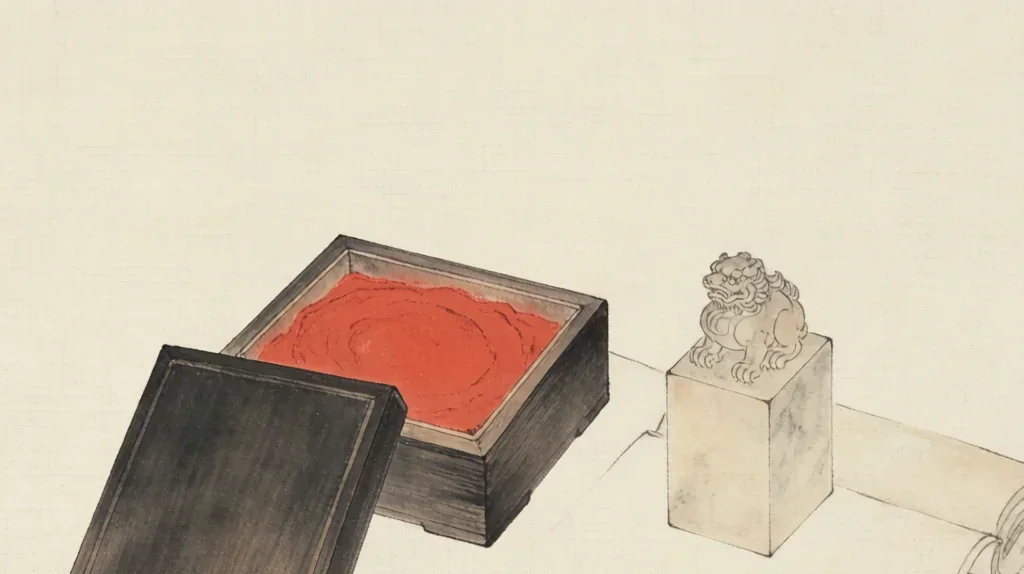
Before there were signatures in China, there were seals. For over 3,000 years, the small red square of a seal impression has been the ultimate mark of identity, authority, and authenticity in Chinese civilization. Emperors ruled through seals; artists authenticated their works with seals; officials conducted business with seals; and ordinary people identified themselves with seals. The Chinese seal — Yinzhang (印章) — is not merely a tool for making marks. It is a concentrated expression of personhood, power, and aesthetic sensibility, a tradition that has survived the rise and fall of dynasties and continues to thrive in the digital age.
The Origins: Marks of Authority
The earliest Chinese seals date back to the Shang Dynasty (1600–1046 BC), where they were used to stamp pottery and bronze vessels with clan insignias. By the Zhou Dynasty (1046–256 BC), seals had evolved into instruments of political authority. Officials carried seals as badges of office; documents were authenticated by seal impressions pressed into clay seals that secured bamboo or wooden slips. The seal was not a convenience — it was the mechanism by which government functioned across China's vast territory.
The most famous seal in Chinese history is the Heirloom Seal of the Realm (传国玉玺), carved from the legendary He Shi Bi jade disc during the Qin Dynasty (221–206 BC). According to tradition, the seal was inscribed with the words "Having received the Mandate of Heaven, may the emperor lead a long and prosperous life" (受命于天,既寿永昌). Possession of this seal was considered proof of legitimate imperial authority, and it was passed from dynasty to dynasty for over a thousand years until it disappeared during the Five Dynasties period. The search for the lost Heirloom Seal has been one of the enduring mysteries of Chinese history.
The Seal as Art: Materials and Craftsmanship
Chinese seals are miniature sculptures, and the choice of material is the first artistic decision. Jade (玉) is the most prestigious material, associated with imperial authority and moral virtue. The finest jade seals, carved from the prized "mutton fat" white nephrite of Khotan, are objects of breathtaking beauty. But jade is extremely hard and difficult to carve, requiring specialized tools and techniques.
Soapstone (寿山石) from Shoushan in Fujian Province became the preferred material for most seals, particularly after the Yuan Dynasty. Soapstone is soft enough to carve with hand tools, allowing seal engravers to create intricate designs with fine detail. Different varieties of soapstone — Tianhuang (田黄), the golden-yellow "emperor of stones"; Furong (芙蓉), the translucent pink "hibiscus stone"; and many others — are collected and treasured like jewels. A small block of top-quality Tianhuang can cost more than gold by weight.
Other materials used for seals include bronze, gold, silver, ivory, horn, wood, and ceramic. Each material has its own aesthetic qualities, carving characteristics, and cultural associations. The seal knob — the decorative top of the seal — is itself a miniature sculpture, often depicting lions, dragons, tortoises, or other auspicious animals. A fine seal is a work of art in three dimensions, appreciated by turning it in the hand to admire the carving from every angle.
Types of Seals: Names, Studios, and Free Thoughts
Chinese seals fall into several categories, each with distinct functions. The name seal (名章, míngzhāng) is the most fundamental, bearing the owner's personal name. This is the seal equivalent of a signature, used to authenticate documents, letters, and artworks. Most individuals have multiple name seals — formal seals with their full name for official use, and informal seals with just their given name for personal correspondence.
The studio seal (斋号印, zhāihào yìn) bears the name of the owner's study or studio, a tradition that reflects the importance of the scholar's workspace in Chinese culture. A studio name might reference a beloved landscape, a philosophical principle, or a literary allusion. "Thatched Cottage of Contemplating the Ancients," "Studio of the Ink Zen," "Hall of Listening to the Rain" — these names are not addresses but expressions of identity.
Most distinctive is the "free time" seal (闲章, xiánzhāng), which bears not a name but a phrase, poem, or saying that expresses the owner's philosophy or mood. Free time seals might quote a line of classical poetry, a Zen aphorism, or a personal motto. "The heart is at ease" (心闲), "Let it be" (随缘), "A clear breeze and bright moon" (清风明月) — these phrases, stamped in red, add a layer of personal expression to any document or artwork. Collectors and connoisseurs also use collection seals (收藏印) to mark artworks they own, creating a visible chain of provenance across centuries.
Red Paste: The Ink of Seals
The distinctive red color of Chinese seal impressions comes from seal paste (印泥, yìnní), a substance as carefully prepared as the seals themselves. Traditional seal paste is made from ground cinnabar (朱砂), a mercury sulfide mineral that produces a brilliant, permanent red, mixed with castor oil or other binders and sometimes silk fibers for body. The finest seal paste is aged for years, even decades, developing deeper color and better consistency over time.
The preparation of seal paste is an art in its own right. The cinnabar must be ground to an extremely fine powder — the finer the grind, the more brilliant the color. The oil must be of the right viscosity to transfer cleanly to paper without bleeding. The paste is stored in covered porcelain containers to prevent drying. A fine seal paste will produce impressions that remain vivid for centuries — ancient seal marks on Tang and Song dynasty artworks remain as bright as the day they were stamped.
The red seal impression serves multiple aesthetic functions in Chinese art. On a painting executed in black ink, the red seal provides a visual punctuation — a point of color that balances the composition. A painting or calligraphy work typically bears multiple seals: the artist's name seal, perhaps a free time seal, and collection seals of subsequent owners. The interplay of black ink and red seals is fundamental to the visual language of Chinese art.
Seals in the Modern World
Despite the digital revolution, seals remain legally significant in China and throughout East Asia. Company seals (公章) are required for official documents, contracts, and financial transactions. The theft or misuse of a company seal can have serious legal consequences. In Japan, personal seals (hanko) are still required for many official procedures. In China, while personal seals are less commonly used than in the past, they retain cultural importance, particularly for artists, calligraphers, and collectors.
The art of seal carving (篆刻, zhuànkè) continues as a living tradition. Master seal carvers are respected artists, their works collected and exhibited. Calligraphy and painting students learn seal carving as part of their training, understanding that the seal is not an afterthought but an integral element of the artwork. The small red square that appears at the corner of a painting or the end of a letter is the continuation of a 3,000-year conversation — proof that in China, identity has always been something you make, not just something you write.
Seal Script: The Calligraphy of Zhuake
Seal carving is written in zhuanshu, the archaic 'seal script' of the Qin dynasty, whose rounded, symmetrical strokes suit the squared stone face. The carver must reverse the characters mentally, cutting them in mirror so they print correctly. Mastery demands fluency in both calligraphy and the knife, since a wrong stroke cannot be erased. The script's antiquity lends every seal an air of ritual authority, linking a modern signature to the visual language of the first emperors. To read a seal is thus to read two thousand years of letterform at once.
Seals as Marks of Collection
Beyond signing, seals record ownership and taste. Collectors stamp a collection seal (收藏印) on each artwork they acquire, so a Song painting may carry the red marks of emperors, scholars, and dealers across centuries. These overlapping impressions form a visible provenance, a chain of hands that proves authenticity and tells a social history. Connoisseurs study the sequence of seals as avidly as the brushwork. The seal thus turns a private possession into a public, cumulative record of who valued it and when.
The Etiquette of Affixing a Seal
Using a seal is a small ritual. The stone is pressed evenly into cinnabar paste, then stamped with firm, even pressure so the impression is crisp and complete. A blurred or partial mark reads as careless and can invalidate a document. On a painting, the artist's name seal anchors the signature, a leisure seal adds a final note, and placement matters: too many marks unbalance the composition. The act is deliberate, almost ceremonial, because the red square is not decoration but the maker's word made permanent.
❓ Frequently Asked Questions
📝 Chinese Vocabulary
- 印章 (Yìnzhāng) — Chinese seal, the carved stamp used as a signature and mark of authenticity for over 3,000 years.
- 传国玉玺 (Chuánguó Yùxǐ) — The Heirloom Seal of the Realm, the legendary imperial seal that symbolized legitimate rule.
- 闲章 (Xiánzhāng) — "Free time seal," a seal bearing a poetic phrase or motto rather than a name.
- 印泥 (Yìnní) — Seal paste, the red cinnabar-based ink used to make seal impressions.
- 篆刻 (Zhuànkè) — The art of seal carving, using the ancient "seal script" calligraphy style.
🎉 Fun Facts
- The Heirloom Seal of the Realm, lost for over a thousand years, remains one of the most sought-after artifacts in Chinese archaeology — if found, it would be arguably the most valuable object in Chinese history.
- Emperor Qianlong of the Qing Dynasty was an obsessive seal collector who owned over 1,800 seals — and used so many on famous paintings that later connoisseurs complained he "vandalized" masterpieces with his stamp.
- Top-quality Tianhuang soapstone, prized for seal carving, can sell for over $10,000 per gram — more expensive than gold.
- Seal impressions come in two classic styles: raised red characters on white (yang) or incised white characters on red (yin).
- Artists often add a leisure seal only after a painting is finished, as a final signature of mood rather than identity.
- A company seal (公章) carries such legal weight in China that a stamped contract can bind a firm even without a signature.