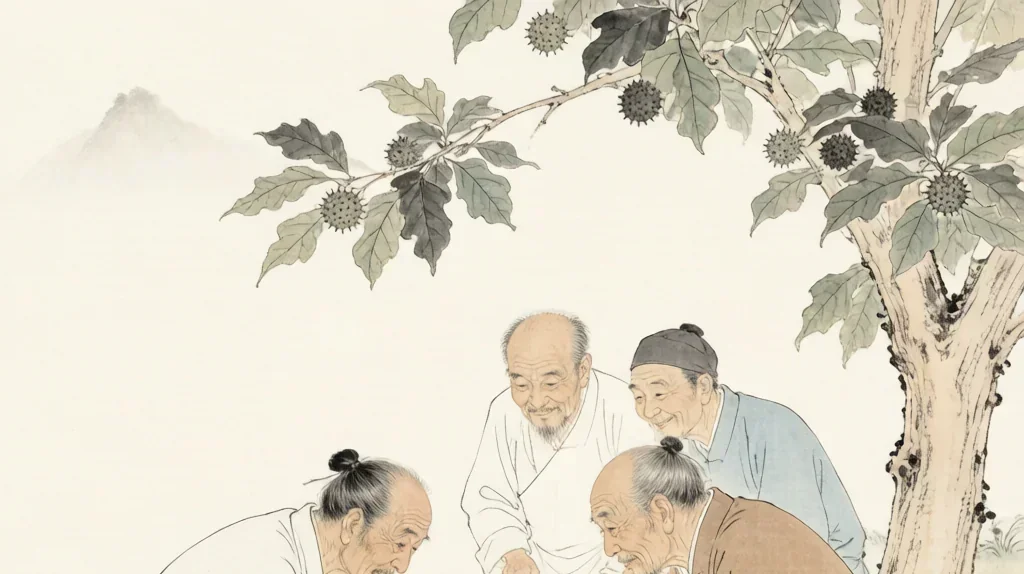
On any given afternoon in cities across China, you can find them: clusters of men crouched around wooden boards, voices rising and falling as pieces clack against the wood. These are Xiangqi players, engaged in what is arguably the world's most popular board game — Chinese chess. With an estimated 300 million regular players, Xiangqi is played in parks and tea houses, in online lobbies and professional tournaments. It is a game of generals and soldiers, of cunning traps and brilliant sacrifices, of a river that divides the battlefield and a cannon that leaps over pieces to strike. To understand Xiangqi is to understand something essential about the Chinese strategic mind.
The Battlefield: Chu River, Han Border
Xiangqi is played on a board of 9 vertical lines by 10 horizontal lines, creating 90 intersection points where pieces are placed. Running through the middle of the board is a blank horizontal band — the river (河). On each side of the river, inscribed on the board, are the words "Chu River" (楚河) on the black side and "Han Border" (汉界) on the red side. This inscription references the Chu-Han Contention (206–202 BC), the civil war that followed the collapse of the Qin Dynasty, when the forces of Chu under Xiang Yu battled the forces of Han under Liu Bang for control of China.
This historical reference is no mere decoration. The Chu-Han Contention was one of the most dramatic periods in Chinese history, filled with strategic brilliance, betrayal, and eventual triumph. Liu Bang, the eventual founder of the Han Dynasty, won not through superior force but through superior strategy — a lesson embedded in every game of Xiangqi. The river that divides the board represents the Honggou Canal that once separated the Chu and Han territories. Every time a piece crosses the river, it reenacts the ancient crossing from defense to attack.
The Pieces: An Army in Miniature
Xiangqi's pieces form a complete military hierarchy, each with unique movement patterns that reflect their battlefield roles. The General (将/帅) is the most important piece — lose him and the game is over. Unlike the Western chess king, who can roam the entire board, the General is confined to a 9-point palace at the back of the formation. He cannot leave his fortress, and he cannot face the enemy General directly across an open file — a rule called the "flying general" restriction that adds a crucial tactical dimension.
The Advisors (士/仕) and Elephants (象/相) are the General's defensive entourage, restricted to their own side of the river. Advisors move diagonally within the palace, serving as the General's last line of defense. Elephants move two points diagonally — a "field" character (田) pattern — but can be blocked by a piece at the center of that diagonal. The Horse (馬) moves in an L-shape similar to the Western chess knight but can be blocked by a piece adjacent to it — a vulnerability called "hobbling the horse's leg." The Chariot (車) is the most powerful piece, moving any distance horizontally or vertically, equivalent to the Western chess rook.
The Cannon: Xiangqi's Unique Weapon
The most distinctive piece in Xiangqi is the Cannon (炮), a weapon with no equivalent in Western chess. The Cannon moves like a Chariot — any distance horizontally or vertically — but it can only capture by jumping over exactly one intervening piece, friend or foe. This "screen" piece is called the cannon mount (炮架). The cannon cannot capture without a mount, and it cannot jump over a piece unless capturing.
The Cannon's unique movement creates tactical patterns found nowhere else in chess. It can threaten pieces from behind defensive walls, strike through formations, and deliver checkmates that exploit the enemy's own pieces as launch platforms. The phrase "behind the mountain cannon" (背弓炮) describes a cannon positioned behind the General's palace, using the General himself as a mount to threaten distant targets. The Cannon's presence fundamentally shapes Xiangqi strategy, making positions that would be safe in Western chess potentially deadly.
The Soldiers (兵/卒) complete the army. Unlike Western chess pawns, which move diagonally to capture, Xiangqi soldiers always move and capture one point forward — and once they cross the river, they gain the ability to move one point sideways as well. They cannot retreat. This forward-only movement embodies the Chinese military concept of soldiers who advance with no thought of return, fighting until victory or death.
Street Chess and Tea House Culture
Xiangqi's soul lives not in tournament halls but on street corners and in tea houses. In parks across China, retired men gather daily with boards and thermoses of tea, playing game after game as spectators crowd around, offering unsolicited advice. The atmosphere is raucous and communal — onlookers often debate moves more loudly than the players themselves, a breach of etiquette in Western chess that is entirely normal in Xiangqi culture.
There is a distinctive rhythm to these games. Pieces are slammed onto the board with decisive force, the wooden discs making a satisfying clack. Players often announce their moves aloud, sometimes with classical terminology: "Cannon crosses the river!" "Chariot sweeps the thousand armies!" The speed of play is typically much faster than in Western chess, with many games played under blitz conditions where each player has only a few minutes total. This fast-paced, aggressive style reflects Xiangqi's more tactical, attacking character.
Xiangqi in the Age of AI
Like all board games, Xiangqi has been transformed by artificial intelligence. In 2006, the program "XieXie" became the first AI to defeat a top human professional. Today, the strongest Xiangqi engines, running on neural networks similar to those that conquered Go, play at levels far beyond human capability. Online platforms allow millions to play, study, and watch games, with AI analysis instantly available to review mistakes.
Rather than diminishing human play, AI has enriched it. Professional players use engines to prepare openings and discover new tactical ideas. Amateur players improve by analyzing their games. The streaming of Xiangqi matches and commentary has created a new generation of online audiences. The ancient game of generals has adapted seamlessly to the digital age, proving that strategic beauty transcends any medium.
Whether played on a wooden board in a dusty park or on a glowing screen in a high-speed train, Xiangqi remains what it has always been: a contest of minds, a miniature battlefield, and a living thread connecting modern China to its imperial past. In a country that has transformed beyond recognition in a single generation, the clack of chess pieces on wood remains a timeless sound.
Classic Openings and Tactics
Serious Xiangqi players memorize opening systems much as Weiqi and chess players do. The 'screen horse' (屏风马) and the 'central cannon' (当头炮) are two pillars: one builds a solid defense, the other strikes early from the center. Midgame revolves around the cannon's screen captures, the chariot's penetration of the opponent's ranks, and the soldier's value after crossing the river. Endgames are studied as puzzles of king safety and pawn promotion. Books of recorded master games form a canon that each new generation studies, so the folk game also has a rigorous professional theory.
Professional Xiangqi and Its Champions
At the top level Xiangqi is a salaried sport. China runs a national league, a ranking system, and televised title matches, with grandmasters such as Hu Ronghua and Xu Yinchuan treated as celebrities. National and Asian championships draw millions of viewers, and the best players coach academies that recruit children as young as six. Prize money and sponsorships have grown, yet the culture retains its tea-house warmth: even champions began on a wooden board in a park. The professionalization has lifted play without erasing its popular roots.
Xiangqi as a Bridge Between Generations
Few Chinese pastimes span ages so easily. A grandfather and grandchild can share a board with no words beyond the clack of pieces, the elder teaching patience and the younger teaching speed. In an aging society the game is also social medicine: park tables keep retirees mentally active and connected. Because the rules are simple to learn and endless to master, Xiangqi links the imperial past to the smartphone generation. The board on a folding stool is a small, durable thread of continuity in a rapidly changing country.
❓ Frequently Asked Questions
📝 Chinese Vocabulary
- 象棋 (Xiàngqí) — Chinese chess, literally "elephant game," referring to the elephant piece and the game's strategic nature.
- 楚河汉界 (Chǔ Hé Hàn Jiè) — "Chu River, Han Border," the inscription on the board referencing the historical Chu-Han Contention.
- 炮 (Pào) — The Cannon piece, Xiangqi's unique piece that captures by jumping over an intervening piece.
- 将军 (Jiāngjūn) — "General," also the word for "check," shouted when threatening the enemy General.
🎉 Fun Facts
- Xiangqi is estimated to have over 300 million regular players worldwide, making it one of the most-played board games on Earth.
- Unlike Western chess, where pieces occupy squares, Xiangqi pieces sit on the intersections of lines — 90 points in total.
- The Cannon piece was inspired by early Chinese military technology — traction catapults that hurled projectiles over walls during siege warfare.
- The oldest known pieces date to the Tang Dynasty, but the rules were standardized only in the Song Dynasty.
- Blindfolded masters play several opponents at once from memory, a celebrated test of concentration.
- In rural tournaments games are often played for cigarettes or small sums, blending sport with social life.