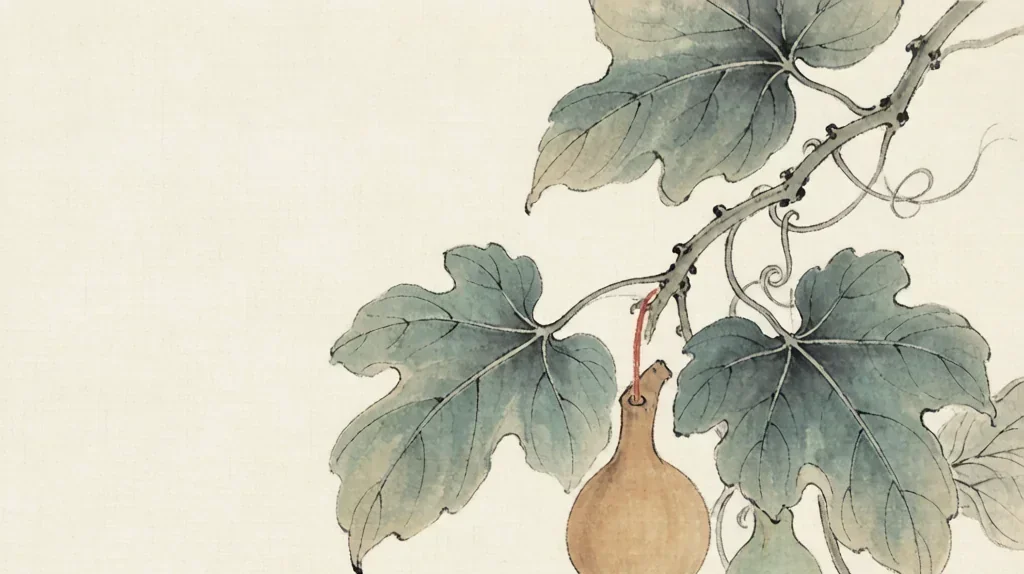
The gourd, known in Chinese as hulu (葫芦), is one of the most enduring and versatile symbols in Chinese material culture. Botanically a member of the cucumber family, the dried Calabash gourd has served for millennia as a practical container, a folk talisman against disease and misfortune, and a potent emblem of fertility and abundance. From the medicine gourds carried by wandering physicians to the double-gourd staff of the immortal Li Tieguai, this humble fruit weaves together everyday utility and layered symbolism, appearing in domestic shrines, Daoist iconography, and the decorative vocabulary of porcelain, jade, and architecture.
Botanical Origins and Everyday Use
The bottle gourd (Lagenaria siceraria) was among the earliest plants cultivated by human societies, and it reached China in the distant Neolithic past. Once harvested and dried, its hard yet light shell made an ideal vessel for carrying water, grain, wine, and seeds. Archaeological finds from early settlements show gourd vessels used long before the widespread mastery of pottery.
Because a single gourd could be cut into two bowl-like halves, it gave rise to the familiar dipper and ladle. In rural China the gourd remained a kitchen staple well into the modern era, prized for keeping liquids cool and for its natural resistance to rot. Its utilitarian profile is the foundation on which all its later symbolic meanings were built.
The plant's vigorous climbing habit and enormous yield also made it a natural symbol of domestic prosperity. A single vine can produce dozens of fruit in a season, and the sight of gourds crowding a courtyard trellis became a visual shorthand for a household blessed with plenty.
The Gourd as a Vessel of Immortality
In Daoist legend the gourd is the signature attribute of several immortals. Li Tieguai, the lame beggar among the Eight Immortals, carries a gourd containing medicine and, according to lore, an entire miniature world. The immortal Li Laojun and the youthful Ludongbin are likewise shown with gourds of elixir.
The idea that a small gourd could hold vast interior space echoes a recurring theme in Chinese cosmology: that the cosmos itself can be contained within a tiny seed or vessel. This notion, sometimes called the "mustard-seed universe," made the gourd a favored metaphor for the adept who carries the whole realm of dao within.
Folk healers and exorcists adopted the gourd as a professional emblem. A physician's "medicine gourd" signified not only his remedies but his mandate to dispel affliction. The gourd thus straddled the line between pharmacy and magic.
Protection Against Disease and Evil
The gourd's rounded, sealed form was believed to trap and contain malign influences. During epidemics, households might hang a gourd at the gate or over a sickbed to absorb illness, and small gourd amulets were tied to children to keep them safe.
This apotropaic role is reinforced by the gourd's phonetic affinity. The word hu (葫) for the plant is distinct from fu (福, fortune), but the gourd's reputation as a guardian of well-being grew through association with other homophonic charms. Together with the character for "protection," the gourd became a quiet household sentinel.
In some regional customs, five gourds were hung to echo the "five blessings," and gourd-shaped wind chimes or window grilles appeared to deflect wandering ghosts at the liminal times of dusk and dawn.
Fertility, Multiplicity, and the Wedding Bed
Because the gourd is packed with seeds and reproduces profusely, it became a classic fertility symbol. Newlyweds were sometimes given a pair of gourds or gourd-embroidered bedding to encourage the birth of many children, ideally sons to continue the family line.
The double gourd, formed where two lobes meet, reads visually as a pair and is a favorite motif on wedding presents and bedroom furnishings. Its shape also resembles the female form, reinforcing associations with the womb and nurturing abundance.
Folk paintings of children clutching gourds, surrounded by butterflies and pomegranates, encode a straightforward wish: a teeming, healthy household. The gourd here joins a small family of "seed-heavy" fruits deployed for the same blessing.
The Gourd in Decorative Arts
Chinese artisans adopted the gourd silhouette across media. Jade carvers produced flawless double-gourds as scholar's table ornaments; porcelain painters placed gourd vines on birthday dishes; and lacquer workers inlaid gourd scrolls on wedding chests.
The "gourd vine" (hulu teng) pattern, with its curling tendrils and plump fruit, is a recurring border design on textiles and ceramics, especially wares made for the domestic market rather than export. Its cheerful repetition suited everyday objects.
Bronze and cloisonné gourd-shaped incense holders, and even gourd-shaped snuff bottles, testify to the motif's migration into the refined material culture of the late imperial elite, far from its peasant origins.
The Gourd in Architecture and Gardens
The gourd's proportions influenced design at several scales. The classic "bottle-gourd gate" appears in some garden walls, its narrow waist admitting only one person at a time and forcing a pause. Such a gateway could double as a playful reference to the immortality gourd.
In courtyard houses, gourd vines trained over a trellis provided summer shade and a living pantry, while the dried fruit hung from eaves well into winter. The plant's annual cycle knit the household's rhythms to the seasons.
On a cosmic scale, traditional geomancers compared the ideal sheltered settlement to a gourd cradled in hills, its narrow neck guarding the entrance and its rounded body holding the community safe within.
Regional Festivals and Folk Performance
In parts of northern China, gourd crafts feature at autumn harvest fairs, where vendors sell painted gourds, gourd flutes, and gourd rattles for children. The gourd's hollow resonance makes a serviceable musical instrument across many regions.
Gourd-bodied lutes such as the huluqin and the hulusi free-reed flute remain beloved folk instruments, especially among southern minority communities. Their mellow tone is itself a cultural ambassador for the humble fruit.
During the Mid-Autumn season, gourds sometimes joined melons and pomegranates on the family altar, completing a triad of fruits that wished the household fullness, offspring, and sweetness.
The Gourd in Language and Proverbs
Chinese idiom preserves the gourd's reputation for awkward containment. The phrase "drawing a gourd by tracing its outline" (an hu lu hua piao) means imitating someone mechanically without understanding, much like copying a form without grasping its spirit.
To "press the gourd only to have the ladle pop up" describes a futile game of whack-a-mole, where solving one problem merely surfaces another. The image draws on the gourd's buoyancy in water.
Such sayings confirm that the gourd was a familiar, almost domestic presence whose behavior everyone understood, making it a natural source of metaphor for everyday reasoning.
Modern Revival and Collecting
Today the gourd enjoys a craft revival. Artisans in Hebei, Tianjin, and Shandong grow and engrave "penghu" gourds, burning intricate scenes into their surfaces with heated tools, then lacquering them into durable art objects.
Contemporary designers borrow the gourd silhouette for tea sets, lamps, and jewelry, banking on its instantly readable aura of good luck. Tourist markets from Beijing to Lijiang sell gourd trinkets as lightweight blessings.
Whether as a farmer's water dipper, an immortal's medicine chest, or a collector's engraved curio, the gourd remains a small but eloquent ambassador of Chinese ideas about health, wealth, and the generous earth.
❓ Frequently Asked Questions
What does a gourd symbolize in Chinese culture?
The gourd symbolizes health, protection from illness and evil, fertility because of its many seeds, and abundance. It is also the attribute of Daoist immortals associated with elixirs and magic medicine.
Why do Daoist immortals carry gourds?
The gourd's sealed, rounded form was believed to contain vast space and potent substances. Immortals like Li Tieguai carry gourds holding medicine or even miniature worlds, signaling their mastery of life and death.
Is the gourd a fertility symbol?
Yes. Its profuse seeds and the paired shape of the double gourd make it a classic wish for many children, and it appears on wedding bedding and newborn amulets.
How is the gourd used as a musical instrument?
Its hollow resonating body forms the chamber of folk instruments such as the hulusi free-reed flute and various gourd lutes, prized for a soft, mellow tone.
What is gourd engraving?
Penghu is a northern Chinese craft of growing and drying gourds, then burning intricate pictures into the shell with heated tools and lacquering them as decorative art.
Why was the gourd hung at household gates?
Folk belief held that a hanging gourd could absorb illness and deflect wandering malign spirits, especially at vulnerable times like dusk, acting as a quiet guardian of the home.