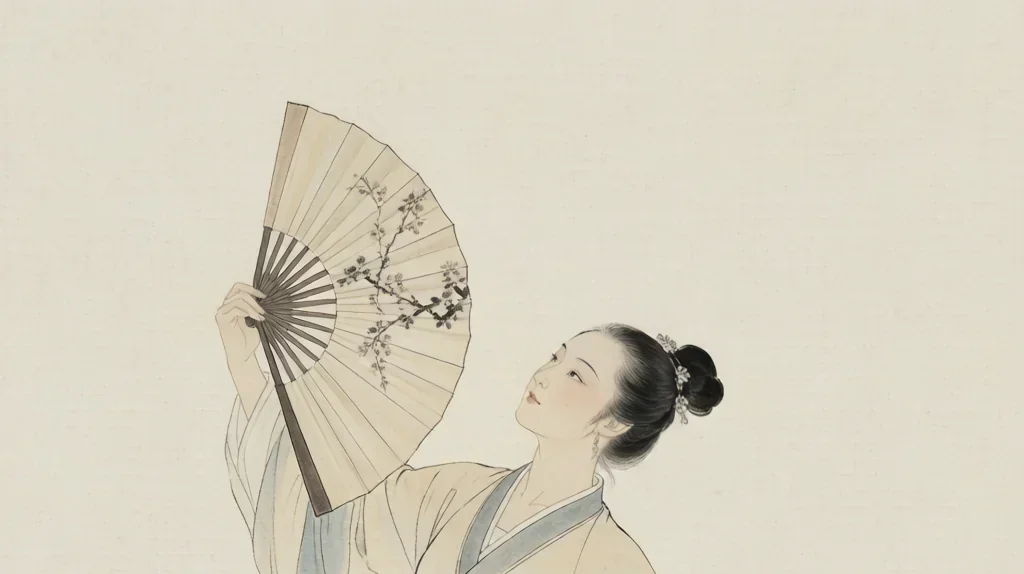
On a stage lit by soft lantern light, a dancer moves in silence. In her hands, a folding fan opens and closes with the precision of a butterfly's wing. One moment it is a flower blooming; the next, a wave cresting; then a letter being read by moonlight. The fan is not a prop — it is an extension of the dancer's body, a partner in storytelling, a brush painting pictures in the air. This is Chinese fan dance (扇子舞), an art form that transforms a simple object of daily life into an instrument of extraordinary expressive power.
Origins: Two Thousand Years of Grace
The fan dance is nearly as old as the fan itself. The earliest Chinese fans — rigid, round fans made of silk stretched over a bamboo frame — appeared during the Han Dynasty (206 BC–220 AD). They were practical objects for cooling, but they quickly acquired aesthetic and symbolic dimensions. Court ladies used fans to hide their faces, to gesture gracefully, to communicate wordlessly. The fan became associated with femininity, refinement, and the expression of emotions too subtle for speech.
The folding fan, which came to China from Japan during the Song Dynasty (960–1279 AD), revolutionized fan culture and dance alike. Unlike the rigid round fan, the folding fan could open and close, snap and flutter, creating a vocabulary of movement that was entirely new. It became a favored accessory of scholars, who wrote poems on the fan's ribs and painted landscapes on its surface. By the Tang Dynasty, fan dances were being performed at court and in temples, their movements codified into formal repertoires.
Classical Fan Dance: Elegance and Restraint
Classical Chinese fan dance, as performed in the court and literati traditions, emphasizes grace, control, and symbolic meaning. The dancer moves with a restrained elegance that reflects Confucian values of propriety and refinement. Every gesture has meaning: a fan held before the face suggests modesty or concealment; a fan opened slowly like a flower blooming suggests beauty emerging; a fan snapped shut suggests decision or finality.
The folding fan's structure creates specific technical possibilities. The dancer can open the fan with a dramatic snap (an effect called shuai shan), flutter it to suggest wind or butterflies, or hold it partially open to create a crescent shape. The fan can be passed from hand to hand, spun, tossed, and caught. Advanced techniques involve manipulating the fan's ribs individually, creating rippling effects like water or the turning of pages.
Classical fan dances often tell stories drawn from Chinese literature and legend. A famous repertoire piece depicts the tragic heroine Yang Guifei, the beloved consort of Emperor Xuanzong, dancing with a round fan that symbolizes the fleeting nature of beauty and imperial favor. Another depicts the poet Li Bai, drunken and inspired, using his fan as a brush to write poems in the air. The fan becomes a narrative device, its movements conveying plot, emotion, and character.
Folk Fan Dance: Joy and Community
Alongside the refined classical tradition exists a vibrant folk fan dance tradition, particularly associated with the Han Chinese and various ethnic minorities. Folk fan dances are performed at festivals, weddings, and community celebrations. They are characterized by larger, more energetic movements, brighter colors, and a communal spirit absent from the solo classical tradition.
The Yangge (秧歌) fan dance, popular in northern China, is performed by groups of dancers moving in formation, their fans creating waves of color and motion. During Chinese New Year and the Lantern Festival, yangge troupes parade through streets, the dancers' fans flashing red and gold — colors of celebration and good fortune. The dance is exuberant, even rowdy, a world apart from the refined restraint of the classical style.
Ethnic minority traditions add further diversity. The Dai people of Yunnan Province perform a fan dance inspired by the peacock, the fans mimicking the bird's spreading tail feathers. The Korean ethnic minority's fan dance, performed in flowing white costumes with elaborately painted fans, creates patterns of extraordinary geometric beauty when viewed from above. The Miao people's fan dance incorporates the percussive sounds of silver ornaments, the fans' movements punctuated by the jingling of traditional jewelry.
The Fan as Symbol
Beyond its role in dance, the fan carries deep symbolic meaning in Chinese culture. In Taoist tradition, the fan is associated with Zhongli Quan, one of the Eight Immortals, who uses his fan to revive the dead and grant longevity. The fan represents the power to create change — to stir the air, to fan flames, to bring the breath of life. In literature and art, a fan given as a gift carries romantic implications, a token of affection that speaks without words.
The fan also embodies the Chinese aesthetic principle of transformation. A closed fan conceals its painted surface — a landscape, a poem, a flower — revealing it only when opened. This play of concealment and revelation is central to Chinese artistic sensibility, and the fan dance makes this principle kinetic. The dancer's fan constantly transforms: open, closed, half-open, spinning, still — each state a different meaning, a different emotion.
Fan Dance Today: Living Tradition
Fan dance remains a vital part of Chinese cultural life. In public parks every morning, groups of mostly older women practice fan dance as exercise, their movements synchronized to traditional music. These informal park performances are not professional art — they are community practice, a form of social bonding and physical activity that keeps the tradition alive at the grassroots level.
On the professional stage, fan dance has evolved in new directions. Contemporary choreographers blend classical fan techniques with modern dance vocabulary, creating works that speak to contemporary audiences while honoring traditional roots. The 2008 Beijing Olympics opening ceremony featured fan dancers on a massive scale, introducing the art form to a global audience of billions. Chinese dance companies touring internationally regularly include fan dance in their repertoires, the universal language of movement transcending linguistic and cultural barriers.
The fan dance endures because it speaks to something fundamental about Chinese aesthetic sensibility: the idea that meaning can be conveyed through suggestion rather than statement, through the flutter of silk rather than the shout of voice. In a single opening of a fan, a thousand words are spoken. In a single closing, a story ends. The poetry is in the motion.
Fan Dance in Peking Opera
In Peking opera the fan is a prop of character. A scholar's folding fan marks refinement; a military officer's fan signals composure; a comedic figure twirls it for laughs. Performers use the fan to punctuate speech, mask emotion, or stalk the stage in stylized walks. The color and material of the fan tell the audience who the character is before a word is sung. Opera thus compressed the everyday etiquette of the fan into readable stage code, and many gestures later fed back into popular fan dance. The two arts share a vocabulary of snap, flutter, and concealment that audiences read instinctively.
The Fan as Romantic Token
Beyond dance, the fan carried intimate meaning. A lady who offered a painted fan to a gentleman signaled quiet affection; the fan leaf, often bearing her calligraphy or a verse, was a piece of herself. In novels and opera, a dropped or exchanged fan sparks a romance. The round fan in particular became a symbol of concealed feeling, its painted surface revealed only when opened. Fan dance draws on this lore: a dancer opening a fan toward a partner echoes the gift of a heart. The object's romantic charge gives the dance an emotional subtext audiences feel even without words.
Fan Dance as Community Exercise
The most widespread form of fan dance today is not theatrical but recreational. Each morning in parks, groups of mostly older women rehearse synchronized routines with silk fans to recorded folk music. The practice blends gentle cardio, balance work, and sociability, and it keeps a heritage art alive at the grassroots. Participants speak of improved mood and mobility. Because the moves are simple and the props cheap, fan dance fitness crosses class and city lines. What began as courtly elegance now serves public health, proving the tradition's adaptability across a thousand years.
❓ Frequently Asked Questions
📝 Chinese Vocabulary
- 扇子舞 (Shànzi Wǔ) — Fan dance, the art of dancing with folding or round fans as an expressive instrument.
- 甩扇 (Shuǎi Shàn) — The technique of snapping a folding fan open with a dramatic flourish.
- 秧歌 (Yānggē) — A lively folk dance from northern China, often performed with fans during festivals and celebrations.
- 团扇 (Tuánshàn) — The round, rigid fan, the earliest Chinese fan form, associated with court ladies and classical elegance.
🎉 Fun Facts
- The folding fan was not invented in China but imported from Japan during the Song Dynasty, where it quickly became more popular than the indigenous round fan.
- In traditional Chinese opera, the color of a character's fan conveys meaning: red fans indicate happiness, black fans suggest authority, and white fans can indicate mourning or treachery.
- During the Tang Dynasty, fan dancing was one of the skills expected of elite courtesans, along with poetry, calligraphy, and music.
- The fan dance is a perennial highlight of the CCTV New Year Gala, performed before an audience of hundreds of millions.
- In the Dai peacock dance of Yunnan, fans dyed to mimic iridescent feathers are flicked in tight rhythm with drumming.
- Morning park classes in 'fan dance fitness' double as low-impact aerobics for retirees across Chinese cities.