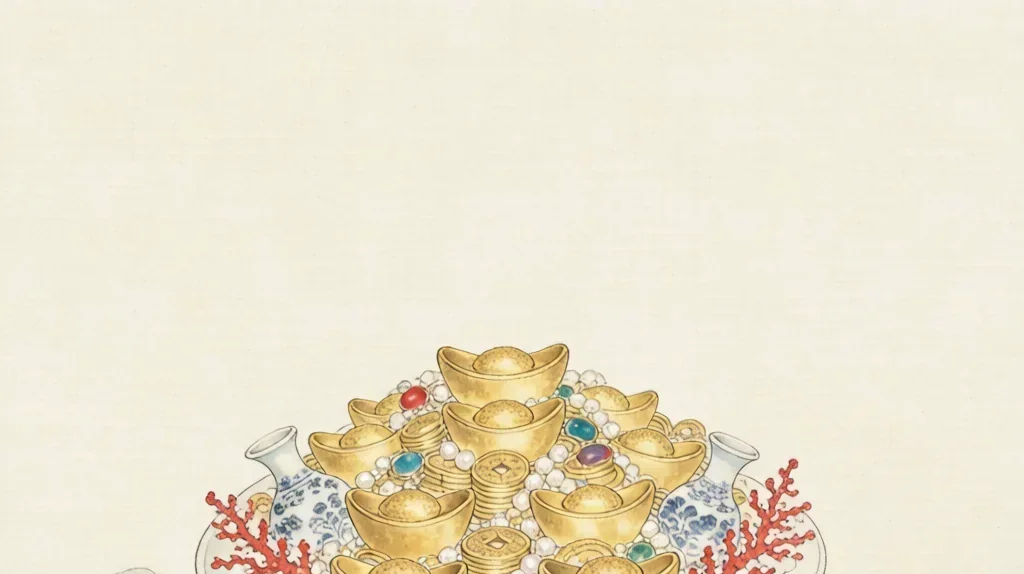
The jubaopen (聚宝盆, "treasure-gathering basin") is a beloved figure of Chinese folk imagination — a magic bowl or basin that endlessly multiplies whatever is placed inside it. Drop in a coin and it returns a hundred; add a grain of rice and it fills with more. As a decorative motif on New Year prints, porcelain, and carvings, the jubaopen is a cheerful, almost playful emblem of abundance, inviting wealth to accumulate without limit. Less a religious object than a wish made visual, it captures the Chinese appetite for prosperity that is both endless and household-friendly.
The Basic Legend
The core story is simple and satisfying: a poor person comes into possession of a basin that reproduces anything put into it. A single object becomes many; scarcity becomes surplus. The tale exists in many regional versions, often attached to a kind figure who uses the basin to help others.
In some accounts the basin belongs to a humble fisherman or farmer who discovers its power by accident. The magic is democratic — anyone might stumble on abundance.
The appeal is obvious in a society where famine and tax pressed hard on ordinary families: a self-refilling basin is the dream of security made literal.
Shen Wansan and the Famous Basin
The best-known association links the jubaopen to Shen Wansan (沈万三), a legendarily wealthy merchant of the late Yuan and early Ming period. Folklore says his riches flowed from a "treasure basin" that multiplied his capital without end.
Whether or not a historical Shen was so enriched, the story cemented the basin as the symbol of merchant fortune. Shen became the patron ghost of business luck, and his basin the mascot of getting rich.
Temples and shops sometimes displayed a jubaopen image to attract custom, borrowing Shen's aura of effortless multiplication.
Visual Form of the Motif
As a picture, the jubaopen is usually a wide, shallow basin overflowing with coins, ingots (yuanbao), jewels, and sometimes a sprouting ingot-tree. The spillover is the point: wealth should brim past the rim.
Artists loved the comedy of excess — a basin so full it cannot contain its own fortune. The image is optimistic to the point of absurdity, which is exactly its charm.
Sometimes the basin sits atop a wave or cloud, elevating household prosperity into a near-cosmic force.
New Year Prints and Popular Art
The jubaopen was a staple of nianhua (年画), the woodblock New Year prints pasted on doors and walls. A print of the basin wished the family a year of accumulating wealth.
Workshops at Yangliuqing, Taohuawu, and elsewhere mass-produced such images, making the basin one of the most widely seen symbols in ordinary homes.
Because the print was replaced yearly, the wish was renewed each Spring Festival — a fresh basin of possibility every twelve months.
Jubaopen in Porcelain and Objects
Beyond paper, the basin appeared on blue-and-white porcelain, on lacquer trays, and as three-dimensional figurines in metal and ceramic. A small jubaopen on a scholar's desk doubled as a brush-rest or paperweight.
In markets, jade or resin replicas are sold as desk ornaments for businessmen, continuing the object's role as a prosperity charm.
The motif also appears on gambling and lottery imagery, where "multiply my stake" is the operative prayer.
The Logic of Accumulation
The jubaopen embodies a distinctly compound view of wealth: not a fixed pot but a growing one. Chinese financial folk wisdom favors steady accumulation (积少成多, "many a little makes a mickle"), and the basin is its fairy tale.
This contrasts with hoarding imagery; the basin is generative, not merely stored. It produces, echoing the agricultural ideal of seed returning hundredfold.
In this it aligns with the cornucopia of the West but keeps a Chinese accent of family-centered, repeatable gain.
Relation to Other Wealth Symbols
The jubaopen belongs to a cluster: the yuanbao ingot, the God of Wealth (Caishen), the bat (fu, fortune), and the coin. Often these appear together — the basin spilling ingots while a bat flutters above.
Where the yuanbao is a single unit of wealth, the basin is the machine that makes yuanbao. It is the source rather than the store.
This made it a natural centerpiece for scenes of abundance, surrounded by the lesser symbols it generates.
The Jubaopen in Modern Culture
Today the image survives in festive décor, commercial logos, and red-packet (hongbao) designs, especially around Lunar New Year. It reads instantly as "more money, please."
Modern cartoon versions soften it into a cute, overflowing pot, fitting the playful side of contemporary Chinese New Year aesthetics.
Though few believe in literal multiplication, the basin still voices a hopeful, harmless greed — the wish that enough might become plenty.
Why the Basin Endures
The jubaopen endures because it answers a permanent human anxiety: will there be enough? Its answer is a smiling yes, delivered as a picture anyone can own for the price of a print.
It is also mercifully undemanding. Unlike gods who require worship, the basin only asks to be displayed. Its blessing is passive, democratic, and renewable.
In a culture that values both thrift and celebration, the treasure basin lets people enjoy the fantasy of abundance without abandoning the discipline of saving.
The basin also carries a moral edge. Folk stories often punish those who use it greedily — a selfish owner whose basin overflows into ruin, or who refuses to share and is ruined by his own glut. The lesson is that multiplication is a gift to be met with moderation. The truly lucky household is the one that lets the basin's surplus spill outward to relatives and neighbors, turning private fortune into shared good. In this quiet moral, the jubaopen is not only a wish for wealth but a small sermon on how to hold it well, a reminder that the fullest basin is the one that gives as freely as it receives.
❓ Frequently Asked Questions
What is a jubaopen?
It is a "treasure-gathering basin," a folk symbol of a magic bowl that endlessly multiplies whatever is placed inside it.
Who is Shen Wansan?
He is a legendary wealthy merchant of the late Yuan/early Ming era whose riches folklore attributes to owning such a treasure basin.
How is the jubaopen depicted?
Usually as a wide basin overflowing with coins, ingots, and jewels, often sprouting an ingot-tree, symbolizing brimming abundance.
Where did people display it?
On New Year woodblock prints, porcelain, lacquer trays, and as figurines, to attract wealth into the home or shop.
How does it differ from a yuanbao?
A yuanbao is a single ingot of wealth; the jubaopen is the source that generates ingots, a symbol of multiplying fortune.
Does the jubaopen appear today?
Yes; it survives on festive décor, red-packet designs, and commercial logos, especially at Lunar New Year.