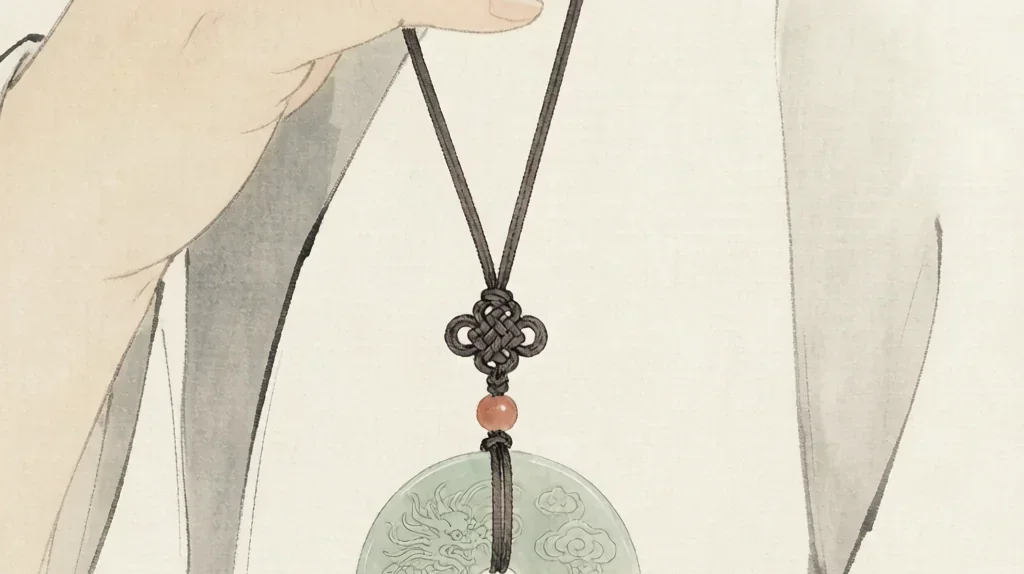
The jade pendant (玉佩, yù pèi) is among the oldest and most meaningful pieces of Chinese personal adornment. Worn at the waist by gentlemen and nobles for more than three thousand years, a jade pendant was never merely decorative. In Confucian thought it was a moral instrument — its cool touch and soft chiming sound were meant to remind the wearer to conduct himself with composure, integrity, and restraint. To wear jade was to wear virtue. This essay explores how a small carved stone became one of China's deepest symbols of character, status, and the gentle music of a well-ordered life.
Jade and the Chinese Soul
Jade (玉, yù) holds a unique place in Chinese civilization, often called the "stone of heaven." Neolithic cultures such as Liangzhu carved jade into ritual emblems, and the material never lost its sacred, aristocratic aura. To the Chinese, jade surpasses gold in moral weight.
Confucius and later moralists compared jade's qualities to human virtues: its luster to benevolence, its density to intelligence, its corners (that do not cut) to righteousness. A pendant thus broadcast the wearer's ethical aspirations.
Unlike a flashy gem, jade is valued for subtlety — a quiet glow rather than brilliance — which suited a culture that prized restraint over display.
The Pendant as Moral Instrument
Ancient Chinese gentlemen hung jade pendants from their sashes so that, when they walked, the pieces struck one another with a faint, clear tone. The ideal was a measured sound: too hurried a gait produced a jangle, reminding the wearer to slow down and compose himself.
The Book of Rites (礼记, Lǐ Jì) and other texts describe how a man's jade announced his bearing. A calm walk meant a calm mind; the pendant was a wearable etiquette coach.
In this way the pendant did moral work. It was not passive jewelry but an active teacher of deportment, sounding a small bell of self-discipline with every step.
Forms and Iconography
Jade pendants took many shapes: flat discs (bi 璧), rectangles (huang 璜 arcs), tubular beads, and carved figurines of animals, plants, and characters. Each form carried its own association — a dragon for power, a crane for longevity, a peach for long life.
A popular motif was the "ruyi" or lingzhi shape, and many pendants were carved as sets of linked plaques that swung together. The craftsmanship turned the waist into a miniature gallery.
Some pendants bore inscriptions — poems, names, or auspicious phrases — making them personal amulets as much as ornaments.
Jade in the Ritual System
In the Zhou dynasty ritual order, jade objects marked rank and ceremonial role. Different shapes and colors of jade were prescribed for different nobles, so a pendant could literally signal a man's place in the hierarchy.
Jade was also buried with the dead — in some tombs covering the body or placed in the mouth — to preserve the person and accompany the soul. The material's purity made it fit for the afterlife.
This ritual weight meant that jade pendants carried both social and cosmic significance: they placed a man in society and in the universe at once.
The Sound of Virtue
The acoustic dimension of the jade pendant is easy to overlook but was central. Ancient writers praised the "ring of jade" (玉声, yù shēng) as analogous to the voice of a cultivated person — clear, moderate, never harsh.
Court ceremonial depended on such sounds. A procession of officials in jade was a process of quiet music, an audible index of civilization itself.
To lose one's jade, or to let it clatter, was a small social failure — a sign that composure had slipped.
Jade for Women and Children
Although gentlemen's waist pendants are the classic image, women wore jade hairpins, earrings, and bracelets, and infants were given jade locks and pendants for protection. A "jade lock" (玉锁, yù suǒ) wished a child safety and a long life.
Jade's coolness and hardness made it a natural guardian against harm in folk belief; it was thought to absorb illness and bad luck from the wearer.
Thus the stone moved from the courtly waist to the cradle, remaining a token of care across the life cycle.
Craftsmanship and Value
Carving jade is notoriously difficult because the stone is harder than steel; artisans used abrasive sand and slow grinding rather than cutting. A fine pendant could take weeks or months.
Hetian jade from Xinjiang (especially the creamy "mutton-fat" white jade) was historically the most prized, though other sources existed. Color, translucency, and carving all affected value.
The slowness of the craft added to jade's aura: a pendant was the condensation of patient, disciplined labor — itself a kind of virtue.
Jade Pendants Today
Jade remains China's favorite stone. Modern wearers choose pendants for beauty, fashion, and the lingering belief that jade protects and signifies good character. Jade bangles and carved pendants are common gifts.
Museums display ancient jade pendants as masterpieces, and contemporary designers reinterpret traditional forms for new audiences, keeping the iconography alive.
Though few now expect their pendant to chime with their gait, the old idea — that wearing jade shapes the self — still hums beneath the surface of the custom.
Jade and the Wider Symbol System
The jade pendant sits among a family of meaningful Chinese objects: the ruyi (wishes), the yuanbao (wealth), the bat (fortune). Jade is unusual in pointing not outward to luck but inward to character.
This inward turn is why Confucians elevated it. Where other charms ask the world to be kind, jade asks the wearer to be good — a small, cool stone that quietly demands the best of you.
To understand the jade pendant is therefore to understand a civilization that wore its ethics on its body.
❓ Frequently Asked Questions
Why was the jade pendant important?
In Confucian thought it was a moral instrument: its cool touch and soft chime reminded the wearer to act with composure and integrity.
How did the pendant make sound?
Worn at the waist, the jade pieces struck together as the wearer walked; a calm gait gave a measured tone, a hurried one a jangle.
What did Confucius say about jade?
He compared its luster, density, and uncutting corners to benevolence, intelligence, and righteousness — virtues in stone.
What forms did jade pendants take?
They appeared as discs (bi), arcs (huang), tubes, and carved animals or characters, often inscribed with poems or auspicious phrases.
How was jade carved?
Because jade is harder than steel, artisans ground it slowly with abrasive sand rather than cutting it with tools.
Are jade pendants still worn?
Yes; jade remains China's favored stone for beauty, fashion, and the enduring belief that it protects the wearer and signals good character.