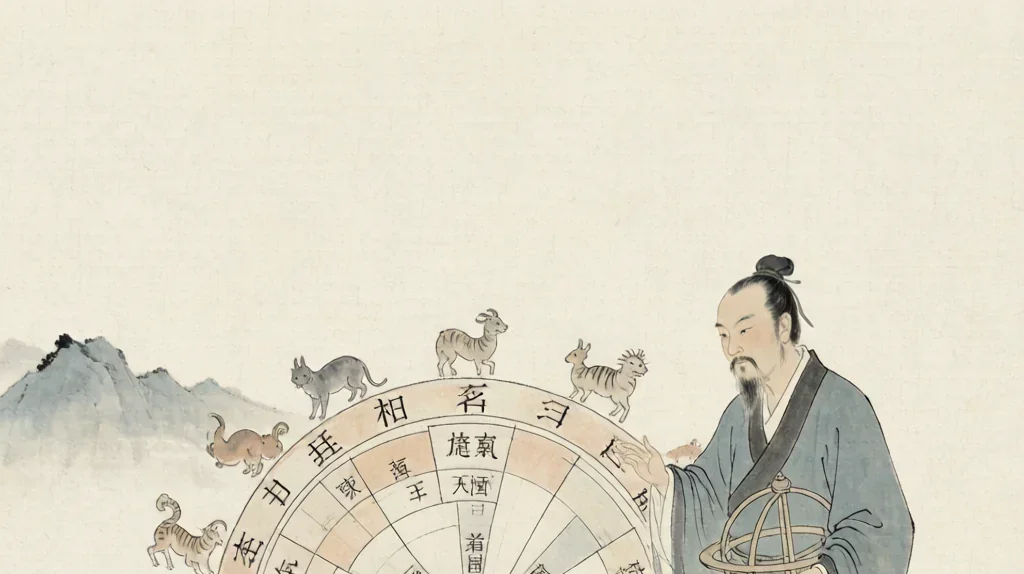
The Liushi Jiazi (六十甲子, "Sixty Jiazi") is the traditional Chinese sexagenary cycle, a rotating system of sixty unique pairings used for counting years, months, days, and hours across the calendar. It combines ten "Heavenly Stems" (天干, tiāngān) with twelve "Earthly Branches" (地支, dìzhī) in a fixed order that repeats every sixty units. Far older than the Gregorian year-numbering we use today, this cycle still names each Lunar New Year—marking, for instance, a "Wood Dragon" or "Fire Rat" year—and appears on almanacs, tomb inscriptions, and horoscopes. Understanding the Liushi Jiazi opens a window onto how classical China measured and imagined time itself.
The Heavenly Stems
The ten Heavenly Stems are: 甲 (jiǎ), 乙 (yǐ), 丙 (bǐng), 丁 (dīng), 戊 (wù), 己 (jǐ), 庚 (gēng), 辛 (xīn), 壬 (rén), 癸 (guǐ). Originally tied to the growth cycle of plants—from sprouting to withering—they later acquired the five phases (wood, fire, earth, metal, water), each phase appearing twice per stem cycle with a yin and yang version.
The stems are abstract and largely limited to calendrical and bureaucratic use. Historically they also numbered ranks and documents. On their own they do not name animals; their meaning is unlocked only when paired with the Earthly Branches.
The Earthly Branches
The twelve Earthly Branches are: 子 (zǐ), 丑 (chǒu), 寅 (yín), 卯 (mǎo), 辰 (chén), 巳 (sì), 午 (wǔ), 未 (wèi), 申 (shēn), 酉 (yǒu), 戌 (xū), 亥 (hài). Each corresponds to an animal of the zodiac, an old Chinese double-hour of the day, and a direction. They are the more familiar half of the system thanks to the zodiac.
Beyond the zodiac, the branches structured the day into twelve two-hour periods and helped lay out space in feng shui and acupuncture. Their dual role as time and space markers made them a versatile scaffolding for classical science and ritual.
How the Cycle Is Built
Because ten and twelve share only the factor two, their least common multiple is sixty. Pairing them sequentially—甲子, 乙丑, 丙寅, and so on—produces sixty distinct combinations before the pattern resets at the sixty-first (甲子 again). This is the Liushi Jiazi.
The mismatch is the point: the stems cycle six times and the branches five times within one sexagenary round. The resulting table is memorized by schoolchildren in imperial times and consulted like a multiplication table, a calendar engine built from two small series.
Historical Use in Dating
Before widespread era-numbering, Chinese records dated events by reign year plus the sexagenary year. Tomb bricks, bronze inscriptions, and official histories thus carry sequences like "the year of 庚子." Modern scholars decode these to absolute years when reconstructing chronology.
The system's longevity is remarkable: it was already standard by the Han dynasty and remains in living use. A person's birth year in the cycle is still noted on some documents and is fundamental to traditional astrology and matchmaking.
The Zodiac Animals
Each Earthly Branch carries a zodiac animal: Rat, Ox, Tiger, Rabbit, Dragon, Snake, Horse, Goat, Monkey, Rooster, Dog, Pig. The animal year rotates independently of the stems, so a "Dragon year" recurs every twelve years but only a "Wood Dragon" every sixty.
This layering gives each sixty-year cohort a unique signature. People speak of sharing a "benming year" (本命年, the return of one's birth animal), considered auspicious yet requiring caution, often marked by wearing red.
Stem-Branch in Almanacs and Daily Life
The traditional almanac (黄历, huánglì) prints the stem-branch for every day and uses it to judge auspicious activities—marriages, travel, groundbreaking. Choosing a "good day" meant reading the branch against the task.
Farmers, physicians, and diviners all consulted the cycle. Acupuncturists tracked the branch-hour of treatment; farmers timed sowing to stem-phase. The Liushi Jiazi was less a clock than a quality-of-time index, grading each moment as favorable or not.
Elemental and Yin-Yang Layer
Each stem carries a phase (wood, fire, earth, metal, water) and a yin or yang polarity, so every year in the cycle has a full profile: e.g., 甲子 is "Yang Wood Rat," 乙丑 "Yin Wood Ox." This enriches fortune-telling and the naming of years in popular speech.
The five phases rotate through the ten stems twice, while the twelve branches alternate yin-yang naturally. The combined profile is what gives, say, a "Fire Horse" year its reputation (traditionally tricky for girls' births), showing how the abstract math fed social belief.
Use in Astrology and Destiny Calculation
Four Pillars of Destiny (八字, bāzì, "eight characters") astrology records a person's birth by stem-branch for year, month, day, and hour—eight characters total. This chart is the basis for traditional character and compatibility readings.
Matchmakers historically compared the bāzì of bridal candidates to avoid clashing elements. Though questioned today, the practice persisted well into the modern era and remains a service offered by traditional consultants.
Modern Survival of the Cycle
The Liushi Jiazi survives in the naming of Lunar New Year animals with their element (e.g., "Year of the Water Rabbit"), on calendars sold each spring, and in the formal dating of traditional festivals. It is taught in schools as cultural heritage rather than a working clock.
In daily conversation, older speakers may still identify a year by its stem-branch, and historians depend on the cycle to date pre-modern sources. The sixty-year frame thus bridges ancient record-keeping and contemporary identity, a quiet survivor of imperial timekeeping.
The Cycle in Historical Chronology
Because the sexagenary cycle repeats, historians combine it with reign names and the Gregorian calendar to fix absolute dates. A record "the winter of 甲午" can be pinned once the reign is known, letting modern scholars reconstruct timelines across dynasties with confidence.
This marriage of cycle and reign era produced a remarkably stable dating language lasting two thousand years. Even after 1949, when the Republic's year-numbering and later the Common Era became standard, the stem-branch year stayed in almanacs and folk speech, a continuity rare in any calendrical tradition.
❓ Frequently Asked Questions
What is the Liushi Jiazi?
It is the sixty-year sexagenary cycle formed by pairing ten Heavenly Stems with twelve Earthly Branches in a fixed sequence that repeats every sixty units.
Why does the cycle have sixty, not ten or twelve, units?
Because ten and twelve share only the factor two, their least common multiple is sixty, so the stem-branch pairings only repeat after sixty distinct combinations.
How is the cycle used today?
It names each Lunar New Year with its animal and element (e.g., Water Rabbit) and appears on almanacs and festival calendars as cultural heritage.
What are the Earthly Branches?
They are twelve signs (子 through 亥), each linked to a zodiac animal, a two-hour period of the day, and a direction.
What is bāzì (Eight Characters)?
Bāzì is destiny astrology recording a person's birth by stem-branch for year, month, day, and hour—eight characters used for character and compatibility readings.
What is a benming year?
A benming year is the return of your birth animal in the twelve-year zodiac rotation, traditionally a sensitive year often marked by wearing red for protection.