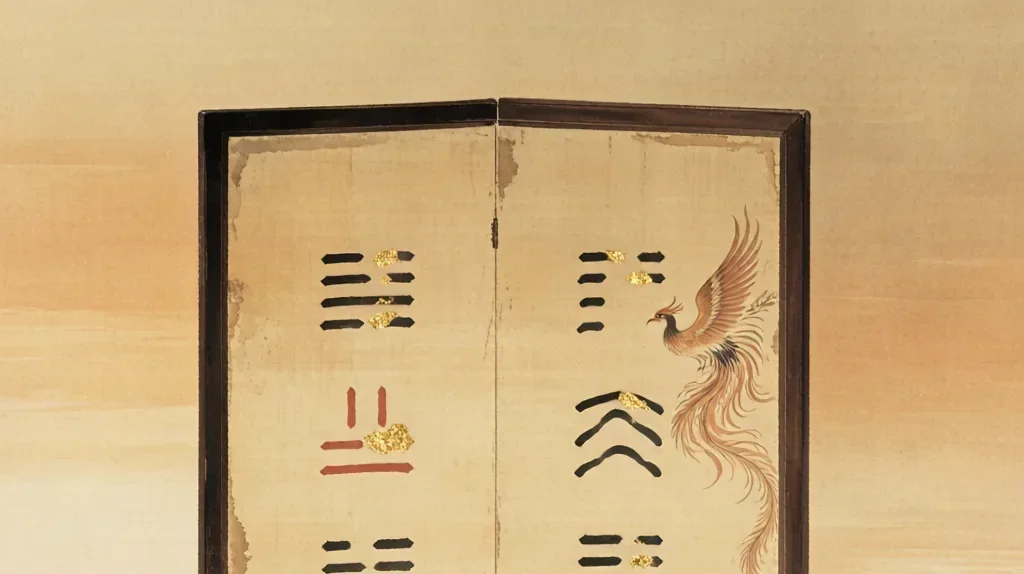
The Bagua (八卦, bāguà), or "Eight Trigrams," is a foundational symbolic system in Chinese cosmology, formed from combinations of broken and unbroken lines representing the primal energies of the universe. Each trigram pairs three lines—either solid (yang) or broken (yin)—to yield eight figures, each linked to a natural force, a direction, a family relation, and a host of associations. Rooted in the ancient classic the Yijing (Book of Changes), the Bagua underpins feng shui, martial arts, fortune-telling, and temple architecture. Far from a mere decoration, it is a map of how the Chinese imagination organizes the world into balanced, interacting parts.
The Eight Trigrams and Their Lines
Each trigram is built from three stacked lines. A solid line (—) is yang, active and bright; a broken line (--) is yin, receptive and dark. The eight possible combinations produce the trigrams: ☰ Qian (heaven), ☷ Kun (earth), ☵ Kan (water), ☲ Li (fire), ☳ Zhen (thunder), ☶ Gen (mountain), ☴ Xun (wind), and ☱ Dui (lake).
The order and stacking matter: the bottom line represents the near or inner, the top the far or outer. Reading a trigram from the bottom up reveals a mini-narrative of how energy moves. This simple binary grammar—just two line types—generates a surprisingly rich vocabulary for describing reality.
Natural and Symbolic Associations
Traditionally each trigram maps to a phenomenon: Qian to heaven and the father, Kun to earth and the mother, Zhen to thunder and the eldest son, Xun to wind and the eldest daughter, Kan to water and the middle son, Li to fire and the middle daughter, Gen to mountain and the youngest son, Dui to lake and the youngest daughter.
These correspondences let the Bagua function as a relational grid. A trigram is never isolated; it gains meaning through contrast with the others. Heaven pairs with earth, fire with water, thunder with wind, mountain with lake—each dyad expressing a complementary tension that keeps the cosmos in motion.
Origins in the Yijing
The Bagua is inseparable from the Yijing (易经, Book of Changes), one of the oldest Chinese texts, whose core is the system of 64 hexagrams made by stacking two trigrams. The classic attributes the trigrams' arrangement to the mythical ruler Fu Xi, who is said to have observed them in the patterns of nature.
Whether or not Fu Xi was historical, the Yijing's use of the Bagua for divination shaped Chinese thought for millennia. By the time of Confucius and the Warring States philosophers, the trigrams were already a shared framework for discussing change, governance, and self-cultivation.
The Two Arrangements: Earlier and Later Heaven
There are two canonical layouts. The "Earlier Heaven" (先天, Xiāntiān) sequence, associated with Fu Xi, places complementary trigrams opposite each other (Qian south, Kun north) and is used for cosmological and meditative purposes. The "Later Heaven" (后天, Hòutiān) sequence, linked to King Wen, rearranges them to reflect the seasonal and directional energies of the lived world.
Practitioners choose an arrangement by purpose. Feng shui and daily calendars lean on the Later Heaven map of earthly qi flow, while contemplative and cosmological work may use the Earlier Heaven's symmetric ideal. Knowing which is in play is essential to reading any Bagua diagram correctly.
Use in Feng Shui
In feng shui the Bagua is laid over a floor plan like a compass, assigning each trigram to a sector of a home linked to a life aspect—wealth, health, relationships, and so on. Adjusting objects in a sector is believed to influence the corresponding part of life by harmonizing its elemental energy.
The trigram affiliations (wood, fire, earth, metal, water) guide what colors and materials belong where. A practitioner might strengthen the southeast (Xun, wood, wealth) with a plant, or calm the south (Li, fire) with water imagery. The Bagua thus becomes a practical toolkit for ordering space.
Bagua in Architecture and Temples
The Bagua appears above doorways, on roof ridges, and carved into stone at temples and traditional homes, often as an apotropaic emblem to ward off harmful influence. A circular Bagua mirror is a common feng shui protective device facing the street.
In religious architecture the eight trigrams may decorate the base of a pagoda or the pavement of a sacred precinct, mapping the building onto the cosmic order. The intention is to align human construction with the patterns Fu Xi supposedly read in nature.
Bagua in Martial Arts
Bagua Zhang (八卦掌, Eight Trigram Palm) is a renowned internal martial art whose circular walking and palm changes are said to emulate the trigrams' transformations. Practitioners move in circles, shifting postures to express the shifting energies the Bagua describes.
The art's philosophy holds that, like the trigrams, the body should be adaptable and never fixed. This martial application shows the Bagua leaving the scholar's desk to become embodied practice—strategy and physiology framed by the same eight figures.
Bagua Mirrors and Folk Protection
A widely seen folk object is the Bagua mirror, a circular mirror backed by the eight trigrams, hung outside a door to reflect and deflect negative energy. Its use is prophylactic rather than decorative, part of a large repertoire of protective charms.
While feng shui professionals caution against misuse, the Bagua mirror remains a vivid example of how an abstract cosmological symbol enters daily protective habit, hanging on apartment doors in cities as readily as on village gates.
Modern and Popular Culture
Today the Bagua is instantly recognizable in logos, jewelry, tattoos, and pop-media depictions of "Chinese mysticism." It appears in films and games as a shortcut for Taoist magic or fortune-telling, sometimes loosely.
Yet genuine study persists in feng shui consultancy, Yijing scholarship, and internal martial arts schools worldwide. The symbol's migration into global visual culture has not erased its serious roots in classical Chinese cosmology.
❓ Frequently Asked Questions
What is the Bagua?
The Bagua (八卦) is the set of eight trigrams, each made of three stacked solid or broken lines, representing fundamental energies and used in the Yijing, feng shui, and martial arts.
What do the solid and broken lines mean?
A solid line is yang (active, bright) and a broken line is yin (receptive, dark); the eight combinations of three lines form the trigrams.
How are the eight trigrams used in feng shui?
The Bagua is overlaid on a floor plan so each trigram governs a sector linked to a life aspect like wealth or health, guiding adjustments to harmonize energy.
What is the difference between Earlier and Later Heaven?
The Earlier Heaven arrangement (Fu Xi) is cosmological and symmetric; the Later Heaven arrangement (King Wen) reflects seasonal and directional energies of the lived world.
Why is the Bagua on doors and mirrors?
It is placed there as a protective emblem to align buildings with cosmic order and, as a mirror, to deflect negative influences from the street.
What is Bagua Zhang?
Bagua Zhang (Eight Trigram Palm) is an internal martial art using circular walking and palm changes said to mimic the transformations of the eight trigrams.