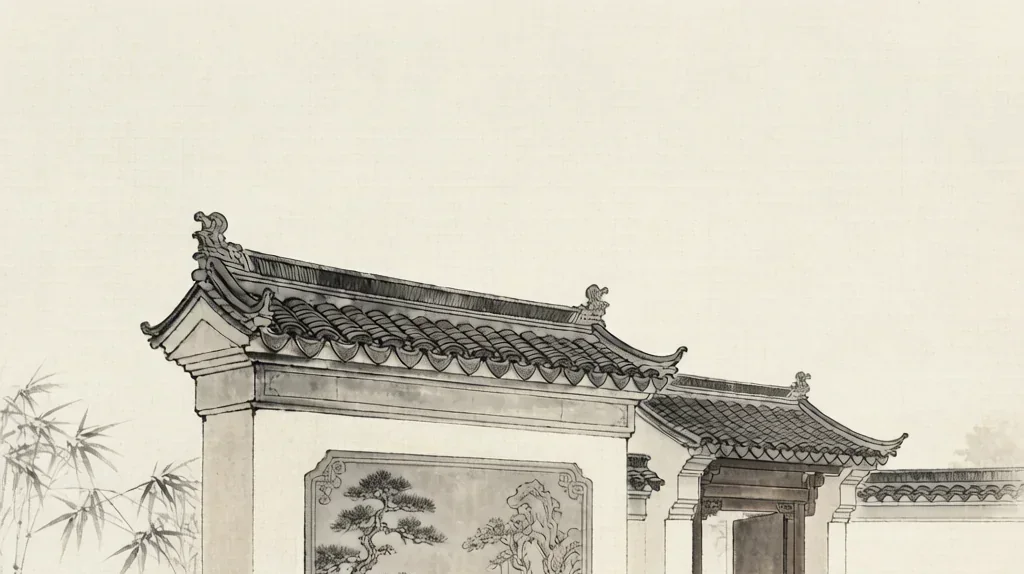
The screen wall (影壁, yǐngbì), also called a spirit screen or ghost wall, is a distinctive feature of traditional Chinese architecture: a freestanding wall placed just inside or outside a gate to block the straight line of sight into a courtyard. More than a privacy device, it is a threshold guardian rooted in geomancy and folk belief, meant to keep wandering spirits out and to gather auspicious energy within. Found at palaces, temples, mansions, and humble homes alike, the screen wall shows how Chinese building blends practicality with cosmology. This article examines its form, meaning, and place in the built environment.
Form and Placement
A screen wall is a wall set perpendicular to the entrance axis, so that a visitor cannot see directly into the main court. It may stand outside the gate (外影壁) facing the street, or inside the gate (内影壁) within the first courtyard. Both variants serve the same interrupting function.
Constructed of brick, stone, or wood with a tiled roof, the wall is usually modest in height—tall enough to block sight but not to loom. Its surface is the canvas for decoration, making even a small wall a focal point of the entrance sequence.
Spirit Barrier and Geomancy
The core belief is that malicious or lost spirits travel only in straight lines and cannot turn corners. A screen wall forces any entering force to veer, thus deflecting harmful influence away from the family. This practical-geomatic logic explains the wall's near-universal presence.
Feng shui reinforces the idea: a straight approach lets "sha qi" (cutting energy) strike the home, while a wall slows and redirects flow, keeping the interior calm. The screen wall is therefore an early, architectural line of defense in the home's energy plan.
Privacy and Sequence
Beyond the spiritual, the wall gives privacy. In dense courtyard houses (四合院, sìhéyuàn), it prevents passersby from glimpsing domestic life and creates a moment of pause before entry, a small procession from public to private.
This threshold choreography—gate, wall, turn, court—shapes how one experiences the home. The wall is the first "room" one enters without entering, a buffer that prepares the visitor and protects the residents.
Decorative Panels and Motifs
The street-facing side of a screen wall is often richly ornamented. Common motifs include the character 福 (fortune), a coiled dragon, a running horse, or floral medallions. Glazed tile and carved brick turn the wall into a public statement of taste and status.
Some walls carry a single large character or a cosmological diagram such as the Bagua, extending the protective function into the visual. The decoration is never merely pretty; it is part of the wall's job of warding and welcoming.
The Nine-Dragon Wall
The most famous screen walls are the glazed "Nine-Dragon Walls" (九龙壁, jiǔlóngbì), especially the ones in Beijing (Beihai Park and the Forbidden City) and Datong. These monumental walls display nine coiling dragons in colored glaze, symbols of imperial power.
Originally serving palace gateways, the nine-dragon walls elevated the screen from household charm to state spectacle. They remain among the most admired works of Chinese ceramic architecture and draw visitors as much as any hall.
Screen Walls in Palaces and Temples
Imperial complexes used large screen walls to separate sacred or royal space from the ordinary street, marking the boundary of the extraordinary. At temple gates a screen wall keeps the profane world at bay before one crosses into the divine precinct.
The scale varies with the institution, but the principle is constant: the wall announces that beyond it lies a different order of space. Even a village shrine may have a small version, democratizing the cosmic boundary.
Materials and Regional Styles
Northern screen walls favor gray brick with carved relief and tiled roofs, suiting the courtyard-house climate. Southern and garden versions may use whitewashed plaster with painted scenes, blending into the softer garden aesthetic.
In Suzhou and other garden cities the screen wall migrates into the landscape as a freestanding decorated panel framing a view, showing how a protective form can become purely ornamental without losing its identity.
Modern Survival
Though few new courtyard houses are built, screen walls survive in restored historic districts, restaurants, and hotels that echo traditional entrance sequences. A modern lobby may place a decorative screen where the old wall stood, keeping the welcoming pause.
The form also travels: Chinese-style gardens abroad often include a screen wall as an instantly readable sign of "Chinese space." The wall's meaning—threshold, protection, revelation in turn—translates across cultures.
Screen Walls and Social Status
The size and ornament of a screen wall tracked a family's standing. A plain brick wall suited a modest home; a glazed, dragon-carved wall announced official rank or wealth. The entrance thus advertised position before a word was spoken.
Yet the form was forgiving: even poor households set a low wall of earth or woven fence to keep the threshold rite. The screen wall was democratic in function even when aristocratic in its grandest examples, a small equalizer of privacy across classes.
Screen Walls Beyond the Home
The screen principle extends to restaurants, banks, and modern lobbies, where a decorative panel blocks the door's line of sight just as the old wall did. The function—pause, protect, reveal—survives even without belief in wandering spirits.
In feng shui consultations the "screen" is still recommended at troublesome entrances, showing the form's practical logic outlasted its myth. A well-placed barrier remains good design, proving the ancients' instinct was as much ergonomic as magical.
Screen Walls in Village Life
In rural courtyards the screen wall often doubled as a message board, its plaster surface painted with slogans or good wishes for the season. The wall's visibility made it the natural place to address the community.
A village's screen wall thus recorded changing times—from old auspicious characters to modern maxims—while keeping its protective role. The form absorbed new messages without losing its old job, a durable piece of social furniture.
❓ Frequently Asked Questions
What is a Chinese screen wall?
A screen wall (影壁) is a freestanding wall at a gateway that blocks the straight view into a courtyard, serving privacy, geomancy, and spirit protection.
Why does it block the sightline?
Folk belief holds that harmful spirits move only in straight lines and cannot turn corners, so the wall deflects them; feng shui says it slows cutting energy (sha qi).
Where is it placed?
Either outside the gate (外影壁) facing the street or inside the gate (内影壁) in the first courtyard, both interrupting the entrance axis.
What are the Nine-Dragon Walls?
They are monumental glazed screen walls showing nine coiling dragons, found in Beijing (Beihai and Forbidden City) and Datong, symbols of imperial power.
What decorations appear on screen walls?
Common motifs include the character 福, dragons, horses, floral medallions, or a Bagua diagram, executed in carved brick or glazed tile.
Do screen walls still exist today?
Yes—in restored historic districts, traditional-style restaurants and hotels, and Chinese gardens abroad, where they keep the welcoming threshold pause.