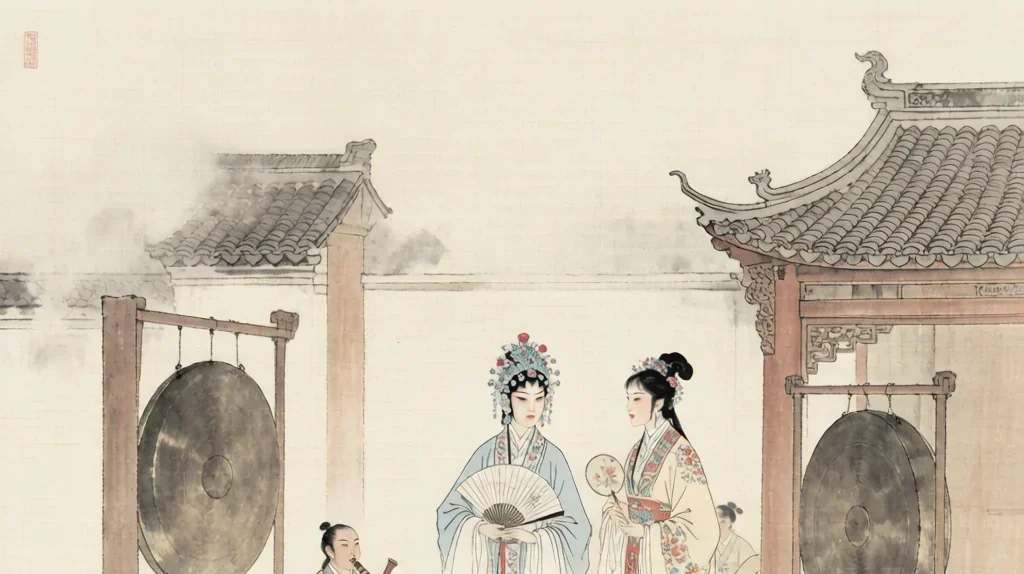
Chaoju, or Cháo Jù (潮剧), is the opera of the Teochew (Chaozhou) people, a slender musical tradition from the coastal corner of eastern Guangdong that has outlived dynasties and crossed oceans. Sung in the soft, ancient Chaozhou dialect and accompanied by a chamber of strings and a single deep drum, Chaoju is often called one of the oldest living forms of Chinese opera, carrying melodies and staging ideas that reach back toward the Southern Drama of the Song and Yuan. For the Teochew diaspora scattered across Thailand, Singapore, Malaysia, and beyond, Chaoju is more than entertainment; it is a sonic passport home, performed at temple festivals and clan gatherings wherever the dialect is spoken. To hear Chaoju is to hear a community remembering itself.
Roots in the Southern Drama and Local Speech
Scholars trace Chaoju's ancestry to the nanxi (南戏), or Southern Drama, that flourished in the Wenzhou region during the Southern Song dynasty and spread along the southeastern coast. As those early plays traveled into Fujian and then into the Chaozhou prefecture, they were reworked in the local tongue and fused with indigenous folk song and puppetry. By the Ming dynasty a recognizable "Chaozhou tune" (潮调) existed, and during the Qing it crystallized into the full opera we call Chaoju. Its conservative nature preserved features—such as certain aria structures and the use of a male falsetto—that vanished from other forms, making it a treasure house for historians of theatre.
The Chaozhou dialect itself is the soul of the art. One of the most archaic and musical of Chinese speech forms, it preserves sounds closer to ancient Chinese than Mandarin does, and Chaoju singers shape their arias to exploit its tonal contours. An audience member who does not speak Teochew may still be moved by the rising and falling lines, but for a native listener the words carry layered meaning that the melody alone cannot.
The Instruments and the Sound of Chaozhou
Chaoju's orchestra is famously intimate. At its heart are the erxian (二弦), a leading fiddle with a bright, reedy voice, and a battery of plucked and bowed strings including the yueqin and the zheng (zither). Percussion is led by the deep "big drum" (大鼓) and a set of clappers, with gongs and the small, crisp "dog-bark" drum marking dramatic beats. Unlike the blaring brass of some northern forms, Chaoju's color comes from strings, giving it a chamber-music delicacy suited to the close-air temple stages of the south.
A distinctive feature is the choral hum that closes many arias, when the offstage musicians join in a wordless "ah" that seems to lift the drama into the realm of ritual. Combined with the leader's falsetto, this creates an otherworldly timbre unlike any other Chinese opera. The whole ensemble serves the voice, never drowning it, so that a single phrase of longing can hang in the warm evening air of a village festival.
Repertoire and the Teochew Imagination
Chaoju's plays draw heavily on the shared storehouse of Chinese legend: the romances of the Three Kingdoms, the exploits of the Yang family generals, and the grieving wives of the "two queens" tales. Yet it also keeps a body of pure Chaozhou stories, comic skits about matchmakers and miserly merchants that mirror local life. The famous Chen San and Wu Niang (陈三五娘) is a beloved Chaoju romance of a scholar who wins his love through disguise and perseverance, performed for centuries at spring festivals as a hymn to youthful devotion.
Staging is restrained and elegant. Movement is less acrobatic than in Peking opera; the emphasis falls on lyric beauty and the refined gestures of the dan and the scholarly sheng. Puppets, too, are part of the tradition—Teochew rod-puppet theatre shares the same plays and music—so that the line between human and wooden performer has always been porous in this region.
Migration and the Overseas Teochew Community
Beginning in the nineteenth century, waves of Teochew emigrants carried Chaoju with them to the ports of Southeast Asia, where it became the entertainment of choice in clan halls and at the hungry-ghost festivals. In Bangkok, Singapore, and Penang, professional troupes from China once toured year-round, and wealthy families hired opera troupes for weddings and funerals. The dialect bound emigrants together across hostile borders, and a Chaoju performance could summon the fog and rice fields of home more powerfully than any letter.
Today the overseas audience has grayed, and troupes are fewer, but revival efforts by cultural associations keep the form alive in diaspora cities. In Thailand, where people of Teochew descent form a large part of the Chinese community, Chaoju still appears at major temple fairs, a living bond between a diaspora and its southeastern coastal homeland.
Preservation and the Modern Stage
In mainland China, Chaoju is safeguarded as a national intangible cultural heritage, with a state troupe in Chaozhou and training schools that pass the difficult falsetto and dialect libretti to new generations. Modern productions sometimes trim the all-night temple format into a manageable evening show and add subtle lighting, yet the core music remains stubbornly traditional. Scholars and recording projects race to document elderly performers before their knowledge fades, for the dialect itself is receding among the young.
Chaoju's future may lie precisely in its role as cultural memory. As a branch of the great tree of Southern Drama, and as the voice of one of the world's great trading diasporas, it offers something no global pop song can: a direct line to the songs sung on the southern coast eight hundred years ago. To protect Chaoju is to protect a working fragment of opera history still breathing on the stage.
The Voice and Training of a Chaoju Singer
Chaoju's signature sound depends on a singer trained from youth in the Chaozhou dialect and the art's unusual male falsetto. The falsetto is not a mere ornament but a structural feature carried over from the Southern Drama, used to lift arias into a bright, otherworldly register. Learners spend years matching pitch and breath to the erxian fiddle, since the voice must ride above the strings without ever overwhelming them. A choral hum closing many arias adds a ritual hush that only a well-rehearsed ensemble can produce. Because the dialect itself is receding among young speakers, training now doubles as language preservation: a singer must master not just notes but the tonal contours that carry meaning. This demanding apprenticeship is why Chaoju troupes guard their methods and why recording elderly masters has become urgent cultural work.
Staging Chaoju at Temple Festivals
Chaoju belongs to the open air as much as the stage. Across the Teochew homeland and the diaspora, the opera is a fixture of temple fairs and hungry-ghost festivals, where a troupe erects a temporary platform and plays through the night to music and incense. The setting shapes the art: without microphones, the singers project to a relaxed, moving crowd, and the intimate string-led ensemble suits the close, warm air. Such performances are communal rituals as much as entertainment, marking festivals and honoring ancestors while giving the whole village a reason to gather. In overseas Teochew communities the temple stage became a focal point of identity, a place where dialect, music, and memory met. Even trimmed for the modern evening show, Chaoju keeps this festive heart, reminding audiences that the opera was born to be heard together under the sky.
Chaoju Among the Southern Operas
Chaoju is one of several living descendants of the Southern Drama, the nanxi root that also fed Kunqu and other regional forms. What sets it apart is how much early structure it kept—certain aria shapes and the male falsetto survived here long after they faded elsewhere, making the opera a kind of preserve of medieval theatre. At the same time it absorbed local folk song and puppetry, so that its character is both ancient and distinctly Teochew. Scholars value Chaoju precisely because it lets them hear echoes of forms that no longer exist in pure form. Among the family of southern operas it is the quiet cousin: less acrobatic than some, more lyrical than most, and uniquely tied to a single dialect community. That combination of conservator and local voice explains why Chaoju, though small in scale, looms large in the history of Chinese theatre.
❓ Frequently Asked Questions
📝 Chinese Vocabulary
潮剧 — : Chaoju, the opera of the Teochew people.
潮州 — : Chaozhou, the eastern Guangdong homeland of the genre.
南戏 — : Southern Drama, the ancient root of Chaoju and many southern forms.
二弦 — : The erxian, Chaoju's bright leading fiddle.
陈三五娘 — : Chen San and Wu Niang, a beloved Chaoju romance.
潮调 — : the Chaozhou tune, an early name for the music
生 — : the male lead role type
旦 — : the female role type
🎉 Fun Facts
- Chaoju preserves a male falsetto singing style and choral hum that give it an otherworldly sound unlike any other Chinese opera.
- The Chaozhou dialect used in Chaoju retains sounds closer to ancient Chinese than modern Mandarin does.
- Teochew rod-puppet theatre shares the same plays and music as human Chaoju performers.
- Chaoju troupes once toured year-round in Bangkok, Singapore, and Penang serving the overseas Teochew community.
- Because the Chaozhou dialect is so distinctive, troupes from different cities can still be told apart by native listeners from slight musical and linguistic differences.
- Chaoju is often performed on makeshift outdoor temple stages during multi-day festivals, its music carrying for blocks through the warm night air.