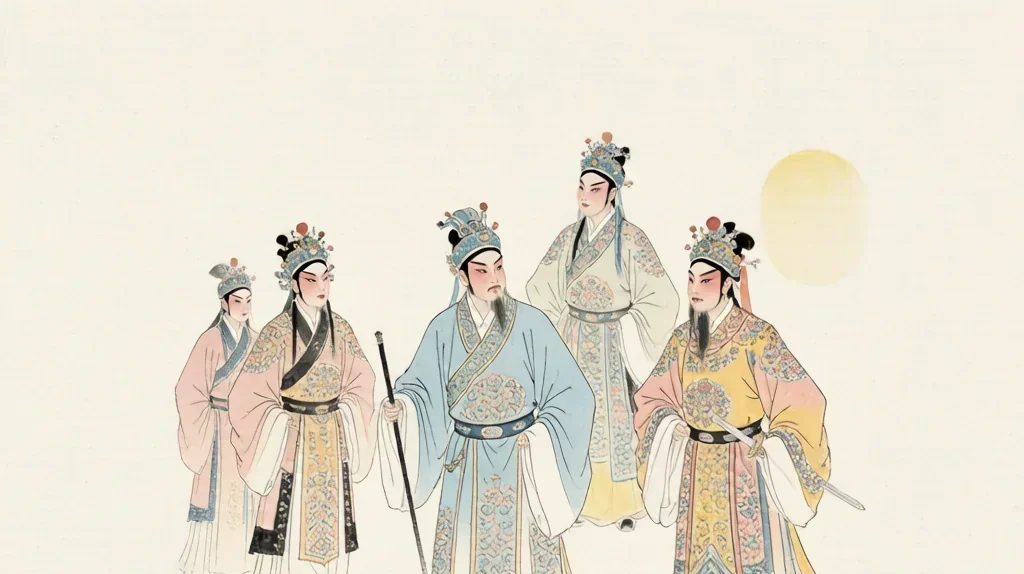
Huiju, or Huī Jù (徽剧), is the opera of Anhui that history remembers as the root of Peking opera. In 1790, to celebrate the eightieth birthday of the Qianlong Emperor, the famous "Four Great Anhui Troupes" (四大徽班) traveled north to Beijing, and from their meeting with the Han opera of Hubei there blossomed, within decades, the art the world now calls Jingju (京剧). Yet Huiju is far more than a parent; it is a complete, sophisticated opera in its own right, rich in gong-and-drum melodies, acrobatics, and a repertoire drawn from Anhui folk theatre. To study Huiju is to stand at the headwaters of the most famous Chinese opera and to meet the lively regional stream that still flows in the hills of southern Anhui.
The Four Great Anhui Troupes Go to Beijing
The pivotal moment came in the autumn of 1790, when the Sanqing (三庆) troupe, first of the Four Great Anhui Troupes, arrived in the capital to perform at the imperial birthday celebrations. They were followed by the Sixi (四喜), Chuntai (春台), and Hechun (和春) troupes, together known as the "Four Anhui Classes." Their songs—a mix of the melodic "erhuang" (二黄) tune and lively local airs—delighted Beijing audiences accustomed to older northern styles. The troupes stayed, established themselves in the capital's theatre district, and began a slow merger with other southern forms already present.
This was not a sudden invention but a convergence. The Anhui troupes were versatile, performing not only their own tunes but also kunqu, qinqiang, and miscellaneous local pieces, a flexibility that let them absorb the Han opera singers who arrived from Hubei. Over the early 1800s, the Anhui "erhuang" and the Hubei "xipi" fused into the "pihuang" (皮黄) system that became the musical foundation of Peking opera. Huiju was thus the seedbed, not the finished tree.
Musical Makeup: Erhuang, Gaobai, and More
Traditional Huiju is a "multivoice" opera, combining several melodic systems rather than a single mode. Its core is the erhuang tune, a steady, expressive melody carried by strings and gongs, but it also employs gaobai (高拨子), a brighter clapper-flavored tune, and kunqiang (昆腔) passages borrowed from kunqu for elegant scenes. The percussion is heavy and brilliant, with a large gong-and-drum battery that marks entrances, battles, and comic beats. This layered music gave Huiju a broader palette than strictly clapper or strictly kunqu forms.
Because Huiju borrowed freely, a single evening might move from a refined kunqu-style lyric to a thunderous battle sequence with full acrobatics. That variety was exactly what made the Anhui troupes so popular in Beijing, where audiences welcomed novelty. The same openness later let Jingju inherit a flexible, mixed-score tradition rather than a rigid one.
Repertoire and the Spirit of Anhui Theatre
Huiju's plays range across the full Chinese cycle: the victories and betrayals of the Three Kingdoms, the filial tales of the opera canon, and a wealth of Anhui folk stories rendered with earthy humor. Many works are "martial" (武戏), showcasing tumbling, swordplay, and stage combat that the Anhui troupes famously perfected and later passed to Peking opera's acrobatic wing. Comic pieces, too, are central, often built around the chou (clown) role and local dialect jokes that anchor the high tales in village reality.
A hallmark of Huiju staging is its integration of song, speech, and pure movement. A general may enter with a stylized walk, deliver a rhymed speech, break into an erhuang aria, and then launch into a combat sequence—all within one scene. This total-theatre approach became a defining feature of the Peking opera that grew from it, so that watching Huiju today is like watching Jingju with the courtly polish washed off.
Huiju and the Birth of Peking Opera
The standard account holds that "Hui melded with Han" (徽汉合流) in Beijing during the early nineteenth century, producing a new synthesized opera by the 1820s–1840s. The Anhui contribution was the erhuang melody and a tradition of strong troupe organization; the Han contribution was the xipi melody and a system of role classification. Add the capital's own taste and the patronage of officials and merchants, and the result was a brilliant new form centered in Beijing—Jingju—which by the late Qing had eclipsed its parents in fame.
Crucially, Huiju did not "become" Peking opera and vanish; rather, the two coexisted, with Hui troupes continuing to tour the south while their northern offspring conquered the empire. Understanding this helps correct a common simplification: Huiju is not merely an ancestor to be filed away, but a living regional opera that lent its blood to a greater child.
Huiju Today: A Root Preserved
In the twentieth century Huiju declined as Peking opera dominated, and many of its old scores were lost. Recognizing its historical importance, the Chinese state listed Huiju as a national intangible cultural heritage and supported revival troupes in Anhui, especially in the Shexian and Wuyuan areas. Scholars and elders have worked to reconstruct lost arias from the memories of aging performers, and festivals now stage Huiju alongside its famous descendant to show the lineage plainly.
For the curious traveler, hearing Huiju is a chance to hear Peking opera's "before." The erhuang still sounds familiar, yet the gongs are looser, the comedy earthier, the whole affair closer to the teahouse than the court. In preserving Huiju, China preserves not just a regional art but the open, mixing moment when southern tunes first met in Beijing and changed Chinese theatre forever.
Regional Variations of Huiju
Although Huiju is spoken of as a single tradition, it survives in regional shades shaped by the hills and towns of southern Anhui. Theaters around Shexian and Wuyuan preserve older aria forms and local pronunciation, while troupes nearer the Yangtze absorbed more urban sounds. These variants share the same erhuang core and the same love of gong-and-drum percussion, yet they differ in tempo, ornamentation, and the balance between kunqu-style lyrics and clapper drive. Scholars value this variety because it shows Huiju not as a finished script but as a living, mixing region where southern tunes met and blended. Modern revival efforts deliberately record elders from different localities so that the distinct local colors are not flattened into one standard score. In this way the opera's famous openness, the very quality that once let it absorb Han opera in Beijing, is kept alive at home.
Huiju Costumes and Stagecraft
Huiju staging sits between the spare symbolism of Kunqu and the polished spectacle of Peking opera, closer to the teahouse than the court. Costumes are traditional but functional, built for tumbling and swordplay as much as for beauty, since martial plays were a Huiju specialty. The painted face appears on generals and bandits, using the same color logic later seen in Peking opera, while the clown carries a white nose-dab for comic business. Stagecraft favors total theatre: an entrance, a rhymed speech, an aria, and a combat sequence can follow one another within a single scene. Percussion cues the action, with the gong-and-drum battery marking battles and beats of humor. Watching Huiju today feels like seeing Peking opera with its courtly polish washed off, a reminder that the greater child inherited both the melodies and the rough, physical energy of its parent.
Huiju's Influence on Other Regional Operas
Huiju's historical importance rests less on its current size than on what it gave to Chinese theatre as a whole. Its erhuang melody and its tradition of strong, versatile troupes seeded the pihuang system that became Peking opera, and its acrobatic martial plays passed directly into the northern combat repertoire. Beyond Beijing, Huiju's willingness to borrow kunqu, qinqiang, and local airs modeled a flexible, mixed-score approach that many regional operas later imitated. The phrase often used for it, the root of Peking opera, understates the case: Huiju was a mixing chamber where southern and northern musics met before flowing into numerous forms. Recognizing this, revival troupes in Anhui now stage Huiju beside its famous descendant so audiences can hear the lineage plainly, preserving not just a regional art but the open moment when Chinese opera first found its common sound.
❓ Frequently Asked Questions
📝 Chinese Vocabulary
徽剧 — : Huiju, the Anhui opera and root of Peking opera.
四大徽班 — : The Four Great Anhui Troupes that went to Beijing in 1790.
二黄 — : Erhuang, the core Anhui melody merged into Peking opera.
皮黄 — : Pihuang, the combined xipi-erhuang system of Beijing opera.
徽汉合流 — : "The fusion of Hui and Han," the birth of Peking opera.
高拨子 — : Gaobai, a bright clapper-flavored melody used by Huiju alongside erhuang.
昆腔 — : Kunqiang, the elegant kunqu-style passages Huiju borrowed for refined scenes.
西皮 — : Xipi, the Hubei melody that fused with Huiju's erhuang to form the pihuang system.
🎉 Fun Facts
- The Anhui troupes were so versatile they performed kunqu, qinqiang, and local airs alongside their own tunes, which helped them absorb other styles in Beijing.
- Huiju perfected the acrobatic "martial" plays that later became a signature of Peking opera's combat scenes.
- The 1790 imperial birthday that brought the troupes north was for the Qianlong Emperor's eightieth year.
- Modern Huiju troupes in Anhui still stage the old erhuang arias to show the living source of Jingju.
- The chou clown role delivers much of Huiju's humor through local dialect jokes, keeping the opera rooted in village life rather than court formality.
- Huiju troupes were among the first regional companies to settle permanently in Beijing, helping turn the capital into a national opera hub.