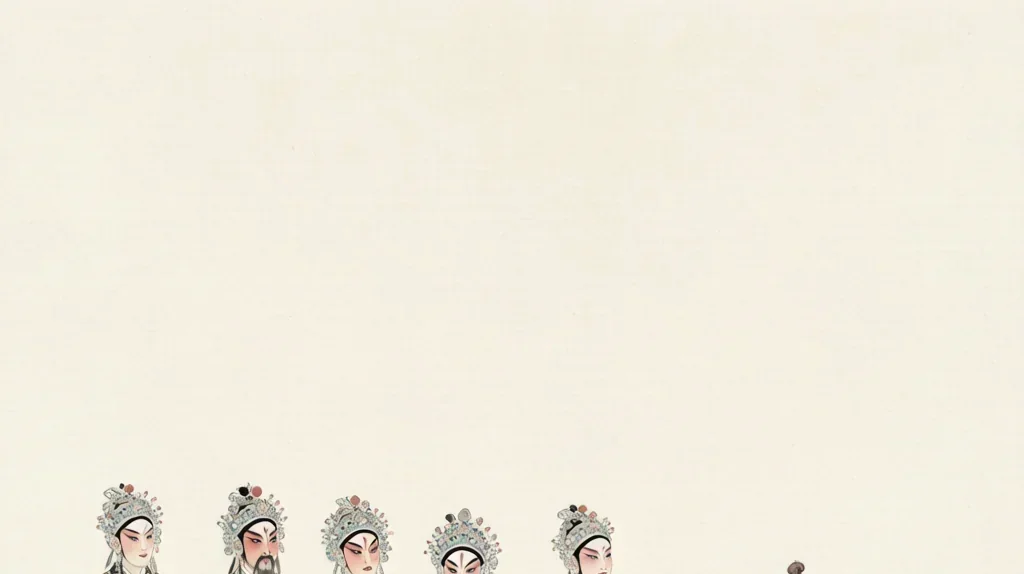
Hanju, or Hàn Jù (汉剧), is the opera of Hubei and one of the senior members of the Chinese theatrical family, a graceful, ancient form that supplied the crucial "xipi" (西皮) melody to the mixture that became Peking opera. Long known in the Yangzi middle basin as Chu tune (楚调) and Han tune (汉调), Hanju matured centuries before its northern fame, with a refined system of ten role types and a repertoire prized for both lyric beauty and comic wit. When Hubei singers joined the Anhui troupes in Beijing in the early nineteenth century, their xipi fused with Anhui's erhuang to form the pihuang core of Jingju. To know Hanju is to know the southern half of the recipe that cooked up China's best-known opera, and to meet a venerable art that still sings along the banks of the Han and Yangzi rivers.
Ancient Name and Hubei Heartland
Hanju's homeland is the floodplain of the Han River where it meets the Yangzi at Wuhan, the great triple city of Hubei. For centuries it was called Chu tune or Chu opera (楚调), echoing the ancient Chu state whose songs were already famous in the poems of the south. Local actors developed a style of "xiangyang" and "jinghu" fiddle music that, by the Ming and Qing, was recognized as a distinct Han tune. Troupes traveled up and down the Yangzi, from Hankou's bustling ports to the markets of Sichuan and Jiangxi, planting the form widely before it ever reached the capital.
What marked Hanju early was its balance. Unlike the bombastic clappers of the north or the rarefied kunqu of the south, Hanju offered melody that was singable and speech that was witty, a middle path suited to the commercial cities of the Yangzi. This sociability made it the favorite of merchants and boatmen, and gave it the confidence to later teach Beijing a new tune.
The Ten Role Types (Yimo Shiza)
A defining feature of Hanju is its classic classification of roles into ten categories, remembered in the phrase "yimo shiza" (一末十杂, "one mo to ten za"). These range from the grave old male (mo, 末) and the young scholar (sheng, 生), through the various female (dan, 旦) ranks, to the painted-face (jing, 净) and the clown (chou, 丑), ending in the miscellaneous "za" (杂) characters. This fine-grained system influenced how later operas, including Peking opera, organized their stages, and it shows Hanju's long, careful cultivation of character types.
Each role carried its own vocal timbre and movement vocabulary. The mo sang with dignified depth, the dan with bright clarity, the jing with explosive power, and the chou with quick comic patter. A full Hanju troupe could thus mount any story in the canon, from solemn history to slapstick, with specialists for every human type—a versatility that made Hubei singers welcome guests in Beijing's mixed troupes.
The Xipi Melody and the Making of Peking Opera
Hanju's single greatest gift to Chinese theatre is the xipi tune, a bright, flowing melody built on a different mode from Anhui's erhuang. When Hubei performers brought xipi north and joined the Anhui troupes already in Beijing, the two melodies interlocked: a play might move from an erhuang section (calm, narrative) to a xipi section (brisk, emotional), giving composers a powerful contrast. This "pihuang" union is the musical skeleton of Peking opera, and Hanju provided exactly half of it.
Scholars stress that Peking opera did not descend from Huiju alone; the Han contribution was essential and co-equal. The phrase "Hui melded with Han" (徽汉合流) names a partnership in which Hubei supplied the xipi and much of the role system, while Anhui supplied the erhuang and the troupe structure. Hanju's place in the family tree is therefore not as a footnote but as a founding parent.
Repertoire: Lyric, Comic, and Historical
Hanju's plays draw on the same great storehouse as other operas—the Three Kingdoms, the Yangzi water margins, palace intrigues—but it is especially loved for its "erduan" (二黄) and xipi arias of parting and longing, and for its robust comedy. The clown roles deliver satirical jabs at greedy officials and pompous scholars in the Wuhan dialect's quick rhythms, while the dan roles sing some of the most tender lines in the regional repertoire. Historical plays about the Han and Chu struggle (the Chu-Han contending) suit the opera's deep local memory of the Chu heartland.
Stagecraft in Hanju favors clarity over spectacle. A scene is built so the words carry the meaning; gesture supports rather than replaces the text. This literary care made Hanju a bridge between the bookish kunqu and the rowdy clappers, and it is one reason the form was respected even by the capital's connoisseurs.
Hanju in the Modern Era
Like many regional operas, Hanju faced decline as Peking opera and later film drew audiences away, but it never disappeared. Wuhan remains a center with professional Hanju troupes, and the art is recognized as a national intangible cultural heritage. Revival work focuses on recording the ten-role system before elderly masters pass, and on staging the classic xipi arias that show the Hubei half of Peking opera's DNA. New plays sometimes address modern themes while keeping the fiddle and the role types intact.
For anyone tracing Chinese opera's genealogy, Hanju is the southern keystone. Stand by the Han River and you can still hear the xipi line that traveled north two centuries ago and returned, transformed, as the music of emperors—proof that the middle Yangzi, not only Beijing, authored the sound the world calls Chinese opera.
The Instruments of Hanju
Hanju's sound is carried by a small, agile ensemble built around string and percussion. The jinghu, a high-pitched fiddle, leads the melody, its bright voice suited to the xipi tune's flowing lines, while plucked lutes and a lower fiddle fill out the texture. A percussion section of drums, clappers, and gongs marks scene changes and underscores emotion, but the music is never overwhelmed by brass the way some northern forms are. This string-centered balance gives Hanju a lyrical, singable quality that suited the merchant cities of the Yangzi, where the opera grew up. The instrumentalists also act as a kind of Greek chorus, setting the pace and cueing the singers through long arias. Together the fiddle and the clappers make a sound that is at once refined and sociable—the musical signature of Hubei that traveled north and helped author Peking opera.
Hanju on the Beijing Stage
The decisive moment in Hanju's history came in the early 1800s, when Hubei singers joined the Anhui troupes already performing in Beijing. The capital had never heard xipi sung with such brightness, and audiences took to the new blend quickly. What followed was a creative merger rather than a conquest: Hubei supplied the xipi melody and a finely graded role system, Anhui supplied the erhuang melody and the company organization, and the two together produced the pihuang score that became Peking opera's skeleton. For a time the forms were nearly indistinguishable on the Beijing stage, with performers moving between them freely. Only later did Peking opera consolidate its own identity and fame. Hanju's role in this story is thus foundational, not incidental: without the Hubei voice in that Beijing mix, the opera the world calls Chinese might sound entirely different today.
Hanju's Chu Heritage
Long before it was called Hanju, the opera of Hubei carried the name Chu tune, a nod to the ancient Chu state whose songs were already celebrated in southern poetry more than two thousand years ago. That Chu inheritance shaped the form's temperament: a love of lyric melody, a taste for wit, and a deep local memory of the Yangzi heartland. Hanju's historical plays about the Chu-Han struggle draw directly on this regional past, letting audiences hear their homeland's old stories sung back to them. The connection also explains why Hanju felt at home on boats and in river ports, traveling the Yangzi as a kind of floating Chu culture. Even after the music evolved into a distinct Hubei tune, the Chu echo remained—in the dialect, the repertoire, and the temperament. To hear Hanju is therefore to hear an unbroken thread running from the songs of antiquity to the stages of modern Wuhan.
❓ Frequently Asked Questions
📝 Chinese Vocabulary
汉剧 — : Hanju, the opera of Hubei.
西皮 — : Xipi, the bright Hubei melody fused into Peking opera.
一末十杂 — : The ten-role classification of Hanju.
楚调 — : Chu tune, an old name for Hanju from the ancient Chu state.
皮黄 — : Pihuang, the xipi-erhuang union underlying Beijing opera.
二黄 — : Erhuang, the Anhui melody fused with xipi to make pihuang
徽汉合流 — : the Hui-Han fusion, the union of Anhui and Hubei troupes in Beijing
楚 — : the ancient Chu state, source of Hanju's early Chu tune identity
🎉 Fun Facts
- Hanju's ten-role system (yimo shiza) predates and influenced Peking opera's own role classification.
- The xipi melody Hanju contributed is still one of the two fundamental modes of Jingju today.
- Hanju troupes once traveled the whole Yangzi, from Hankou to Sichuan and Jiangxi, spreading the Hubei tune.
- Wuhan, at the meeting of the Han and Yangzi rivers, remains the living capital of Hanju performance.
- Because Hanju supplied half the musical foundation of Peking opera, scholars often call it the southern root of the national opera.
- The Wuhan dialect's quick comic rhythms give Hanju's clown roles a playful, satirical edge that audiences up and down the Yangzi loved.