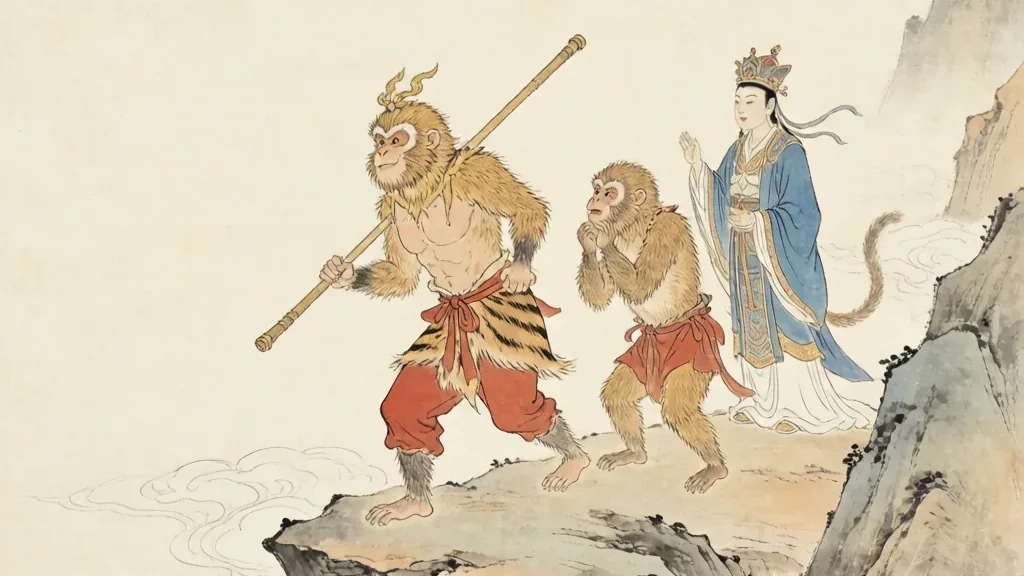
In the pantheon of world mythology, there are warriors and tricksters, heroes and rebels. But there is only one Monkey King. Sun Wukong — the Handsome Monkey King, the Great Sage Equal to Heaven — is arguably the most dynamic and beloved character in all of Chinese literature. His story of rebellion, punishment, and eventual redemption forms the opening chapters of "Journey to the West," one of the Four Great Classical Novels of Chinese literature, and his influence extends far beyond the page into every corner of Chinese and global popular culture.
What makes Sun Wukong (孙悟空) so captivating is his complexity. He is at once a trickster and a sage, a rebel and a protector, a being of immense power and profound humility. His journey from a stone egg on a mountain to the heights of heaven and the depths of Buddha's palm is one of the most extraordinary character arcs in world literature. This article focuses on his origin story and his legendary rampage through heaven — the events that made the Monkey King a name feared by gods and loved by mortals.
Born from Stone
On the Mountain of Flowers and Fruit, there sat a magical stone that had been absorbing the essence of heaven and earth since the dawn of creation. One day, the stone cracked open, and from within emerged a stone egg. When the egg was touched by the wind, it hatched into a stone monkey — complete in every limb and feature, with eyes that shot beams of golden light straight up to the very gates of heaven.
The Jade Emperor, ruler of heaven, noticed the disturbance but dismissed it as insignificant. It was a mistake he would come to regret.
The stone monkey quickly became the leader of the monkeys on the Mountain of Flowers and Fruit. One day, he led his troop to discover a hidden waterfall behind which lay a magnificent cave — the Water Curtain Cave. For his bravery and cleverness in finding this paradise, the monkeys proclaimed him their king. He took the title "Handsome Monkey King" and lived in joy and contentment among his subjects.
But even as king of the monkeys, Sun Wukong was haunted by a question: what was the point of all this happiness if it must one day end in death? Determined to find a way to escape mortality, he built a raft and sailed across the vast ocean to seek out the immortals who could teach him the secrets of eternal life.
The Search for Immortality
After years of searching, Wukong found a Daoist master named Subodhi, who recognized the monkey's extraordinary potential. Subodhi taught him the secrets of immortality, the art of cloud-somersaulting (which allowed him to travel 108,000 li — roughly 54,000 kilometers — in a single leap), and the legendary 72 Earthly Transformations. With these transformations, Wukong could change his shape into anything — a bird, a fish, a tree, a temple, even another person. He could shrink to the size of an insect or grow to tower over mountains.
Wukong was a brilliant student, absorbing knowledge with supernatural speed. But he was also prideful and impulsive. When he showed off his newfound powers to his fellow disciples, Subodhi was furious. He expelled Wukong from his tutelage, making him promise never to reveal who had taught him. It was a pattern that would define the Monkey King's early life: immense talent, reckless display, and consequences he had not fully considered.
Returning to the Mountain of Flowers and Fruit, Wukong discovered that his home had been attacked in his absence by a demon king. He easily defeated the intruder and realized he needed a proper weapon — something worthy of his status as the Handsome Monkey King.
The Ruyi Jingu Bang
Wukong traveled to the undersea palace of the Dragon King of the Eastern Sea, demanding a weapon. The Dragon King, intimidated by the monkey's reputation, brought out weapon after weapon — swords, spears, halberds — but Wukong found them all too light. Finally, the Dragon Queen suggested an ancient pillar that had been used by Yu the Great himself to measure the depths of the ocean during his flood control efforts. It was a massive iron column, far too heavy for any being to lift — or so they thought.
Wukong approached the pillar and found it was exactly the right size for his grip. "A little smaller would be nice," he mused — and the pillar immediately shrank to match his thought. He discovered that the Ruyi Jingu Bang (如意金箍棒), the "As-You-Will Gold-Banded Cudgel," could change its size at his command — from as small as a needle he could tuck behind his ear to as large as a pillar that could hold up the sky. It weighed over 8,000 kilograms, but in Wukong's hands, it was as light as a feather.
He also demanded and received a full suit of magical armor — golden chain mail, a phoenix-feather cap, and cloud-walking boots. Armed and armored like a true warrior, Wukong returned to his mountain kingdom more powerful than ever. But his ambitions were only beginning to stir.
The Havoc Begins
Death came for Wukong eventually — or tried to. Two agents of the underworld arrived to drag his soul to the land of the dead, claiming his time among the living had expired. Wukong was not having it. He beat the messengers senseless, stormed into the underworld, and demanded to see the Book of Life and Death. Finding his name listed — along with the names of every monkey on the Mountain of Flowers and Fruit — he crossed them all out with a stroke of his brush. Henceforth, no monkey from his mountain would ever die of natural causes.
The Dragon King and the rulers of the underworld filed formal complaints with the Jade Emperor in heaven. The celestial court was outraged — a mere monkey had defied the natural order of the universe. The Jade Emperor prepared to send an army to destroy Wukong, but a clever advisor suggested a subtler approach: invite the monkey to heaven, give him an official position, and keep him where he could be watched.
Wukong, flattered by the invitation, ascended to heaven. But the position he was given — Keeper of the Heavenly Horses — was the lowest rank in the celestial bureaucracy. When Wukong discovered this insult, his rage was apocalyptic. He declared himself the "Great Sage Equal to Heaven," beat up the guards, and stormed back to earth, raising a banner of rebellion on his mountain.
War in Heaven
The Jade Emperor sent his finest generals — including the fearsome Erlang Shen, who had a third eye in his forehead and could see through all of Wukong's transformations. A battle of epic proportions ensued, with Wukong and Erlang Shen transforming into dozens of different creatures as they fought, each trying to outwit the other. In the end, Wukong was captured — not by force, but by a sneak attack from Laozi, who struck him with his diamond snare while he was distracted.
Wukong was dragged to heaven in chains and sentenced to execution. But here the gods discovered a problem: nothing could kill him. They tried beheading him — his neck was harder than diamond. They tried burning him — the fire only made him angry. They tried striking him with divine lightning — he laughed and asked for more. Laozi suggested throwing him into his Eight Trigrams Furnace, a magical oven that would reduce even the most powerful being to ashes over 49 days.
Forty-nine days later, Laozi opened the furnace, expecting to find nothing but dust. Instead, Wukong burst out — alive, furious, and now gifted with eyes that could see through all deception and evil (having hidden in the one spot in the furnace protected from the flames). He grabbed his cudgel and went on a rampage through heaven itself.
No one could stop him. He defeated every celestial general sent against him. He ate the Peaches of Immortality from the Queen Mother's sacred garden, drank the Jade Emperor's wine of eternal life, and consumed Laozi's pills of longevity — making himself not just immortal, but multiply immortal, beyond the reach of any force in the universe. The Jade Emperor, cowering under his throne, was forced to call for help from the one being more powerful than any god in heaven.
The Buddha's Palm
The Buddha appeared, calm and serene, and regarded the rampaging monkey with something approaching amusement. He made Wukong a wager: if the monkey could leap out of the Buddha's palm, he would be acknowledged as the rightful ruler of heaven. If he failed, he would accept whatever punishment the Buddha deemed appropriate.
Wukong, supremely confident in his cloud-somersault that could cover 108,000 li in a single bound, accepted immediately. He leaped — and flew for what felt like an eternity, crossing the entire universe until he reached five towering pillars at the edge of existence. Certain he had reached the end of all things, he carved his name into one pillar and urinated at its base to mark his achievement. Then he somersaulted back to the Buddha.
"I won," Wukong declared triumphantly. "I reached the end of the universe and came back."
The Buddha opened his hand. On one of his fingers, Wukong's graffiti was clearly visible, and the distinct smell of monkey urine wafted from it. The five pillars he had seen were the Buddha's fingers. He had never left the Buddha's palm at all.
Before Wukong could react, the Buddha's hand flipped over and transformed into a mountain — the Five Elements Mountain — which crashed down on the Monkey King, pinning him beneath its impossible weight. For his rebellion against heaven, Wukong was sentenced to imprisonment for 500 years, sealed by a magical talisman that no force could break. He would remain there, unable to move, fed only molten copper and iron pellets, until a wandering monk on a sacred mission would one day pass by and offer him a chance at redemption.
The Eternal Rebel
The story of the Monkey King's rebellion is, on one level, a cautionary tale about the dangers of unchecked ambition and pride. Wukong's desire to be recognized, his refusal to accept a place in the cosmic hierarchy, his insistence on being treated as an equal by beings far older and more powerful than himself — all of these led directly to his downfall.
But on another level — the level that has made Wukong a beloved figure for centuries — his rebellion is inspiring. He is the underdog who refuses to stay down, the outsider who demands to be taken seriously, the individual spirit who will not be crushed by an unjust system. The celestial bureaucracy that Wukong defies is portrayed as stuffy, corrupt, and more concerned with face and hierarchy than with justice. When Wukong declares himself "Great Sage Equal to Heaven," he is making a radical claim: that worth is not determined by birth or position, but by ability and character.
This duality is what makes Sun Wukong such an enduring character. He is both a cautionary tale and a heroic ideal. His story would continue — his release from the mountain, his journey to the West as the disciple and protector of the monk Tang Sanzang, his eventual enlightenment and ascension to Buddhahood. But the Wukong who emerges from the mountain is a changed being, tempered by suffering and bound by a golden headband that tightens painfully whenever he misbehaves. The wild rebel of heaven becomes, through struggle and service, a true sage.
And yet, even as a Buddha, there is always a glint of mischief in the Monkey King's eyes — a reminder that the spirit of rebellion, properly channeled, can be a force for good rather than destruction. Sun Wukong reminds us that it is possible to fight the system without becoming a villain, to be powerful without being cruel, and to be clever without being deceitful. He is, quite simply, one of the greatest characters ever created — and his story has only just begun.
📝 Chinese Vocabulary
孙悟空 — : Sun Wukong, the Monkey King — "Sun" is his surname, "Wukong" means "awakened to emptiness."
金箍棒 — : The Ruyi Jingu Bang, Wukong's magical staff that can change size at will, originally used by Yu the Great.
大闹天宫 — : "Great havoc in the heavenly palace" — refers to Wukong's legendary rampage through heaven.
如来佛 — : The Buddha (Tathāgata), the only being powerful enough to subdue the Monkey King.
七十二变 — : "72 transformations" — the shapeshifting abilities Wukong learned from Subodhi.
菩提祖师 — : Subodhi, the Daoist master who taught Sun Wukong immortality, cloud-somersaulting, and the 72 transformations.
弼马温 — : Keeper of the Heavenly Horses, the lowly post the Jade Emperor gave Wukong, whose insult sparked his rebellion.
花果山 — : The Mountain of Flowers and Fruit, the monkeys' home where the stone-born Wukong hatched and was crowned king.
From Rebel to Pilgrim
Wukong's story does not end beneath the Five Elements Mountain. Five centuries later the monk Tang Sanzang, on a mission to fetch sacred scriptures from India, finds the imprisoned monkey and frees him, and Wukong becomes the monk's fiercest protector. Guanyin places a golden headband on him that tightens at a chant, curbing his wild impulses and binding rebellion to discipline. The long journey west, full of demons and trials, transforms the proud havoc-maker into a devoted follower, and at its close he is granted Buddhahood. This redemption arc is why the Monkey King endures: he is not only the joyful rebel but the being who learns restraint through service. His later self keeps a glint of mischief, a reminder that disciplined freedom is stronger than unchecked power.
🎉 Fun Facts
- Sun Wukong is the direct inspiration for Goku, the protagonist of the globally popular "Dragon Ball" franchise — even Goku's extending power pole and flying cloud are directly borrowed from the Monkey King's cudgel and cloud-somersault.
- The 16th-century novel "Journey to the West" has been translated into more languages than almost any other Chinese literary work and remains required reading in many Chinese schools.
- In 2024, the video game "Black Myth: Wukong" became a global phenomenon, selling millions of copies and introducing the Monkey King's story to a new generation of international audiences.
- The Keeper of the Heavenly Horses post was a deliberate insult, since horses were considered lowly in the celestial hierarchy, and Wukong raged when he learned it.
- The Monkey King's golden headband was given by the Bodhisattva Guanyin to keep him disciplined on the pilgrimage to the West, tightening at a chant when he misbehaves.
- In Chinese zodiac art and popular astrology the Monkey King is the archetype of the clever, restless Monkey sign, loved for his wit and defiance.
🐒 Born in the Year of the Monkey?
Sun Wukong is the ultimate Monkey archetype — clever, rebellious, and impossible to ignore. Discover what your Chinese zodiac sign says about your personality with our free zodiac calculator.
Calculate Your Zodiac →❓ Frequently Asked Questions

📖 The Monkey King and the Magic Staff — a kids' book!
Love the legend? Xiaoyu Luo's gentle picture-book retelling of Journey to the West is written mainly in simple English for children ages 4–10 — woven with Mandarin words, tone-mark pinyin, and cultural notes that make Chinese language and culture feel fun and easy to explore. Twenty short chapters, vocabulary with pinyin, simple example sentences, culture notes about Sun Wukong, the Jade Emperor, and Tang Monk, plus a mini quiz and discussion questions for families and classrooms.
📖 Get the book on Amazon