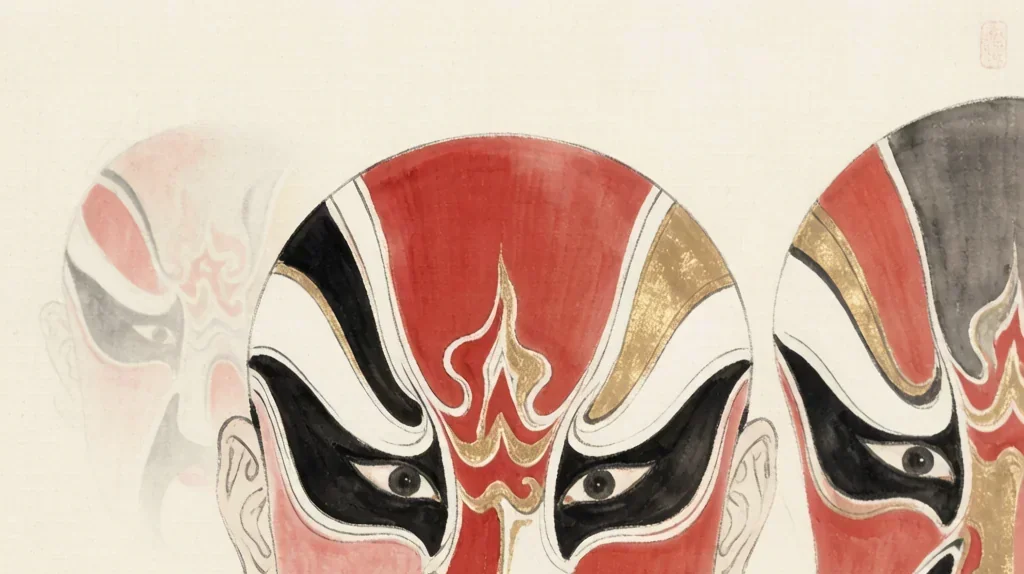
Lianpu, or Liǎn Pǔ (脸谱), is the painted facial makeup of Chinese opera, the blazing code of colors and patterns by which a single glance tells you a character's soul. Seen above all on the jing (净, the "painted-face" role) and the chou (丑, the clown), lianpu turns the human face into a symbolic map: red announces loyalty, white proclaims treachery, black declares uprightness, and a whole bestiary of patterns marks gods, demons, and notorious villains. Far from mere decoration, the opera face is a centuries-old visual language that lets an audience read a stranger's fate before he speaks a word. To understand lianpu is to learn the alphabet of Chinese theatre's most striking image, and to see how paint became character.
Which Roles Wear the Paint
Lianpu belongs mainly to two role families. The jing (净) are the bold-faced generals, judges, and bandits whose full-face designs cover cheeks and forehead in sweeping patterns; their paint is the most elaborate, often built from a central "main color" with added lines for eyebrows, eyes, and a "noodle" pattern of wrinkles or symbols. The chou (丑) wear only a small dab of white on the nose and eyes, a comic marker saying "I am the fool or the wisecracker." The sheng and dan, by contrast, wear little or no paint—their characters are read from costume and bearing, not from the face.
This division is meaningful. The more "painted" a role, the more symbolic and less individual he is; the jing is often a type—the loyal fre, the cruel prime minister—rather than a subtle person. The plain-faced sheng and dan carry the human intimacy. Lianpu thus encodes a hierarchy of character: the face-paint announces archetype, the bare face allows psychology.
The Color Code: Red, White, Black, and Beyond
The core of lianpu is its color symbolism. Red (红脸) stands for loyalty and courage, the color of the god-general Guan Yu (关羽); white (白脸) marks cunning and treachery, worn by the statesman Cao Cao (曹操); black (黑脸) signifies honesty and bluntness, the color of the upright judge Bao Zheng (包公). Blue and green (蓝脸/绿脸) denote stubborn bravery or a fierce, sometimes rebellious nature; yellow hints at cunning or a supernatural warrior; gold and silver mark gods, spirits, and demons. A face is therefore a verdict rendered in pigment before the story starts.
These associations are not arbitrary but traditional, taught to painters and audiences alike over generations. A child at a Peking opera can tell hero from villain by the first close-up of the face. The code is so strong that it leaks into everyday Chinese: calling someone "white-faced" (白脸) still implies a schemer, proof of lianpu's grip on the cultural imagination.
Patterns and the "Three Caves" of Meaning
Beyond color, lianpu uses patterns with their own logic. A "crane" or "bat" motif may signal longevity or fortune; a "noodle" whorl on the forehead can indicate a particular family or a supernatural origin; the shape of the eyebrows and the "silk" lines around the eyes individualize a stock type. Some designs are "totem" faces for gods, others "hero" faces for warriors, and others "clown" faces for comics. The great masters developed signature looks for famous characters that later painters copied exactly, so that Guan Yu's face is now fixed by tradition.
The art also encodes biography. A character who later turns traitor may begin with a divided face; a monk may carry a "swastika"-like or lotus mark; a bandit-hero may wear a "broken" pattern suggesting his wild past. In skilled hands lianpu is not a mask hiding the actor but a compressed life-story written across the skin, read by those who know the script of the paint.
History: From Mask to Face-Paint
Lianpu evolved from ancient mask traditions. Early ritual and temple performers wore physical masks (面具), as seen in the masked dances of the south and the "ghost masks" of folk religion; over time, as opera demanded mobile facial expression, painters transferred the mask onto the skin with pigments, giving the freedom to speak and emote while keeping the symbolic power. By the Qing, with the rise of Peking opera, lianpu crystallized into the codified system we see today, and painting manuals began to standardize the great characters' faces.
The materials, too, became theatrical: oil-based pigments for durability under stage light, applied in layers from a white base through the color fields to the fine black outlines. A master painter could complete a jing face in twenty minutes backstage, yet the design might represent decades of inherited convention. The "painter" backstage is thus a keeper of lineage as much as a makeup artist.
Lianpu as Art and Cultural Symbol
Today lianpu has leapt off the stage. Painted-face designs appear on porcelain, paper-cuts, T-shirts, and Olympic mascots; collectors prize the "face books" (脸谱谱) that catalog hundreds of characters. As a national intangible cultural heritage, the craft of painting is taught in workshops, and museums display the great masters' renderings. Yet purists warn that when stripped from its role and music, a lianpu design can become a pretty pattern rather than a living sign—the danger of any symbol lifted from its stage.
In the end, lianpu is Chinese opera's clearest lesson in stylization: that a face need not be realistic to be true, and that color can speak character more directly than words. The next time a red-faced general strides on, or a white-faced minister smirks, remember you are reading a language older than the play—a language painted, nightly, onto living skin.
Regional Styles of Lianpu
Although the color logic of lianpu is shared across Chinese opera, the actual designs vary by region and by troupe, and connoisseurs can often name a character's home style at a glance. Peking opera favors bold, symmetrical patterns with thick black outlines, while some southern forms use finer lines and softer fields. Certain families of painters developed signature looks for famous roles, and these were copied so faithfully that a given hero's face became fixed by tradition. Local operas also invented their own motifs drawn from regional legends, so a god or bandit may look different in two provinces. Face books preserve this diversity, listing hundreds of recorded designs as a kind of printed archive. Studying these variations shows that lianpu is not one fixed code but a living graphic tradition, rewritten slightly by each place and each master while keeping the same essential grammar of color and pattern.
Lianpu in Daily Life and Popular Culture
Lianpu long ago escaped the opera stage to become a general visual symbol of Chinese theatrical culture. Its designs appear on porcelain, paper-cuts, lacquerware, T-shirts, and festival decorations, and stylized painted faces are used as logos and mascots. The color verdicts have entered everyday speech: calling someone white-faced still implies a schemer, proof of how deeply the code sits in the language. At the same time, artists warn that a design lifted from its role and music can become a pretty pattern rather than a living sign, since the face only means fully in the context of the character it portrays. This double life, as both stage language and popular ornament, is what makes lianpu unusual among theatrical crafts: it is at once an actor's working tool and a widely recognized emblem of Chinese performance art.
Learning the Painter's Craft
The backstage painter is a keeper of lineage as much as a makeup artist, because each design carries decades of inherited convention that must be reproduced exactly for a familiar character. Apprentices learn the base, the main color, and the fine black line in sequence, studying face books and copying senior masters until the hand is automatic. A full jing face can be completed in about twenty minutes under show pressure, yet the knowledge behind it may take years to absorb. Workshops and museums now teach the craft as intangible heritage, lest the rarer designs vanish with the elders who remember them. The work demands both steadiness and memory: the wrong eyebrow or a misplaced whorl can change a hero into a villain. In this sense lianpu painting is less decoration than transcription, the daily copying of a graphic script that has been performed, night after night, onto living skin for centuries.
❓ Frequently Asked Questions
📝 Chinese Vocabulary
脸谱 — : Lianpu, the opera facial makeup.
净 — : The jing, the painted-face role that wears full lianpu.
丑 — : The chou, the clown marked by a white nose-dab.
关羽 — : Guan Yu, the red-faced epitome of loyalty.
曹操 — : Cao Cao, the white-faced emblem of cunning.
生 — : Sheng, the male role type, which usually wears little or no paint.
旦 — : Dan, the female role type, likewise read from costume and bearing rather than face paint.
包公 — : Bao Zheng, the upright judge whose black face stands for honesty and blunt justice.
🎉 Fun Facts
- A master backstage painter can complete a full jing face in about twenty minutes using layered oil pigments.
- The design for Guan Yu's red face is now fixed by tradition and copied exactly by painters generation after generation.
- Calling someone "white-faced" in Chinese still implies a schemer, showing lianpu's grip on daily speech.
- Gold and silver faces are reserved for gods, spirits, and demons rather than ordinary humans.
- The number of named lianpu designs runs into the hundreds, cataloged in face books that record the look of each classic character.
- Some designs encode a character's life story, such as a divided face for one who later turns traitor, so the paint is a compressed biography.