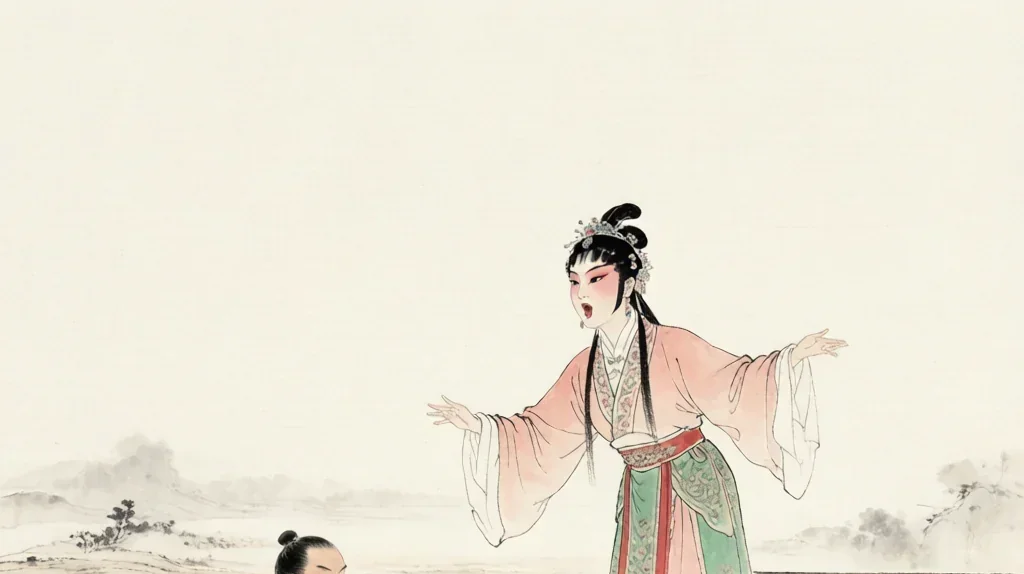
Hebei Bangzi, or Hé Běi Bāng Zi (河北梆子), the Hebei Clapper Opera, is the ringing, high-pitched voice of the North China plain, a bangzi (clapper) tradition that once shook the rafters of Beijing and Tianjin and carried the passions of the common people in music as sharp as a winter wind. Emerging in the early nineteenth century from the clapper songs of the borderlands between Hebei and Shanxi, it rose to become one of the most popular operas of the late Qing, famous for its soaring female arias and its fiery, outsized emotion. Though its dominance later faded before Peking opera, Hebei Bangzi remains a vital, thrilling art and a textbook example of how a regional clapper style could conquer the imperial capital. Its sound is the sound of the north refusing to whisper.
Origins on the Hebei–Shanxi Border
Hebei Bangzi grew out of the "Shanxi clapper" (山西梆子) that migrated east with traders and performers into the Hebei countryside, where local speech and taste reshaped it into a faster, brighter, higher style. By the Daoguang reign (1820s–1850s) of the Qing, troupes were performing in the villages and market towns of central Hebei, and the form was distinct enough to earn its own name. Its beating heart was the bangzi clapper and the hard, plucked strings that gave the music its driving, percussive attack, perfectly matched to the blunt energy of northern audiences.
From the start, Hebei Bangzi aimed high—literally. Its melodies climb to piercing altitudes that only a few voices can reach, a test of stamina that turned the best singers into local heroes. This vocal daring, combined with plots of righteous anger and romantic defiance, made the opera a favorite of soldiers, laborers, and market women who heard their own loudly lived lives reflected on stage.
The Conquest of Beijing and Tianjin
In the mid-nineteenth century, Hebei Bangzi troupes marched into Beijing and Tianjin and, for a few decades, rivaled everything else on the stage. At the height of its fame in the Tongzhi and Guangxu reigns, it was said that the clapper's beat could be heard in teahouses from the legation quarter to the outer city, and that Peking opera troupes borrowed its tunes to keep up. The genre's success rested on its female stars, whose high, brilliant arias drew crowds that sometimes overshadowed the all-male Peking opera houses.
The relationship between Hebei Bangzi and the rising Jingju was competitive but fruitful. Singers moved between the forms; melodies and gestures crossed over; and the capital's audiences grew used to a louder, more northern style of singing. When Peking opera eventually consolidated its supremacy at court, Hebei Bangzi retreated to the cities and countryside of Hebei, but it had already left its mark on the national stage.
The Art of the High Female Voice
Hebei Bangzi is above all a singer's opera, and its glory is the dan (female) voice raised to extraordinary height with seeming ease. The technique demands not only range but a bright, cutting tone that can ride above a clapper and drum ensemble without amplification. A great performer could hold a sustained high note at the climax of a lament, bringing an entire fairground to silence. Training begins in childhood, with years of breath and resonance work before a single full aria is attempted.
Movement in Hebei Bangzi is bold rather than minutely graceful. The acting favors large feeling: a wronged woman's rage, a general's defiance, a lover's desperation. Costumes and makeup draw on the same visual language as Peking opera, but the overall impression is of greater heat and less restraint, as if the plain itself were singing through the actor. For this reason the genre is sometimes described as the most "northern" of the bangzi family.
Repertoire of Passion and Righteous Anger
The plays of Hebei Bangzi lean toward the dramatic and the moral. Tales of wronged women who accuse corrupt officials, of loyal generals betrayed by courtiers, and of lovers who defy their families fill the bill. Favorites include "The Cry at the City Wall" (哭长城), echoing the legend of Lady Meng Jiang, and martial romances of the Yang family generals. The constant theme is the individual—usually a woman—pitted against an unjust power, and singing her protest to the sky.
This repertoire suited a society in flux, where ordinary people faced arbitrary authority and found in the opera a safe theater of revenge and vindication. The high, strained voice became the sonic symbol of protest itself, a sound that said what the audience could not say in the street. It is no accident that the genre peaked in the unrest of the late Qing and early Republican years.
Decline, Revival, and Heritage
After its Qing heyday, Hebei Bangzi lost ground to Peking opera and to the upheavals of the early twentieth century, its troupes scattering and its high style seeming old-fashioned. Yet it never died. State support after 1949 reorganized surviving artists into provincial and municipal companies, and the genre was listed among China's protected intangible cultural heritages. In recent decades festivals and competitions have nurtured a new generation of high-voice dan performers determined to keep the piercing line alive.
Today Hebei Bangzi is celebrated less for size than for spirit. Audiences come to feel the old thrill of a voice thrown against the rafters, a reminder that Chinese opera was never only refined and stylized—it could also be raw, loud, and gloriously angry. In the clapper's crack and the soprano's climb, the North China plain still announces that some feelings are too big for a whisper.
Instruments and the Bangzi Beat
Everything in Hebei Bangzi hangs on the bangzi, a wooden clapper struck to mark the beat, and from which the whole genre takes its name. Struck in sharp rhythmic patterns, it gives the music its hard, driving attack, while hard plucked strings answer with brittle, bright phrases. Drums and gongs fill out the ensemble, but it is the clapper's crack that the ear locks onto, a pulse as insistent as a northern winter wind. Against this percussive bed the high dan voice must project without amplification, riding above the beat rather than under it. The instrumental language is deliberately raw and rhythmic rather than lush, matching the opera's taste for big feeling and plain speech. This is what sets the bangzi family apart from string-led southern forms: the rhythm comes first, and the melody is built to be heard over it. The result is music built for open squares and fairgrounds, not hushed chambers.
Hebei Bangzi Across the Bangzi Family
Hebei Bangzi is one branch of a wider northern clapper family that includes the Shanxi and Shaanxi clappers, all sharing the wooden bangzi and a taste for high, bright singing. It grew directly out of the Shanxi clapper that migrated east with traders and performers, then stiffened and rose in pitch as it met Hebei speech and taste. What distinguishes the Hebei version is its especially soaring female voice and its tight, fast rhythms, traits that made it the family's most successful export to the capital. Singers and tunes moved freely among the clapper styles, so the borders were always porous, yet each kept a local accent. Understanding Hebei Bangzi means seeing it as both a distinct opera and a cousin in a regional clan, one whose particular genius was to push the clapper's natural height to its loudest, most thrilling extreme. The family resemblance is the key to its history.
Training a High-Voice Performer
The signature of Hebei Bangzi is a vocal feat that cannot be rushed. Singers, especially in the dan role, begin training as children, building the breath support and resonance needed to reach and hold notes far above normal speech. Years pass before a student attempts a full aria at performance pitch; early work focuses on posture, diaphragm control, and the bright, cutting tone that can ride above clapper and drum. Teachers pair each promising voice with a veteran mentor, a master-apprentice chain that protects both technique and repertoire. The danger is real—forcing the voice risks permanent damage—so progress is patient and incremental. Modern heritage festivals now showcase these young high voices, letting audiences hear that the piercing line survives. Behind every apparently effortless sustained note lies a decade of disciplined practice, a reminder that Hebei Bangzi's raw power is in fact the product of the most careful, long-term craft.
❓ Frequently Asked Questions
📝 Chinese Vocabulary
河北梆子 — : Hebei Clapper Opera.
梆子 — : Clapper, the rhythm block central to the music.
旦 — : The female role, home to the genre's famous high voice.
哭长城 — : "Crying at the Great Wall," a Hebei Bangzi play tied to Lady Meng Jiang.
河北 — : Hebei, the North China plain province of the opera's birth.
山西梆子 — : Shanxi clapper, the parent tradition from which Hebei Bangzi evolved
生 — : the male role type
戏班 — : an opera troupe or company
🎉 Fun Facts
- At its late-Qing peak, Hebei Bangzi rivaled Peking opera in Beijing and was known for drawing bigger crowds with its female stars.
- The genre demands a soprano range so high that singers train from childhood just to manage the breath and resonance.
- Hebei Bangzi and Peking opera exchanged melodies and performers freely during the capital's opera wars of the 1800s.
- Its repertoire often dramatizes ordinary people protesting corrupt officials, making the high voice a symbol of defiance.
- Hebei Bangzi's popularity was so great in the late Qing that it was performed not only in grand teahouses but also at temple fairs and village markets across the North China plain.
- Modern festivals pair young dan singers with veteran teachers in an apprenticeship model that keeps the difficult high register alive.