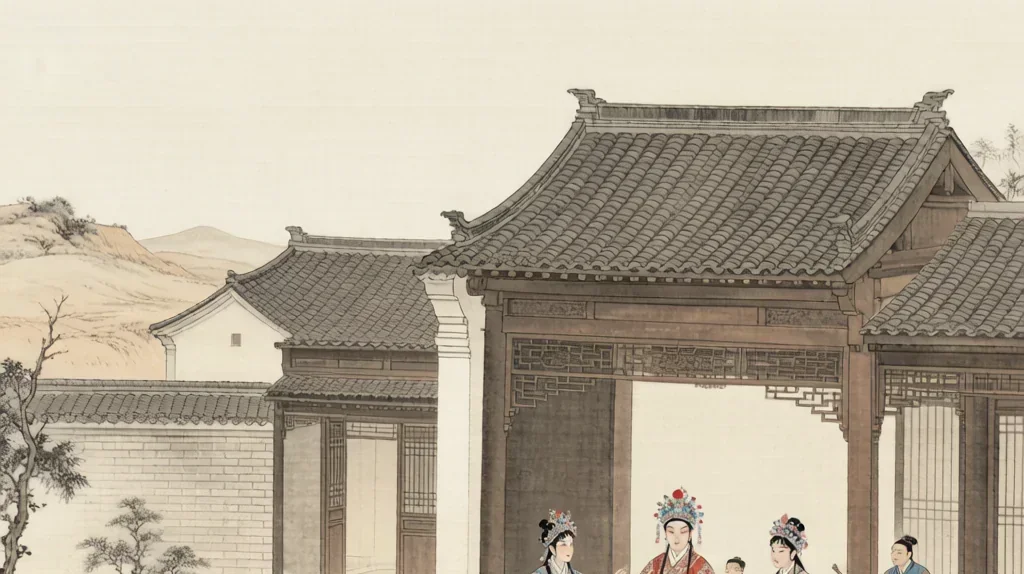
Jinju, or Jìn Jù (晋剧), known in full as Zhonglu Bangzi (中路梆子, the "middle-route clapper"), is the opera of Shanxi, the loess plateau province whose merchants once bankrolled half of China. A proud member of the bangzi (clapper) family, Jinju sings in a bright, ringing tenor that seems to cut through the dry northern air, and it is celebrated above all for its qingyi (青衣) — the sorrowful, upright married women whose arias can reduce an audience to tears. Born in the heart of Shanxi in the nineteenth century, Jinju carried the stern moral world of the merchant households and the open plains into melody, and it remains one of the four great regional bangzi operas of the north. Its high, clear voice is the sound of Shanxi itself.
Birth from the Bangzi Family
Jinju is one of the four major branches of Shanxi clapper opera, the others being the northern, southern, and upper routes; the "middle route" (zhonglu) centered on the provincial capital Taiyuan and the fertile Fen River valley. It took shape in the early nineteenth century as local storytellers and singers adopted the bangzi clapper rhythm, a pattern of speech-song set to a wooden clapper and hard-struck strings. The form matured through the Qing, drawing players from neighboring Hebei and Shaanxi troupes, and by the late 1800s it had its own star system and a repertoire distinct from its cousins.
What defines a bangzi opera is its mode, the "bangzi qiang," built on the four rising and falling tones of northern speech and driven by the zhuhu (主胡, a leading fiddle) and the clapper. Jinju's particular flavor is a slightly sweeter, more lyrical line than the harsher Shaanxi or Hebei clappers, suited to the long, melancholy arias of its women. The result is music that is both rousing and grieving, able to open a play with martial excitement and close it with quiet lament.
The Supreme Art of the Qingyi
If Jinju has a signature, it is the qingyi, the role of the virtuous, often wronged woman, sung by actresses whose controlled vibrato and slow trills express endurance rather than flash. Training a qingyi is a lifetime's labor: the voice must project to the back of an open-air fairground without microphone, the steps must be small and weighed with dignity, and the sleeves must fall like curtains of sorrow. Generations of Shanxi girls trained for this role, and the greatest became household names across north China.
Famous Jinju qingyi such as Ding Guoxian (丁果仙), who was so respected she performed male sheng roles as well, raised the status of the actress and expanded the repertory. Ding's crisp, androgynous voice in "old male" roles was legendary, proving that Jinju artistry was not bound by the body of the performer. Through such artists the qingyi became the moral center of the stage, the figure whose suffering measures the injustice of the world.
Repertoire: Loyalty, Wrongs, and the Plains
Jinju's plays are drawn from the broad Chinese epic cycle—the Three Kingdoms, the Yang family generals, the patriotic widow Mu Guiying—but filtered through Shanxi's taste for domestic and moral tales. A perennial favorite is "The Destitute Scholar" (打金枝) about a princess and her husband's family, and "Selling Water" (卖水), a comic romance. Many plays turn on a woman's loyalty tested by exile, poverty, or a cruel mother-in-law, themes that resonated in a society where merchant husbands traveled and wives waited.
The storytelling is direct and unembarrassed about emotion. Jinju does not hide grief behind irony; it stages it, song after song, until the audience has felt the full weight of a faithful wife's wait. This emotional honesty, more than spectacle, is why villagers would walk miles to a temple fair to hear a single famous aria performed live.
The Shanxi Merchants and the Opera's Patrons
No account of Jinju is complete without the Shanxi merchants (晋商), the banking families whose draft houses (票号) moved silver across the empire. Rich, conservative, and proud of their province, these merchants patronized Jinju troupes as both entertainment and a display of local identity. A successful merchant's homecoming might include weeks of opera at the clan temple, and troupes competed for the honor of performing before the masters of the great courtyards. In this way Jinju was carried along the trade routes to Zhangjiakou, Baotou, and even beyond the Great Wall.
The merchants' values—thrift, filial piety, female chastity—found their stage mirror in Jinju's plots, and the opera in turn taught those values to the countryside. It was a circular exchange: the wealth of Shanxi funded the art, and the art sanctified the wealth's morals.
Jinju on the Modern Stage
Today Jinju is preserved as a national intangible cultural heritage with professional troupes in Taiyuan and throughout Shanxi. The Fen River valley still rings with its arias at festival times, and television broadcasts carry the great qingyi roles to older audiences nationwide. Younger performers experiment with shortened plays and modern lighting while keeping the hard clapper beat and the high line intact. Contests and academies ensure that the difficult vocal technique is not lost, even as rural audiences shrink.
Jinju endures because it speaks a truth the plateau understands: that dignity is kept through endurance, and that a clear, high voice can carry a lifetime of waiting. In a China racing toward the future, the middle-route clapper still calls the plain to remember who it was, and the qingyi still weeps for every wronged wife the audience has ever known.
Jinju Musical Instruments and Tempo
Jinju's unmistakable sound comes from the bangzi clapper, a hard wooden block struck in a bright, driving pattern that keeps the open-air beat. Above this rhythm the zhuhu fiddle sings the main line, its penetrating tone built to reach the back of a temple-fair crowd without a microphone. Plucked and bowed strings fill in the harmony, while percussion marks entrances, battles, and comic beats. The music is organized around the four rising and falling tones of northern speech, which is why the melody can sound both rousing and grieving within a single play. Tempo shifts signal mood: a brisk clack for a march or a martial scene, a slower beat for a qingyi's lament. This combination of a hard clapper and a sweet, lyrical melody is the technical signature that separates the middle-route clapper from its harsher Shanxi or Hebei cousins.
Costumes and the Visual World of Jinju
Jinju costumes are those of the north China plain: robe and armor for generals, modest dress for the wronged wife, and the scholar's fan for the young male lead. They are traditional without the extreme ornament of court opera, suited to the earthy, moral tales the opera prefers. The painted face appears on bold generals and judges, using the familiar color code of loyalty and treachery, while the clown wears a white nose-dab for local humor. Staging is direct and unembarrassed about emotion, letting a single famous aria carry a scene rather than relying on spectacle. A performer's small, weighed steps and falling sleeves do the expressive work that grander operas hand to scenery. The overall visual world is one of plain dignity, a style that matches the merchant households and village audiences who made Jinju the voice of Shanxi itself.
Jinju's Place Among Northern Bangzi Operas
Jinju belongs to the great bangzi family of northern China, the clapper operas whose hard wooden beat names an entire musical tradition. Among them it is the middle route, centered on Taiyuan and the Fen River valley, distinct from the northern, southern, and upper routes that complete the four great Shanxi branches. Compared with the sharper Shaanxi or Hebei clappers, Jinju's line is sweeter and more lyrical, which is why it became the natural home of the qingyi's long, melancholy arias. The form also absorbed players from neighboring Hebei and Shaanxi troupes, so its repertoire and technique are a regional blend rather than an isolated dialect. Today, with professional companies in Taiyuan and festival performances across Shanxi, Jinju remains the most prominent of the province's clapper operas, a clear-voiced reminder of the plain's own musical identity within China's vast opera map.
❓ Frequently Asked Questions
📝 Chinese Vocabulary
晋剧 — : Jinju, Shanxi opera.
中路梆子 — : The "middle-route clapper," the full name of Jinju.
青衣 — : The qingyi, the virtuous married-woman role.
梆子 — : Clapper, the wooden rhythm block defining bangzi opera.
晋商 — : Shanxi merchants, historic patrons of the art.
梆子腔 — : Bangzi qiang, the clapper-rhythm mode that defines Jinju and the whole bangzi opera family.
主胡 — : Zhuhu, the leading fiddle whose bright tone carries the Jinju melody.
打金枝 — : Da Jin Zhi, a favorite Jinju play about a princess and her husband's family.
🎉 Fun Facts
- Jinju is one of four great regional branches of Shanxi clapper opera, the others being northern, southern, and upper routes.
- The star actress Ding Guoxian was so versatile she famously performed male roles as well as female ones.
- Shanxi merchants' draft-banking houses once spread Jinju troupes as far as Baotou and beyond the Great Wall.
- Jinju's high, clear tenor is said to suit the open, dry air of the Shanxi loess plateau.
- The zhuhu fiddle leads the Jinju orchestra, its bright, piercing tone designed to carry across open-air fairgrounds without amplification.
- Jinju actresses train for years to produce the qingyi's slow, controlled vibrato, a sound so demanding that mastering it is considered a career-long pursuit.