← Back to Opera
🏮 Opera
Qinqiang Opera (秦腔) — The Oldest Chinese Opera
✍️ by xiaoyu luo
🗓️ Updated Jul 29, 2026
By Xiaoyu Land · 12 min read
Qinqiang opera (秦腔, Qín Qiāng), literally 'the melody of Qin,' is widely recognized as the oldest surviving form of Chinese opera, with roots stretching back over 2,000 years to the Qin Dynasty (221–206 BCE) and the ancient state of Qin in what is now Shaanxi Province. The art form as it is known today crystallized during the Ming Dynasty (1368–1644), but its musical foundations lie in the folk songs, work chants, and ritual performances of the Yellow River basin's earliest agricultural communities. Qinqiang is not merely an art form but a sonic embodiment of the rugged spirit of northwestern China — its singing style, characterized by a powerful, resonant delivery that can fill vast outdoor spaces without amplification, reflects the vast landscapes of the Loess Plateau (黄土高原) where it was born. Recognized as a National Intangible Cultural Heritage of China in 2006, Qinqiang is regarded as the 'ancestor of Chinese opera,' having directly influenced the development of later forms including Peking opera (京剧), Yu opera (豫剧), and numerous regional traditions.
The Sound of the Northwest: Musical Characteristics
The defining characteristic of Qinqiang opera is its vocal style, which stands in stark contrast to the refined, melodic singing of southern opera traditions. Qinqiang employs two fundamental vocal modes: 'huayin' (花音, 'flower sound') — a bright, celebratory tone used for joyful scenes; and 'kuyin' (苦音, 'bitter sound') — a raw, emotionally intense delivery that expresses sorrow, suffering, and the harsh realities of life on the Loess Plateau. The kuyin mode is particularly distinctive, utilizing a scale that incorporates microtonal inflections — notes that fall between the standard pitches of the Western musical scale — creating a sound that can seem harsh or even strident to unfamiliar ears but carries immense emotional power for those who understand its vocabulary. The instrumental accompaniment is dominated by the banhu (板胡), a two-stringed fiddle with a coconut-shell resonator that produces a penetrating, nasal tone, along with percussion instruments including cymbals (钹, bó), gongs (锣, luó), and the distinctive 'bangzi' (梆子) wooden clappers that keep time with sharp, commanding strokes — the opera form is technically classified as a 'bangzi opera' (梆子腔) because of this rhythmic foundation.
Stories of Heroes and History
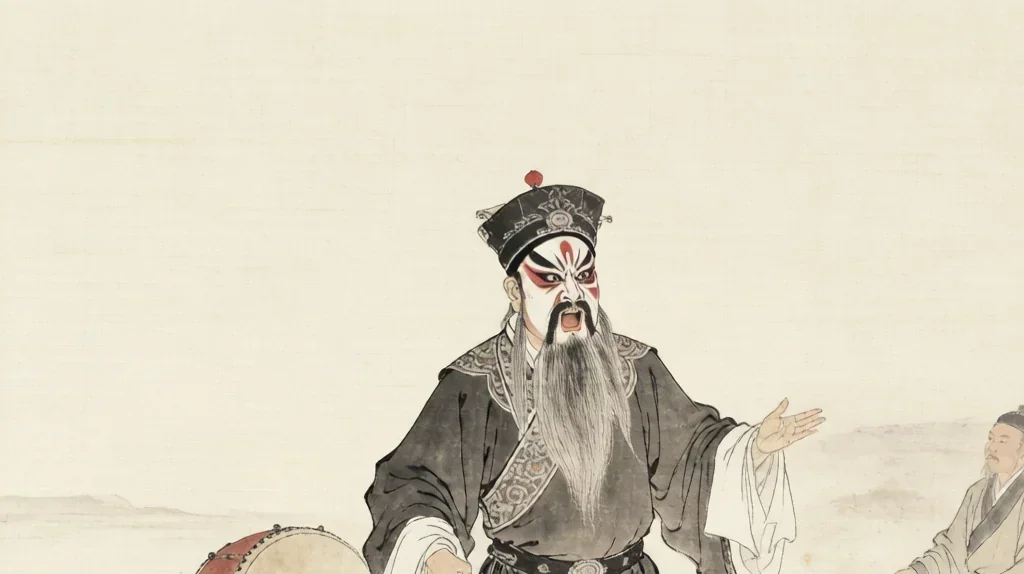
The repertoire of Qinqiang opera encompasses over 4,700 known plays, making it one of the richest theatrical traditions in the world. Unlike the romantic comedies and domestic dramas of southern Chinese opera, Qinqiang specializes in grand historical narratives, military epics, and tales of loyalty, betrayal, and justice. The plays draw heavily from Chinese historical classics like 'Records of the Grand Historian' (史记, Shǐjì) by Sima Qian and 'Romance of the Three Kingdoms' (三国演义, Sānguó Yǎnyì). The role types in Qinqiang follow the traditional Chinese opera classification system but with distinctive regional characteristics: the 'lao sheng' (老生, old male) roles demand a powerful, gravelly voice that conveys decades of life experience in a single phrase; the 'da jing' (大净, painted face) roles, portraying heroes and villains, require actors to sing while executing acrobatic movements and wearing heavy, elaborate makeup that takes hours to apply. Perhaps the most famous Qinqiang play is 'The Orphan of Zhao' (赵氏孤儿, Zhào Shì Gū'ér), a tragedy set in the Spring and Autumn Period about loyalty, sacrifice, and revenge — a story so powerful that it became the first Chinese play to be translated into a European language (French, 1735) and was adapted by Voltaire as 'L'Orphelin de la Chine.'
Performance Spaces and the Village Stage
Qinqiang opera was traditionally performed not in grand urban theaters but on temporary stages erected in village squares, temple courtyards, and open fields — settings that shaped the art form's aesthetics. The 'temple stage' (庙台, miào tái), a permanent platform built into the architecture of rural temples, served as the primary performance venue for centuries. These open-air stages required a vocal technique that could project to audiences of thousands without amplification, and the actors developed an extraordinary capacity for sustained, high-volume singing that remains the hallmark of the tradition. Performances were typically commissioned by village communities for religious festivals, harvest celebrations, and temple fairs — the opera was inseparable from the rhythms of agricultural life. In the rural areas of Shaanxi, Gansu, and Ningxia provinces, the arrival of a Qinqiang troupe was a major community event, with families traveling from miles around, setting up food stalls, and settling in for performances that could last from sunset to dawn during festival seasons. The intimate relationship between performers and their rural audience created a unique performance dynamic — villagers would shout encouragement, express disapproval, and sometimes even climb onto the stage to offer gifts of food or money to particularly impressive performers.
Qinqiang in Modern China
Like many traditional art forms, Qinqiang faced significant challenges during the 20th century. The Shaanxi Qinqiang Opera Troupe, founded in 1938, continues to perform regularly, and the annual Qinqiang Arts Festival in Xi'an draws performers and audiences from across northwestern China. In 2006, UNESCO included Qinqiang on the Representative List of the Intangible Cultural Heritage of Humanity. Contemporary artists are exploring new directions: the acclaimed 2016 film 'Song of the Phoenix' (百鸟朝凤) by director Wu Tianming, though centered on the suona instrument, drew attention to the broader crisis facing traditional Shaanxi performing arts. Young Qinqiang performers are incorporating elements of rock music and contemporary theater, seeking to attract new audiences while preserving the raw, powerful essence that makes Qinqiang one of humanity's most ancient living theatrical traditions.
❓ Frequently Asked Questions
Q: What is Qinqiang opera?
A: Qinqiang (秦腔, 'Qin Opera') is one of the oldest and most influential forms of Chinese opera, originating in the Shaanxi and Gansu regions. It has a history of over 2,000 years and is characterized by its powerful, high-pitched vocals and bold, dramatic percussion.
Q: What are the distinguishing features of Qinqiang?
A: Qinqiang is known for its loud and vigorous style. The singing is high-pitched and penetrating, accompanied by loud percussion instruments including bangzi (wooden clappers), gongs, and drums. The music reflects the rugged landscape and bold temperament of northwest China.
Q: What is the relationship between Qinqiang and other opera forms?
A: Qinqiang is considered the 'father of Chinese operas' (百戏之祖) by some scholars, as its musical structure influenced Peking Opera and many regional forms. The bangzi (wooden clapper) used in Qinqiang gave the entire 'clapper opera' (梆子腔) tradition its name.
Q: What stories are commonly performed in Qinqiang?
A: Qinqiang's repertoire includes many historical and martial stories, such as tales from the Three Kingdoms period, the story of Yue Fei (岳飞), and folk legends like 'The Legend of the White Snake.' The performances emphasize loyalty, righteousness, and justice.
Q: What are the huayin and kuyin vocal modes?
A: Huayin is the bright, cheerful mode used for joyful scenes, while kuyin is the raw, sorrowful mode whose microtonal slides express suffering; together they give Qinqiang its wide emotional range.
Q: Why is Qinqiang called the ancestor of Chinese opera?
A: Its bangzi clapper rhythm named the whole clapper-opera family, and its melodies influenced Peking opera, Yu opera, and many regional forms, earning it the title ancestor of Chinese opera.
Key Terms
秦腔 (Qín Qiāng)
qín qiāng · 'melody of Qin' · 中国戏曲之祖 (zhōngguó xìqǔ zhī zǔ, ancestor of Chinese opera)
花音 (huā yīn)Huayin, the bright, cheerful vocal mode used for joyful Qinqiang scenes.
苦音 (kǔ yīn)Kuyin, the raw, sorrowful vocal mode whose microtonal slides express suffering.
板胡 (bǎn hú)Banhu, the coconut-resonator fiddle whose penetrating tone leads the Qinqiang orchestra.
梆子 (bāng zi)Bangzi, the hardwood clapper whose sharp beat names the whole clapper-opera family.
黄土高原 (huáng tǔ gāo yuán)The Loess Plateau, the rugged homeland in Shaanxi where Qinqiang was born.
赵氏孤儿 (Zhào Shì Gū'ér)The Orphan of Zhao, the famous Qinqiang tragedy later adapted by Voltaire.
魏长生 (Wèi Chángshēng)Wei Changsheng, the late-Qing Qinqiang star whose Beijing sensation shook the capital's stage.
Fun Facts
- Qinqiang is one of the few Chinese opera forms where female roles were traditionally performed by male actors. The art of 'female impersonation' (乾旦, qián dàn) in Qinqiang was considered the highest form of the actor's craft, requiring years of specialized training in voice, movement, and gesture.
- The oldest surviving Qinqiang script, 'The Orphan of Zhao,' dates to the Yuan Dynasty (1271–1368) and is based on events from the 6th century BCE. It was the first Chinese play ever performed in Europe, premiering in Paris in 1755.
- During the late Qing Dynasty, the famous Qinqiang actor Wei Changsheng (魏长生, 1744–1802) caused a sensation in Beijing, where his performances drew such crowds that performances of the established Kunqu opera were temporarily suspended. His innovative costume designs and hairstyles were copied by fashionable women throughout the capital.
- Qinqiang's repertoire is enormous, with more than 4,700 known plays, making it one of the richest theatrical traditions in the world.
- The kuyin bitter-sound mode uses microtonal slides between pitches to express sorrow, a sound that can seem harsh at first but carries deep feeling for locals.
- Qinqiang was inscribed on UNESCO's Intangible Cultural Heritage list in 2006, the same year Huangmei opera received the honor.
Qinqiang Role Types and Vocal Demands
Qinqiang follows the traditional role system but with a northwestern accent all its own. The old male role demands a powerful, gravelly voice that conveys decades of experience in a single phrase, while the painted-face general must sing amid acrobatics and heavy makeup. Female roles, long a showcase for the art, were historically performed by male actors whose training in voice, step, and gesture was considered the highest craft. What unites the roles is the demand for projection: village stages and temple courtyards required singers to fill vast open spaces without amplification, so the voice is trained deep in the diaphragm for volume and endurance. A performer might sustain three-hour shows night after night, a stamina that astonishes modern audiences used to microphones. This physical, full-bodied singing is the true test of a Qinqiang artist and the reason the form sounds so alive even at a distance.
The Loess Plateau Homeland of Qinqiang
Qinqiang is inseparable from the Loess Plateau, the yellow, wind-carved land of Shaanxi, Gansu, and Ningxia where it was born. Its high, resonant, sometimes strident singing is often described as the sonic mirror of that vast, rugged terrain and the bold temperament of its people. The opera grew from the folk songs, work chants, and ritual performances of the Yellow River basin's early farming communities, and it kept their earthy directness even after it crystallized into a staged art in the Ming dynasty. For centuries the form belonged to village squares and temple courtyards rather than grand urban theaters, so its aesthetics were shaped by open-air performance and by audiences of farmers and migrants. That homeland explains both the music's force and its themes of loyalty, hardship, and justice, making Qinqiang less a court art than the voice of the northwest itself.
Qinqiang and the Clapper-Opera Family
Qinqiang is the prototype of the bangzi, or clapper-opera, family that spread across northern China. Its hardwood bangzi clapper, striking a sharp, commanding beat, gave the whole tradition its name, and its melodic and rhythmic logic traveled east into Shanxi, Hebei, and Henan opera. Crucially, Qinqiang carried the seeds of the pihuang system as well, since its musical ideas fed the mixing that later produced Peking opera in Beijing. Scholars therefore call it the ancestor of Chinese operas, a claim supported by the breadth of forms it influenced, from Yu opera in Henan to the various clappers of the plain. The 2006 UNESCO listing confirmed its status as a foundational intangible heritage. To hear Qinqiang is thus to hear the raw source from which much of northern Chinese theatre descends, the elder voice whose clapper still echoes in younger forms.
Famous Qinqiang Plays and Stories
Qinqiang's stage favors grand historical narratives, military epics, and tales of loyalty and justice over romantic comedy. Its richest works draw on the Chinese historical classics and the cycles of the Three Kingdoms and the Yang family generals, with the tragedy The Orphan of Zhao standing as a centerpiece. That play, set in the Spring and Autumn Period, moved west to Europe as early as the 1730s and was reworked by Voltaire, making it among the first Chinese dramas known in the West. Other staples celebrate faithful wives, wronged officials, and upright judges, reflecting the plain moral world of the northwest audience. The repertoire's scale is staggering, with thousands of titled plays recorded over the centuries. Because the stories are public and well known, the pleasure lies less in plot surprise than in a favored aria's execution, the actor's command of huayin and kuyin, and the percussion that lifts a familiar scene into something felt anew.