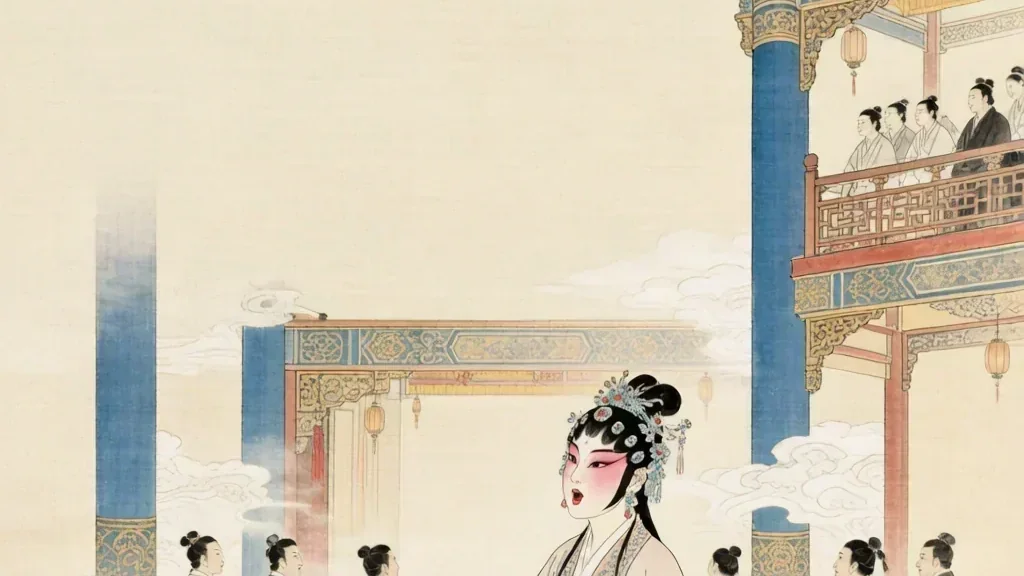
Enter a Chinese theater and the first thing that strikes you is the sound — a piercing cascade of gongs, cymbals, and a high, reedy fiddle sawing through the air. Then a figure strides onto the stage: a general in full armor, his face painted in bold blocks of red, white, and black, his headdress bristling with pheasant feathers six feet long. He stamps his foot. The gongs fall silent. He opens his mouth, and what comes out is not a song in any Western sense but a soaring, nasal, drawn-out wail that fills the theater without any microphone. This is 京剧 (jīng jù), Peking Opera — two hundred years old, gloriously artificial, and one of the most distinctive performing arts in the world.
Peking Opera is a total theater in which singing, reciting, acting, and acrobatics are combined into a single seamless art. A character does not just speak or sing; he or she performs every word, with stylized gestures, a walk that suggests far more than locomotion, and a painted face that announces the character's nature before a single line is spoken. To watch Peking Opera is to enter a world where every element — color, sound, movement, costume — is a code, and where the pleasure lies as much in decoding the code as in following the story.
Two Hundred Years of Peking Opera
Despite its name, Peking Opera is not especially ancient. It was born in 1790, when four Hui opera troupes from Anhui Province traveled to Beijing to perform for the Qianlong Emperor's eightieth birthday. They stayed, and over the next decades their style — itself a blend of Han opera, Kunqu (the older, more refined classical opera of the south), Shaanxi melodies, and local Beijing tunes — fused into a new art. By the mid-19th century, this fusion had become what we now call Peking Opera, and it had become the dominant theatrical form not just in Beijing but across China.
The golden age of Peking Opera was the late 19th and early 20th centuries. The art form was patronized by the Qing court and adored by the common people; theaters were packed from dawn to midnight, and the great performers were as famous as film stars are today. The legendary Mei Lanfang (梅兰芳, 1894–1961) — the greatest female-role specialist of the century — toured Japan, the United States, and the Soviet Union, where he met Stanislavski, Brecht, and Eisenstein, all of whom were stunned by his art. Bertolt Brecht's theory of theatrical alienation was partly inspired by Mei's stylized, anti-naturalistic performances.
The 20th century was not always kind to Peking Opera. After 1978, the traditional repertoire was slowly restored. Today, Peking Opera is taught in conservatories, performed in major theaters, supported by the state as a national treasure, and inscribed on UNESCO's list of Masterpieces of the Oral and Intangible Heritage of Humanity.
The Four Role Types: Sheng, Dan, Jing, Chou
Every character in Peking Opera belongs to one of four role types (行当, háng dāng). The role type determines not just the character's social position but everything about how the actor moves, sings, and is costumed.
1. Sheng (生) — the male roles. Laosheng (老生) is the older, bearded man: a scholar, official, or general, sung in a rich baritone with a measured dignity. Xiaosheng (小生) is the young man, often a scholar or lover, sung in a peculiar alternation of natural voice and high falsetto that signals youth and refinement. Wusheng (武生) is the warrior, an acrobat who performs breathtaking martial feats — somersaults, spear work, and stage combat — with little singing.
2. Dan (旦) — the female roles. Qingyi (青衣), "blue robe," is the virtuous wife or devoted daughter, sung in a high, pure falsetto with restrained gestures. Huadan (花旦) is the lively young woman, often a maid or coquette, who speaks more than she sings and uses playful, expressive movement. Daomadan (刀马旦) is the female warrior, skilled in horsemanship and combat. Laodan (老旦) is the elderly woman, sung in a cracked, natural voice rather than falsetto. For centuries, all dan roles were played by men — Mei Lanfang being the most famous — because women were forbidden to perform on stage. The convention produced a distinct aesthetic: the male dan trained for years to embody femininity not through imitation but through stylization.
3. Jing (净) — the "painted face" roles. These are forceful, larger-than-life male characters: generals, bandits, demons, gods, rebels. The jing actor wears an elaborate full-face painting (lianpu, 脸谱) and sings in a booming, sometimes guttural voice. Jing roles demand physical power and vocal force more than delicacy.
4. Chou (丑) — the clown. A small patch of white paint around the eyes and nose identifies the chou, who provides comic relief, earthy commentary, and sometimes surprising wisdom. The chou is the only role type allowed to improvise, and a good chou can have the audience roaring with a gesture or a single well-placed dialect joke.
The Language of Painted Faces
The painted face (脸谱, liǎn pǔ) is one of the most recognizable elements of Peking Opera — and one of the most fascinating. Far from being mere decoration, the painted face is a complete character portrait painted directly onto the actor's skin. Color, pattern, and shape together reveal the character's personality, history, and moral nature before a word is spoken. A knowledgeable fan can identify a character at a glance just from the face.
The basic color code is consistent across the tradition:
· Red — loyalty, courage, and integrity. The prototype is Guan Yu (关羽), the general hero of the Three Kingdoms, whose red face marks him as the very embodiment of righteous loyalty.
· Black — impartiality, toughness, and rough honesty. The prototype is Bao Zheng (包拯), the legendary Song Dynasty judge whose black face signaled his incorruptible justice. Black is also worn by blunt, fierce warriors like Zhang Fei (张飞).
· White — treachery, cunning, and deceit. The villain's color. The prototype is Cao Cao (曹操), the brilliant and ruthless warlord of the Three Kingdoms, whose white face marks him as a brilliant schemer not to be trusted.
· Yellow — cruelty, ambition, and hidden malice. Worn by vicious generals and wild characters.
· Blue — fierceness, wildness, and stubborn valor. Often worn by bandit heroes and rebel generals.
· Green — chivalry, often worn by outlaws, Robin Hood-like bandits, and supernatural beings.
· Gold and silver — divinity. Gods, demons, and Buddhist figures wear metallic faces to mark their supernatural nature.
Beyond color, the pattern of the painting adds further information. A "butterfly face" suggests a dashing warrior; a "broken face" with asymmetrical marks suggests a flawed or tragic character; a "full face" of one color suggests a single dominant trait. The combinations multiply into hundreds of named patterns, each tied to a specific historical or fictional character.
The Classic Repertoire
Peking Opera's repertoire includes over a thousand traditional plays, drawn from history, legend, and classical novels. Among the most beloved:
· Farewell My Concubine (霸王别姬, Bà Wáng Bié Jī) — the tragic last night of the warlord Xiang Yu, who is surrounded by his rival Liu Bang's forces. His consort Yu Ji performs a sword dance for him, then takes her own life so that she will not be a burden. The role of Yu Ji was one of Mei Lanfang's signature pieces.
· The Empty Fort Strategy (空城计, Kōng Chéng Jì) — from the Three Kingdoms cycle. The strategist Zhuge Liang, left with an undefended city, opens the gates and plays the qin on the wall, bluffing the advancing enemy into believing an ambush awaits them.
· The Drunken Beauty (贵妃醉酒, Guì Fēi Zuì Jiǔ) — the Tang Dynasty consort Yang Guifei, abandoned by the emperor for the evening, drinks alone and dances her longing and resentment. Another Mei Lanfang masterpiece.
· Monkey Subdues the White Bone Demon (三打白骨精, Sān Dǎ Bái Gǔ Jīng) — from the Journey to the West cycle, featuring the Monkey King Sun Wukong in dazzling acrobatic combat against a shape-shifting demoness.
· Women Generals of the Yang Family (杨门女将, Yáng Mén Nǚ Jiàng) — the widows of the Yang clan take up arms to defend the Song Dynasty after their husbands have fallen, a showcase for the daomadan female warrior role.
An Art of Stylization
What makes Peking Opera so distinctive — and so challenging for newcomers — is its total commitment to stylization. There are no realistic sets: a table and two chairs can be a throne room, a mountain, a boat, a banquet, or a judge's court, depending on how the actors use them. Walking in a circle around the stage means a long journey. A soldier waving four flags represents an entire army. A whisk of a sleeve across the face signals tears. Lifting a foot and tilting the body suggests passing through a door.
Every gesture is codified, every movement trained for years. A professional performer begins training as a child — typically around age seven or eight — in a rigorous residential school, studying singing, acrobatics, mime, and stage combat. The four skills (唱念做打, chàng niàn zuò dǎ: singing, reciting, acting, acrobatic fighting) must all be mastered. The training is demanding enough that the profession has been compared, with some justice, to ballet and Olympic gymnastics combined.
For all its artifice, Peking Opera reaches heights of emotional truth that naturalistic theater rarely touches. When the jing general sings of his fallen comrades, the formal precision of his gestures only intensifies the grief. When the qingyi wife waits for her husband through the long night, the slow, deliberate circles of her walk make the audience feel the waiting in their bones. The stylization is not a barrier to feeling; it is a lens that concentrates feeling into pure form. To watch Peking Opera is to be reminded that theater, at its best, is not a copy of life but a translation of life into something more vivid than life itself.
Music: The Two Melodic Modes
Every Peking Opera aria belongs broadly to one of two musical modes, xipi and erhuang, and the choice shapes the feeling of a scene. Xipi is brighter and more open, often carrying quick dialogue-like passages suited to tension or excitement; erhuang is lower and more rounded, lending itself to introspection and lament. The two are blended within a single play, the orchestra switching mode as the drama turns from action to reflection. Above the singing sits the jinghu, a high two-stringed fiddle whose shrill tone cuts through gongs and cymbals and whose player must follow the actor's breath exactly, since the singer sets the tempo. Percussion marks entrances, strikes, and laughter, so the small ensemble functions less as accompaniment than as a second character commenting on the action.
Costume and the Language of the Sleeve
A Peking Opera costume is a coded identity. Color, rank of embroidery, and headdress announce a character's status, region, and mood before a line is sung, and the long water sleeves turn the arms into instruments of meaning. A performer trains for years to make the sleeve flick, droop, or spiral on cue, so that grief, pride, or refusal can be shown across the stage without explanation. Boots with high white soles add stature to generals, while a simple flag on the back can stand for an entire army. Because the settings are minimal, the body and the costume do the world-building, and a knowledgeable audience reads the cloth as readily as the face paint. The result is theatre in which what is worn is a kind of speech.
Peking Opera on the World Stage
Peking Opera first reached foreign audiences through the tours of Mei Lanfang, whose performances in Japan, the United States, and the Soviet Union in the early and mid twentieth century stunned audiences and influenced theatre masters from Stanislavski to Brecht. Mei's stylized, anti-naturalistic art helped inspire Brecht's idea of the alienation effect, a deliberate contrast to realistic Western drama. Since then the form has appeared in international festivals, films, and televised galas, and conservatories abroad now offer training in its techniques. While grassroots popularity at home faces competition from modern entertainment, its status as a cultural ambassador remains strong, and each overseas staging reopens the conversation about what Chinese theatre uniquely contributes to world performance.
❓ Frequently Asked Questions
📝 Chinese Vocabulary
京剧 — : Peking Opera, literally "capital drama," the dominant Chinese opera form since the late 18th century.
脸谱 — : the painted face makeup of Peking Opera, in which color and pattern encode a character's personality and moral nature.
生旦净丑 — : the four role types of Peking Opera — male lead, female lead, painted-face warrior, and clown.
唱念做打 — : the four skills every Peking Opera performer must master — singing, reciting, acting, and acrobatic combat.
京胡 — : the jinghu, a small two-stringed fiddle with a piercing tone that leads the Peking Opera ensemble and sets the vocal pitch.
西皮 — : one of the two principal melodic modes of Peking Opera, generally bright and flowing, associated with lively or anxious scenes.
二黄 — : the other principal melodic mode, deeper and more solemn than xipi, used for reflective or tragic passages.
水袖 — : water sleeves; the long white silk cuffs attached to a costume, trained to flick, sweep, and curl as an extension of the actor's emotion.
🎉 Fun Facts
- For most of Peking Opera's history, all female roles were played by men. The greatest "dan" of the 20th century, Mei Lanfang, was a man whose artistry so impressed Brecht and Stanislavski that it helped shape modern Western theater theory.
- In Peking Opera, a table and two chairs can represent a throne room, a mountain, a boat, a court, or a banquet — the set is fixed, the imagination does the work.
- The color of a painted face tells you everything about the character before he speaks: red = loyal (Guan Yu), black = honest (Bao Zheng), white = treacherous (Cao Cao), gold = divine.
- Peking Opera is only one of more than three hundred regional opera traditions in China, and it became the dominant national form only in the nineteenth century.
- The water sleeves are not decorative alone; a single flick can signal disdain, a slow sweep can show grief, and a trembling cuff can convey fear without a word being sung.
- Performers typically begin training as children around seven or eight in rigorous residential schools, mastering singing, reciting, acting, and acrobatics together over many years.