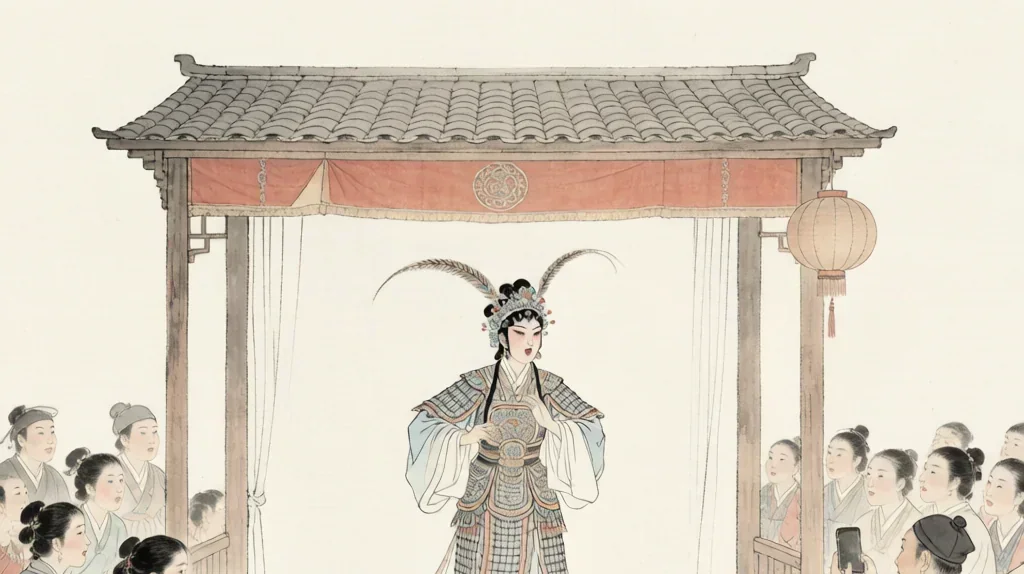
If you travel across China and ask people to name a regional opera, Henan Opera — or Yu Opera — will be one of the most common answers. With more professional performers than any other Chinese opera form, this vibrant tradition from the Central Plains has captured hearts with its bold, powerful sound and deeply relatable stories. From village stages to national television, Yu Opera is the voice of China's heartland.
Roots in the Central Plains: The Birth of Yu Opera in Henan
Yu Opera (豫剧) takes its name from "Yu" (豫), the ancient abbreviation for Henan province, the cradle of Chinese civilization in the Yellow River valley. The form emerged in the late Ming dynasty (1368–1644) and matured through the Qing dynasty (1644–1912), drawing on the rich musical traditions of the region. Henan's location at the geographic heart of China made it a crossroads of cultural exchange: the bangzi (clapper) style originated in neighboring Shanxi and Shaanxi and traveled eastward along trade routes, while local folk songs from Henan's vast agricultural plains contributed melodic material. The opera's early development centered on the cities of Kaifeng and Luoyang — both ancient capitals — where teahouses and temple fairs provided venues for performances. Unlike the court-sponsored operas of the imperial capital, Yu Opera thrived as a genuinely popular art form, shaped by the tastes and concerns of common people who filled the outdoor stages. By the early 20th century, Yu Opera had grown from a regional curiosity into the dominant theatrical form of the Central Plains, with hundreds of traveling troupes crisscrossing the province.
Chang Xiangyu: The Voice That Defined a Century
No figure looms larger in Yu Opera history than Chang Xiangyu (常香玉, 1923–2004), the towering performer who became the art form's most celebrated ambassador. Born Chang Miaoling in Gongxian, Henan, she began training at age nine under her father, a Yu Opera actor who had himself been a performer in the declining years of the Qing dynasty. Her father's teaching methods were notoriously harsh — he beat her when she made mistakes, drove her to practice for hours in freezing cold, and refused to let her rest until she mastered each aria. This brutal training produced a performer of extraordinary technical accomplishment. By her teenage years, Chang Xiangyu was already a leading actress in Kaifeng's most prestigious troupes, acclaimed for her crystalline voice and her ability to convey profound emotion across the vast distances of open-air theaters.
Chang Xiangyu's most defining achievement was her performance as Hua Mulan, which she debuted in the 1940s and refined over decades. Her interpretation of Mulan's signature aria "Who Says Women Are Inferior to Men?" (谁说女子不如男) became a cultural landmark — its melody known to generations who had never seen a full Yu Opera performance. Beyond her artistic contributions, Chang Xiangyu was also a figure of extraordinary patriotism: during the Korean War (1950–1953), she led a nationwide fundraising tour, performing over 170 shows in 15 cities, and donated the entire proceeds to purchase a MiG-15 fighter plane for the Chinese People's Volunteer Army. This act made her a national hero, and she was later appointed to the Chinese People's Political Consultative Conference. When she died in 2004, tens of thousands lined the streets of Zhengzhou to pay their respects. Her unique vocal style — clear, penetrating, and emotionally direct — became the foundation of the "Chang School" (常派), the most influential of Yu Opera's four great performance schools.
Classic Repertoire: Mulan, Mu Guiying, and the Judge Bao Cycle
Yu Opera's repertoire centers on stories that resonate with the values and experiences of ordinary people. The most famous work is "Hua Mulan" (花木兰), adapted from the ancient folk ballad about the woman warrior who disguised herself as a man to take her aging father's place in the army. The Yu Opera version, perfected by Chang Xiangyu, transforms the ballad's brief narrative into a full-length drama of family loyalty, martial valor, and gender defiance — its climactic aria has become an anthem of female empowerment throughout China. The role of Mulan demands extraordinary range: the performer must project the tenderness of a daughter leaving home and the ferocity of a general leading cavalry charges, often switching between these registers within a single scene.
"Mu Guiying Takes Command" (穆桂英挂帅) is another cornerstone of the Yu Opera repertoire, featuring a fierce female general from the Song dynasty who steps out of retirement to lead the army when her country is threatened. The character of Mu Guiying — bold, brilliant, and unapologetically powerful — has made this one of the most frequently performed Yu Opera works, especially since the 1950s, when a film version starring Ma Jinfeng (founder of the Ma School) brought it to national prominence. The "Judge Bao" cycle of plays forms the third pillar of the repertoire. Bao Zheng (包拯), the Song dynasty official famous for his incorruptibility, is a folk hero in Yu Opera: in plays like "The Case of the Beheaded Son" (斩子) and "The Case of Qin Xianglian" (秦香莲), Judge Bao fearlessly prosecutes corrupt officials and even his own relatives, embodying the ideal of justice that ordinary people could rarely find in real-life courts. The Judge Bao roles are performed by the "flower face" (花脸) vocal type, with a deep, powerful delivery that audiences find thrilling.
The Sound of the Central Plains: Bangzi Clapper, Bangqiang, and the Yu Opera Orchestra
The distinctive sound of Yu Opera is rooted in the bangzi (梆子) tradition, named after the hardwood clapper that beats time with a sharp, commanding pulse. The clapper player, known as the "bangzi master" (梆子头), is the de facto conductor of the orchestra, controlling tempo and dramatic tension throughout the performance. What distinguishes the Henan bangzi tradition from its regional cousins is its characteristic rhythmic pattern called "bangqiang" (帮腔) — a technique in which the percussion section and the chorus echo the lead singer's phrases, creating a call-and-response texture that intensifies emotional climaxes. The leading melodic instrument is the banhu (板胡), a high-pitched two-stringed fiddle with a coconut-shell resonator, whose penetrating, slightly nasal tone is instantly recognizable as the signature sound of Yu Opera. The erhu (二胡) provides the middle register, the zheng (筝) adds harmonic depth, and the suona (唢呐) — a double-reed horn — blasts triumphant fanfares during military scenes.
The vocal technique of Yu Opera is as demanding as its instrumental accompaniment. Performers are trained from childhood to project without amplification, using a technique called "zhengsheng" (正声) that originates deep in the diaphragm and resonates through the chest cavity. The vocal style varies dramatically by role type: dan roles (young women) use a bright, piercing falsetto that can cut through the noise of a crowded temple fair; sheng roles (male scholars) employ a more moderated tenor; jing roles (painted-face characters) project with a deep, gravelly roar; and chou roles (clowns) use deliberately exaggerated, comic vocal effects. Students typically begin training between ages eight and twelve, spending the first three years exclusively on breath control and vocal exercises before being permitted to study any repertoire. This rigorous foundation produces voices capable of sustaining three-hour performances, six nights a week, for decades — a level of vocal stamina that astonishes audiences accustomed to amplified modern entertainment.
The Four Great Schools and the Modern Legacy
Yu Opera's 20th-century golden age was marked by the emergence of four distinctive performance schools, each founded by a master performer whose style continues to define the tradition today. The Chang School (常派), founded by Chang Xiangyu, is characterized by its clear, penetrating vocal quality and emotionally direct expression. The Chen School (陈派), established by Chen Suzhen, is known for its lyrical elegance and refined character interpretations. The Cui School (崔派), created by Cui Lantian, specializes in tragic roles with extraordinary emotional depth. The Ma School (马派), founded by Ma Jinfeng, is distinguished by its vigorous energy and powerful martial performances. These schools ensure the systematic transmission of knowledge from master to disciple, and connoisseurs take delight in comparing how different schools interpret the same aria. Today, Yu Opera continues to thrive: Henan Television operates a dedicated Yu Opera channel broadcasting 24 hours a day, and the annual "Yu Opera Star" competition attracts thousands of young contestants. As the clapper strikes its first beat and the bold, unmistakable sound fills the air, this is the voice of the Central Plains — still strong after four centuries.
Yu Opera's Vocal Training and Technique
Yu Opera demands a voice built for open-air power, because its audiences have always been the crowds of temple fairs and village squares. Performers train from childhood using a diaphragm-centered technique that lets them project without amplification across a noisy fairground. The vocal color shifts by role: young female leads use a bright, piercing tone, male scholars a moderated tenor, painted faces a deep roar, and clowns exaggerated comic effects. Students typically begin between eight and twelve, spending years on breath and exercise before touching repertoire, a foundation that yields the stamina for three-hour shows six nights a week. This rigorous, body-first training is why Yu Opera voices sound so immediate and why the form feels like the speech of the Central Plains made song. Mastery is measured not in ornament but in the ability to carry plain emotion to the farthest row.
Yu Opera Costumes and Stagecraft
Yu Opera costumes signal character through the familiar opera grammar of color and cut: a general's flags mean command of an army, a judge's black face means uprightness, a scholar's fan means refinement. Yet the staging leans popular rather than courtly, favoring clear, vigorous action that reads easily to a broad rural audience. The bangzi clapper and the responding chorus give scenes a rhythmic drive, and military plays such as Mu Guiying Takes Command make full use of stylized combat. Because the repertoire centers on figures the common people admire, Mulan, Mu Guiying, and the just Judge Bao, the visual world is one of bold, recognizable types rather than subtle abstraction. This directness is the point: Yu Opera is theatre for the heartland, designed to be understood at once and remembered by tune, so its staging serves the story and the song above all else.
Yu Opera in Contemporary Media
Yu Opera is unusual among regional operas for its strong presence in modern media. Henan Television runs dedicated opera programming that reaches audiences far beyond the live stage, and the annual Yu Opera Star contest draws thousands of young hopefuls who keep the schools and arias in public view. New plays on contemporary themes and updated stagings test whether the bangzi sound can speak to urban, digital audiences without losing its plainspoken soul. At the same time, classics such as Hua Mulan and the Judge Bao cycle remain steady favorites on broadcast and online platforms, where clips of famous arias gather new fans. This media footprint helps explain why Yu Opera has more professional troupes than any other Chinese form. The challenge ahead is the familiar one, balancing heritage with relevance so that the voice of the Central Plains keeps filling rooms in a changed China.
❓ Frequently Asked Questions
📝 Chinese Vocabulary
- 豫剧 — Yu Opera, the regional opera of Henan province
- 梆子 — Wooden clapper, the percussion instrument that names this opera family
- 花木兰 — The legendary woman warrior, star of Yu Opera's most famous work
- 常香玉 — Chang Xiangyu, the most celebrated Yu Opera performer of the 20th century
- 谁说女子不如男 — "Who says women are inferior to men?", Mulan's famous aria
🎉 Fun Facts
- Yu Opera has the largest number of professional troupes and performers of any Chinese opera form — over 1,600 professional companies.
- During the Korean War, Chang Xiangyu donated a fighter plane to the Chinese military by performing a nationwide fundraising tour — she performed over 170 shows.
- Yu Opera is one of the few regional operas with a significant presence on national television, with dedicated channels and programs.
- Yu Opera grew out of the bangzi clapper tradition that traveled east from Shanxi and Shaanxi along Henan's trade routes.
- The four great schools, Chang, Chen, Cui, and Ma, are named after master performers whose styles are still taught and compared by connoisseurs.
- The annual Yu Opera Star competition draws thousands of young contestants, showing the form's continuing pull on new generations.