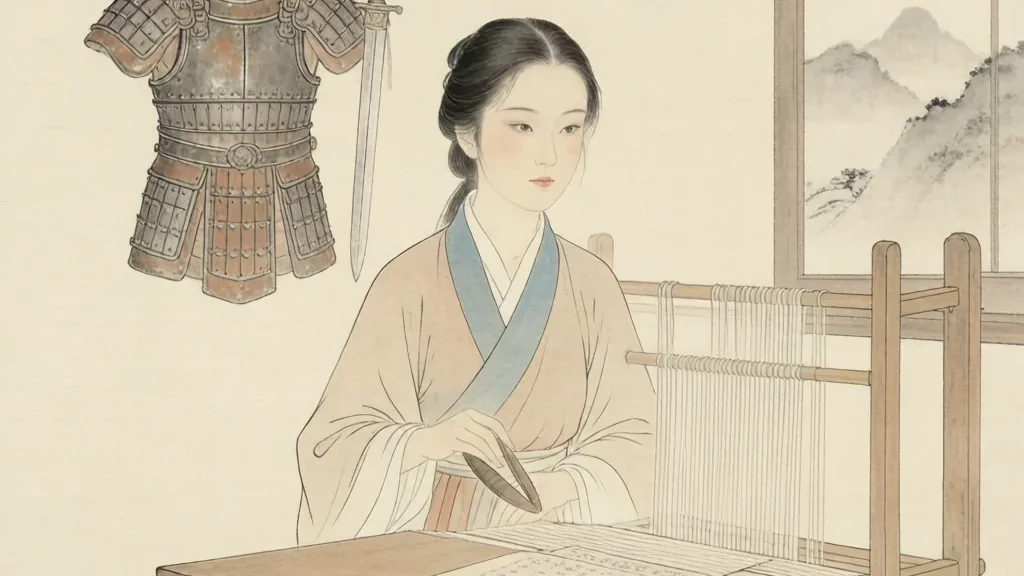
At the loom she sat, weaving cloth, when the imperial messenger arrived with terrible news: the Khan had ordered a great mobilization, and every household must send one man to war. Her father's name was on the conscription rolls—an old man, weakened by age, who would surely die on the battlefield. She had no elder brother to take his place. And so, in one of the most famous moments in Chinese legend, Mulan made her choice. She would go to the market, buy a horse and saddle, cut her hair, and ride to war in her father's stead.
This is the opening of the Ballad of Mulan, a poem first recorded in the sixth century CE that has become one of the most beloved stories in Chinese culture. It tells of a young woman who disguised herself as a man and served in the army for twelve years, fighting alongside her fellow soldiers without anyone discovering her secret. The tale is simple, even stark—the original ballad is only about three hundred characters long—but its power has resonated across centuries and continents.
The Original Ballad
The Ballad of Mulan first appears in a collection called the Musical Records of Old and New, compiled during the Northern Wei Dynasty (386–534 CE). This was a period of near-constant warfare between the northern Chinese states and the nomadic peoples of the steppe. The ballad reflects this martial reality, opening with the clatter of the loom and moving swiftly to the clang of weapons and the thunder of hooves.
In its original form, the ballad is remarkably free of sentimentality. Mulan does not agonize over her decision. She does not deliver speeches about gender equality or women's rights. She simply sees a problem—her father will die if he goes to war—and solves it in the most direct way possible. The poem's power comes from this matter-of-factness, which makes Mulan's courage feel all the more authentic.
The ballad describes her preparations with concrete, almost documentary detail. She goes to the eastern market for a horse, the western market for a saddle, the southern market for a bridle, the northern market for a whip. This repetition—each market visited in turn—conveys both the thoroughness of her preparations and the enormity of what she is undertaking. She is not just buying supplies; she is transforming herself from a weaver into a warrior.
Then comes the war itself. The ballad compresses twelve years of combat into just a few lines, describing the harsh conditions—the cold of the northern nights, the flash of armor in the moonlight—and the deaths of countless soldiers. "Generals die in a hundred battles," the poem says, "but stout soldiers return after ten years." Mulan is among the survivors, and she has distinguished herself so greatly that the Khan himself offers her a high official position as a reward.
The Journey Home
Mulan refuses the Khan's offer. She does not want power or prestige; she wants only to go home. The Khan grants her request and sends an escort to accompany her. This is when the ballad delivers its most famous and emotionally powerful scene: the homecoming.
Her parents, hearing that their daughter is returning, come out of the city to meet her, supporting each other in their old age. Her elder sister, hearing that her younger sister is coming, puts on her finest dress and waits by the door. Her younger brother, hearing that his elder sister is coming, sharpens a knife to slaughter a pig and a sheep for the celebration feast.
Mulan enters her old room, opens the eastern chamber door, and sits on her western chamber bed. She removes her warrior's armor and puts on the clothes she wore before the war. She combs her hair by the window and applies her makeup before the mirror. When she emerges, transformed back into the woman she always was, her comrades are stunned. They have fought beside her for twelve years and never knew.
The ballad ends with Mulan's own words—the only direct speech she is given in the entire poem. She uses an analogy to explain her achievement: "The male hare kicks and scrabbles when running; the female hare's eyes are blurred and bleary. But when two hares run side by side, who can tell which is male and which is female?" The message is clear: in the heat of action, when character and ability are all that matter, the distinctions we draw between men and women lose their meaning.
Fact or Fiction?
Historians have long debated whether Mulan was a real person or a fictional creation. No contemporary historical records mention her, and the ballad itself contains anachronisms—references to institutions and customs that didn't exist simultaneously in any single historical period. The name "Mulan" means "magnolia flower," which may be a poetic invention rather than a historical name.
That said, the story may have roots in reality. Women warriors were not unknown in the nomadic and semi-nomadic cultures of northern China, where the harsh environment demanded that everyone contribute to defense. Archaeological evidence has uncovered female skeletons buried with weapons in regions corresponding to Mulan's supposed homeland. And the Tuoba people who ruled the Northern Wei Dynasty had traditions of female military participation that would have made Mulan's story more plausible to contemporary audiences than it might seem today.
Various locations across China claim to be Mulan's hometown, including Yucheng in Henan Province and Huangpi in Hubei Province. Temples and shrines dedicated to her can be found in several provinces, each with its own local legends and traditions. The multiplicity of claims suggests that Mulan belongs not to any single place but to the whole of Chinese culture.
Mulan in Chinese Literature
The Ballad of Mulan has inspired countless adaptations and retellings throughout Chinese literary history. During the Tang Dynasty, the poet Wei Yuanfu wrote an expanded version that added romantic elements, giving Mulan a love interest and a more conventionally feminine ending. During the Ming Dynasty, the playwright Xu Wei wrote The Female Mulan Joins the Army in Her Father's Place, which introduced the character's bound feet—an anachronism that created dramatic tension between Mulan's warrior identity and the feminine ideal of the period.
The Qing Dynasty novel The Complete Account of the Extraordinary Mulan expanded the story into a full-length narrative, adding villains, subplots, and a tragic ending in which Mulan, rather than returning to a quiet life, takes her own life rather than submit to the emperor's demand that she become his concubine. This darker version reflects changing attitudes toward female virtue and imperial power.
In each era, writers have reshaped Mulan's story to reflect their own values and concerns. The Tang Dynasty emphasized her filial piety; the Ming Dynasty grappled with gender norms; the Qing Dynasty added tragic pathos. The core elements—the disguise, the war, the revelation—remain constant, but the meaning of the story shifts with the times, making Mulan a mirror in which each generation sees its own image.
Mulan Goes Global
In the twentieth century, Mulan's story transcended Chinese culture to become a global phenomenon. The 1998 Disney animated film Mulan introduced the character to audiences around the world, transforming her into an international icon of female empowerment. The film took significant liberties with the source material—adding a comic dragon sidekick, a romantic subplot with a military captain, and a dramatic confrontation with the Hun leader—but it preserved the essential heart of the story: a daughter's love for her father and her courage in defying social expectations.
The Disney adaptation sparked both celebration and critique. Many Chinese viewers appreciated the global attention the film brought to their cultural heritage, while others criticized its Americanization of the story—the individualistic framing, the romantic plot, and the departures from the ballad's more understated tone. The 2020 live-action remake further complicated the cultural conversation, adding fantasy elements and removing the musical numbers that had made the animated version so beloved.
Yet the very fact that Mulan's story can generate such passionate debate across cultures testifies to its enduring power. Few figures from ancient folklore have proven so adaptable, so capable of speaking to audiences separated by centuries and continents. Whether in a sixth-century ballad, a Ming Dynasty play, a Disney musical, or a modern novel, Mulan continues to inspire.
Why Mulan Endures
The secret of Mulan's longevity lies in the story's elegant simplicity. At its core, the Ballad of Mulan is about the tension between social roles and individual character. Mulan does not set out to challenge gender norms or to prove that women are equal to men. She simply sees a loved one in danger and acts to protect him, drawing on abilities that society did not expect her to possess. Her heroism is not ideological but personal—which makes it all the more relatable.
The story also embodies one of the most fundamental Confucian virtues: filial piety. Mulan's decision to take her father's place is the ultimate expression of devotion to family. But the story complicates this traditional value by showing that true filial piety sometimes requires breaking other social rules. Mulan cannot be a good daughter in the conventional sense—staying home, marrying, bearing children—and also save her father. She must choose between competing obligations, and her choice reveals that virtue is not about rigidly following rules but about discerning what love requires in a particular situation.
Perhaps most importantly, Mulan's story offers a vision of wholeness. She is not forced to choose permanently between being a warrior and being a woman. She can be both. She can ride to war and return to the loom. She can command the respect of generals and delight in her old clothes and her reflection in the mirror. In a world that often demands that people—especially women—fit into narrow categories, Mulan's ability to move between worlds while remaining true to herself is profoundly liberating.
The final image of the ballad captures this wholeness perfectly. The two hares run side by side, indistinguishable. The point is not that gender doesn't exist, but that in the full flow of life, in the heat of action and the depth of love, the categories we construct to separate people from one another dissolve into irrelevance. What remains is character, courage, and the bonds of family—the things that make Mulan's story, after fifteen centuries, still feel urgent and true.
Mulan's Symbolism in Modern China
In modern China, Mulan serves several purposes at once. Schools present her as a lesson in filial piety and patriotism, while writers and filmmakers recast her as a pioneer of female courage in a society still negotiating gender roles. The state has embraced her as a cultural emblem that travels well abroad, and her image appears in textbooks, posters, and tourist sites that claim her hometown. At the same time, feminists read her story against the grain, asking whether true freedom lay in returning to the loom. These shifting uses show that Mulan is less a fixed character than a screen on which each generation projects its own hopes about family, duty, and the rights of women.
The Ballad's Poetic Craft
The original Ballad of Mulan is a small masterpiece of technique. Its famous catalogue of markets, east, west, south, north, uses repetition to show the thoroughness of Mulan's preparation and the scale of her resolve. The cold of the night camp and the flash of armor are compressed into a few lines that carry twelve years of war. Most striking is the closing image of two hares running side by side, a plain spoken analogy that dissolves the line between male and female in the heat of action. With only about three hundred characters the poem achieves character, plot, and a quiet philosophical punch, which is precisely why it has outlasted far longer works.
❓ Frequently Asked Questions
📝 Chinese Vocabulary
- 花木兰 (Huā Mùlán) — Hua Mulan, literally "Magnolia Flower"
- 木兰辞 (Mùlán Cí) — The Ballad of Mulan, the original sixth-century poem
- 孝 (Xiào) — Filial piety, the Confucian virtue that motivates Mulan's actions
- 女扮男装 (Nǚ bàn nán zhuāng) — "Woman disguised as man," a common motif in Chinese literature
- 唧唧复唧唧 (Jījī fù jījī) — The opening words of the ballad, representing the sound of weaving
🎉 Fun Facts
- The original Ballad of Mulan is only about 300 Chinese characters long—shorter than this Fun Facts section—yet it has inspired thousands of adaptations across every medium imaginable.
- The surname "Hua" (meaning "flower") was not part of the original ballad; it was added by later writers, possibly to make the name more poetic.
- Mulan has a crater on Venus named after her, recognized by the International Astronomical Union for her cultural significance.
- Mulan's story was carved into a stone inscription as early as the Tang dynasty, showing how quickly it entered official culture.
- In some northern Chinese villages she is honored in local temple festivals as a protector of families.
- The 2020 live-action film added a phoenix as her ancestral spirit, a wholly new symbol absent from the old ballad.