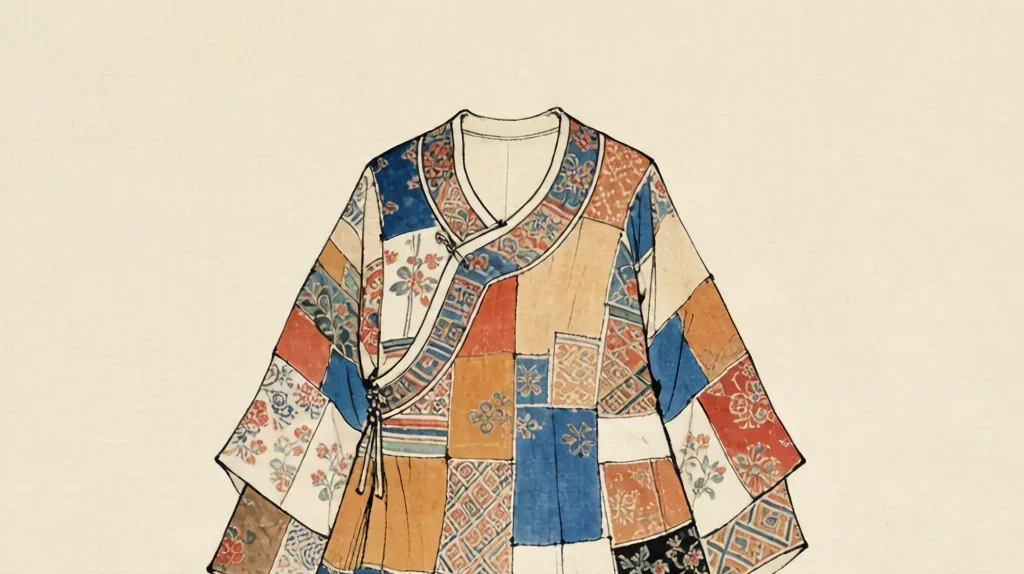
The baijiayi (百家衣), or "hundred-family jacket," is a traditional Chinese garment made for infants from scraps of cloth collected from many households. Far from being merely patchwork, it is a protective charm: by gathering bits of fabric from a hundred families, the baby is thought to be wrapped in the collective blessing and guardianship of the whole community, warding off illness and evil spirits. The custom reflects a deep cultural belief that a child's survival depends not only on the parents but on the goodwill of society at large.
Origins and Folk Belief
The making of a baijiayi belongs to a family of "hundred-family" protective customs (百家) in which objects are assembled from many donors to spread risk and gather luck. The underlying idea is that a child who is "claimed" by no single family alone, but blessed by many, is less likely to be targeted by malevolent forces that prey on the vulnerable.
In a time when infant mortality was high, such shared garments expressed both practical neighborliness and a magical appeal for communal protection.
How the Cloth Was Gathered
To make a true baijiayi, a grandmother or mother would go from door to door asking relatives, friends, and even strangers for a small piece of old clothing or leftover cloth. Pieces from a hundred households were ideal, though in practice any substantial number would do. The donors were often chosen to include families with healthy, long-lived children, passing on their good fortune.
The collected scraps were then sewn into a single jacket, each patch a tiny token of another family's goodwill.
Design and Materials
The finished jacket is a kaleidoscope of colors and patterns, since the scraps come from many sources. Quilted for warmth and made loose for ease of movement, it is typically worn over ordinary clothes. Some versions incorporate symbolic fabrics—a bit of a bride's gown, a scrap of a scholar's robe—to import wishes for happiness or success.
Though humble in origin, the garment is often finely pieced, the patchwork itself a display of the maker's care.
Protective Symbolism
The baijiayi works on several symbolic levels. The number "hundred" (百) signals abundance and the involvement of the whole community. The many-colored patches confuse evil spirits, who cannot "recognize" the child as a single, vulnerable individual. And the act of receiving gifts binds the baby into a web of social obligation and care.
Such logic is common in Chinese folk protection: diffuse the child's identity, multiply its protectors, and dilute its misfortune.
Relations to Other "Hundred-Family" Charms
The jacket belongs to a set of related customs. The baijia su (百家锁), a "hundred-family lock," is a silver ornament bought or collected coin by coin from many families and worn to "lock" the child's life in place. The baijia zhou (百家粥), a "hundred-family congee," is shared to spread blessing. Together they show a systematic folk technology of communal protection.
These objects are often given at the "hundredth-day" celebration (百日) or first birthday, milestones when the baby was considered past its most fragile stage but still in need of guarding.
Regional Practice
The custom has been especially strong in north China, though analogous patchwork baby clothes appear in many regions. In some villages the mother would beg the cloth as a deliberate act of humility, since being "poor" before the spirits could make the child seem unworthy of their envy.
Local naming varied, but the purpose—a safeguarded, blessed infancy—was consistent.
From Magic to Memory
In the modern era the baijiayi has largely shifted from protective necessity to cultural keepsake. Grandmothers may still stitch one as a heirloom or for a photo at the hundredth-day rite, and museums and folk-art exhibitions display fine examples as expressions of maternal and communal love.
The garment thus survives as a tender artifact of how villages once raised a child collectively.
Continuity in the Present
Among overseas Chinese and in rural areas, the idea of gathering blessings from many families persists in subtler forms—group gifts, shared naming ceremonies, and community baby celebrations. The baijiayi remains the most vivid symbol of the belief that a child belongs first to the community that helps keep it alive.
It is a small piece of cloth that carries a large social philosophy: no family is an island in the raising of its young.
The Baijiayi as a Record of Community
Beyond its protective purpose, the hundred-family jacket is a social document. Each patch records a relationship—a neighbor's kindness, a stranger's blessing, a friend's scrap of a treasured garment—so that the finished cloth maps the web of people who wished the child well. In close-knit villages this network of donors was nearly the whole community, making the jacket a soft census of local goodwill and a portrait of the bonds that held a place together.
Seen this way, the custom reveals a logic in which child-rearing is distributed rather than privatized. The baby belongs not only to its parents but to the circle that clothed it, a circle that would later help feed, teach, and marry the child. The baijiayi is therefore a quiet statement of mutual obligation, stitched from the everyday generosity of ordinary households rather than from any single family's wealth.
The garment also softened the hard edge of poverty. By asking for cloth rather than money, a family could gather protection without shame, and donors gave gladly, knowing their small scrap joined a greater shield. In this economy of scraps, a child's safety was measured not in coins but in the number of hands that reached out to keep it alive, a communal arithmetic of care that the patchwork makes visible.
❓ Frequently Asked Questions
What is a baijiayi?
It is a patchwork baby jacket made from cloth collected from many families, worn as a charm to protect an infant from illness and evil.
Why use cloth from many families?
The shared scraps wrap the child in the community's collective blessing and protection, spreading risk and goodwill.
How does it protect the child?
The many-colored patches were believed to confuse malicious spirits and the many donors multiplied the child's guardians.
Is it the same as a hundred-family lock?
No, but related: the lock is a silver ornament that "locks" the child's life, while the jacket is sewn clothing; both gather communal blessing.
When was it given?
Often at the hundredth-day or first-birthday celebration, key milestones in an infant's early life.
Do people still make it?
Mostly as a keepsake or folk-art heirloom today, though the idea of community blessing at birth persists in softer forms.