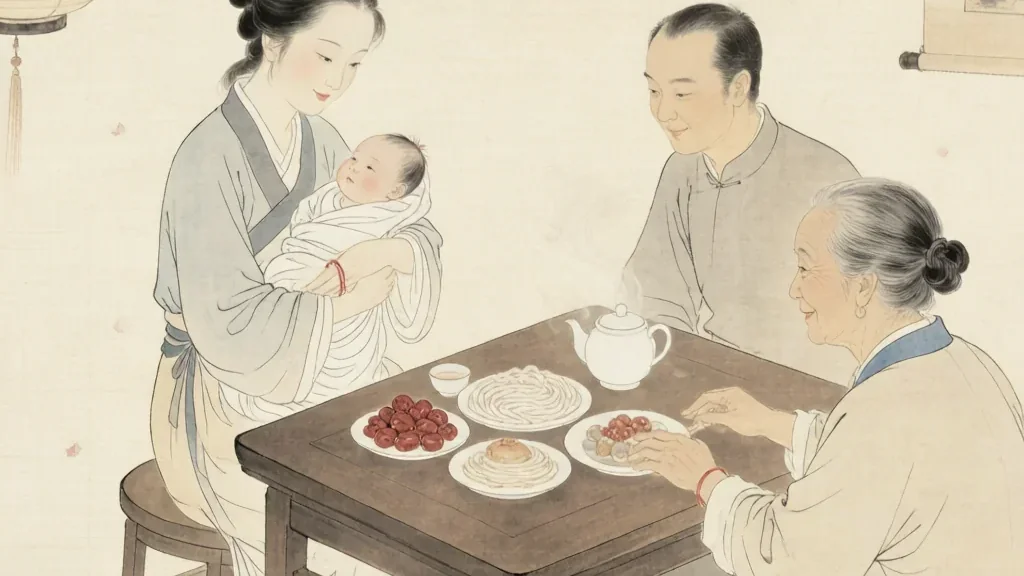
Thirty days after a child is born, Chinese families mark one of the happiest milestones in the domestic calendar: 满月 (Mǎn Yuè), the "full month" celebration for a newborn. This is the day a baby is formally introduced to the wider family and community, and it arrives wrapped in food, red eggs, and heartfelt wishes for health and a long life. More than a party, the full-month feast is a public acknowledgment that the infant has survived its most fragile first weeks and is now, by custom, securely part of the world. Understanding Mǎn Yuè opens a window onto Chinese attitudes toward birth, kinship, and the communal sharing of joy.
The Significance of the Thirtieth Day
In traditional belief the first month of life was the most perilous, and reaching the full month was a genuine cause for relief and celebration. The Mǎn Yuè feast therefore doubles as a thanksgiving: thanks that mother and child are well, and a welcome extended to relatives and friends who had, in the early days, kept their distance to protect the vulnerable pair. The baby is often dressed in new clothes and, in older custom, taken outdoors for the first time on or near this day.
The celebration also serves a social function. It announces the birth widely, cements the child's place in the lineage, and renews the network of mutual support among relatives. Gifts of money, clothing, and gold trinkets flow to the baby, while the hosts reciprocate with symbolic treats that carry the family's good wishes back out into the community.
Traditional Foods of the Feast
No full-month celebration is complete without hong dan, hard-boiled eggs dyed red, the premier symbol of happiness and new life. These are given to guests and sent to friends and neighbors, often in pairs, as edible announcements of the birth. Another staple is hong shao rou or special noodles, and in the south a savory rice dish may be served, all chosen for auspicious color and meaning.
The mother's own postpartum diet is central to the occasion and overlaps with the confinement month. She is fed nourishing, warming foods, think ginger, sesame oil, and bone broths, intended to restore her strength. Guests may be offered "longevity noodles" for the baby's future, and sweet soups symbolizing a smooth, sweet life. Food here is medicine, omen, and hospitality at once.
Gifts and Red Eggs
The red egg deserves special note. Eggs themselves suggest fertility and the rounding of life, and the red dye marks festivity and protection. Customarily the number given signals the baby's sex in some regions, an even number for a girl and an odd number for a boy, though today families often simply give a generous handful. Receiving red eggs obliges the guest to share in the family's joy and, often, to return a small gift.
Other presents include gold or silver locks and bangles, tiny hats and shoes, and cash in red envelopes. The longevity lock, in particular, is frequently first bestowed at the full month, a silver charm meant to "lock in" the child's life force. Together these gifts form a material chorus of protection around the newest, weakest member of the clan.
Rituals of Introduction
The heart of Mǎn Yuè is the baby's formal introduction. In earlier times the infant might be carried to the ancestral altar so that forebears could "meet" the new member, and relatives would take turns holding and blessing the child. A name-giving element sometimes accompanies the feast, though many families settle the name earlier; either way, the day confirms the baby's social birth even more than its biological one.
Photographs now play the role the altar once did, capturing the moment for relatives near and far. The mother, having completed her confinement, reappears among guests, and the gathering becomes a kind of debut for both her and the child. What was, a month before, a private and risky event is now a shared and celebrated one.
Regional and Modern Variations
Customs differ by region and dialect group. Among southern Chinese, the sending of red eggs and a glutinous-rice dish to neighbors is elaborate, while northern families may emphasize noodles and dumplings. Overseas communities blend local practice with homeland custom, holding full-month parties in restaurants and sharing the news through group chats when relatives cannot travel.
Urban families today often host the celebration in a banquet hall and pair it with professional photography, yet the essentials remain: red eggs, well-wishers, and the wish for the child's safe thriving. The form scales up or down with means, but the emotional core, relief, gratitude, and welcome, stays constant across wealth and place.
A Communal Welcome
Perhaps the deepest meaning of Mǎn Yuè is that a birth is never only a family's business. By feeding neighbors, distributing red eggs, and opening the home, the family declares that this small life belongs to a web of relations and will be looked after by many hands. The full-month feast is the ritual by which the individual is woven into the collective from the very start.
In a culture that balances the fragility of infancy against the strength of community, the celebration teaches a quiet lesson: joy shared is joy secured. The red eggs travel from door to door, carrying not just news of a birth but an invitation to coauthor the child's future with blessings, gifts, and care.
The Mother's Month of Confinement
The full-month feast is the public face of a private practice, zuoyuezi, the month of postpartum confinement the mother observes from birth. During these thirty days she rests indoors, follows a warming diet of ginger, sesame oil, and bone broths, and is shielded from cold and exertion while her body recovers. The confinement is taken as seriously as the celebration that ends it, and relatives often rotate in to cook and care for her and the infant. When the full month arrives, her reappearance among guests marks the moment she rejoins household life, and the feast doubles as her own debut after weeks of seclusion. Seen this way, the red eggs announce two recoveries at once, the baby's survival and the mother's renewal.
Ancestors and the Lineage: Welcoming a New Member
In earlier custom the full month was also the infant's formal entry into the family line. The baby might be carried to the ancestral altar so forebears could 'meet' the newest member, and elders would take turns holding and blessing the child in a sequence that confirmed its place among the living and the dead. A name, settled earlier or chosen for the occasion, was spoken aloud as part of this recognition, so the day served as a social birth as much as a biological one. Though photographs and group chats have replaced the altar for many families, the underlying act remains: the lineage formally receives the child. The feast is therefore less a party than an enrollment, writing one small name into a long continuing register of kin.
❓ Frequently Asked Questions
📝 Chinese Vocabulary
满月 — : full month, the newborn's thirtieth-day celebration.
红蛋 — : red-dyed eggs given to mark a birth.
宴 — : a banquet or feast.
寿面 — : longevity noodles symbolizing a long life.
坐月子 — : the postpartum month of confinement.
长命锁 — : the longevity lock, a silver charm given to lock in a child's life force and protect it through a fragile infancy.
报喜 — : announcing the good news; the family's first act of telling relatives and neighbors of a birth, often with red eggs.
姜醋 — : ginger-vinegar pork, a warming postpartum dish in Cantonese regions served to help the mother recover during confinement.
🎉 Fun Facts
- Red eggs at a full-month feast can symbolize the baby's sex by their number in some regional customs.
- The celebration traditionally doubles as the end of the mother's confinement month.
- The longevity lock is often first given to a baby at the full-month party.
- Distribution of red eggs to neighbors is a centuries-old way of announcing a birth.
- In many families both the maternal and paternal grandparents host their own full-month gatherings, so a single baby may be celebrated at two separate feasts.
- The mother's confinement menu, ginger, sesame oil, and bone broths, is believed not only to nourish but to help her body recover from childbirth before she returns to daily life.