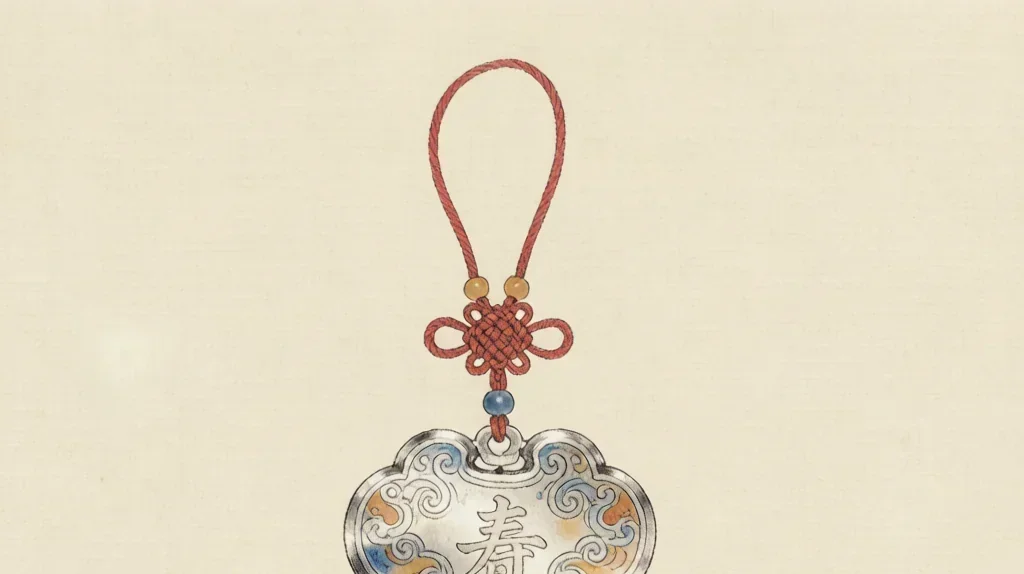
Worn around the neck of countless Chinese toddlers, the 长命锁 (Cháng Mìng Suǒ), or "longevity lock," is one of the most endearing objects in Chinese folk custom. Usually a silver pendant shaped like a padlock or a stylized plaque, it is inscribed with wishes for a long life and tied with a red cord. Given to children to "lock in" their vital energy and shield them from early death, the charm sits at the meeting point of love, anxiety, and artistry. To trace the longevity lock is to see how ordinary families have, for centuries, tried to buy a little safety for their most precious and fragile members through silver, symbol, and prayer.
What the Longevity Lock Is
The Cháng Mìng Suǒ is a small ornament, most often of silver though sometimes gold or gilt, worn on a cord around a young child's neck or, in some regions, attached to the cap. Its form mimics an old-fashioned lock, complete with a hasp and keyhole, and its surface is engraved with characters such as chang ming fu gui (long life, wealth, and honor) or simply chang ming (long life). The lock is purely symbolic; no key is meant to open it.
Behind the shape lies a metaphor: life is a treasure that can slip away, and the lock keeps it secure. The child is "locked" to the world of the living and protected from the wandering spirits or bad luck thought to threaten infants. Worn close to the body, the silver itself was also believed to detect and draw out poison, an added practical reassurance in an age of high infant mortality.
Origins and Folklore
The custom likely grew from ancient beliefs in "continuation locks" and from the widespread fear of child death, amplified by the high mortality of premodern times. Similar protective locks appear in various cultures, but the Chinese version became richly specific, tied to the worship of the Star of Longevity and to local gods who could grant years. By the Ming and Qing dynasties the longevity lock was a standard gift for newborns and one-year-olds.
Folklore links the lock to several protective deities. In some areas a parent would "ask" the Star of Longevity or a local temple for the child's life, receiving a lock as a token. The idea that life is a measured quantity that can be borrowed, extended, or locked safe appears across Chinese legend, and the charm is a domestic expression of that belief, small enough for a baby to wear.
Who Gives the Lock and When
The lock is typically presented at the full-month celebration or the first birthday, often by grandparents, godparents, or a respected elder rather than the parents themselves, the distance adding to its protective power. In a touching variation, many families "beg" the lock from a temple or even from strangers, the humility of the request itself counted as merit that helps the child.
Sometimes the gift is collective: relatives each contribute a coin or a link, so the lock is literally woven from the community's goodwill. This shared origin mirrors the communal care that surrounds Chinese child-rearing, where a child is raised not only by parents but by an extended web of kin and neighbors, each adding a stitch of protection.
Symbolism of Silver and Red
Silver is chosen for reasons both symbolic and practical. Bright and cool, it was traditionally thought to neutralize toxins and to shine as a sign of purity, and it was affordable enough for common families yet precious enough to matter. The red cord that holds it is the universal Chinese color of luck and warding, binding the metal's virtue to the color's power.
The engravings do quiet theological work. Characters for longevity, wealth, and peace are not decoration but miniature petitions, repeated on the child's body day after day. To wear the lock is to wear a sentence of hope, a daily, silent wish spoken in metal and thread rather than words.
A Regional Craft
Longevity locks vary beautifully by place. Northern examples may be heavier and more ornate, southern ones finer and lighter; some are flat plaques, others three-dimensional mini-padlocks, and a few are worked with filigree, bells, or tiny coins. Local silversmiths developed distinctive patterns, and the best were heirlooms passed from one child to the next, their shine deepening with use.
In parts of Shaanxi and beyond, the lock appears within a larger set of "protective garments," while in other regions it is paired with silver bangles or a "centipede" whisk said to sweep away harm. The diversity shows a folk tradition healthy enough to localize, adapting a single idea, lock the life, to countless hands and styles.
The Lock in Modern Life
Today the longevity lock survives as both a cherished heirloom and a popular gift. Jewelry shops sell refined versions in gold and platinum for affluent families, while traditional silver locks remain common at births and first birthdays. Many urban parents, even those who scoff at superstition, happily clasp one on a child for its beauty and sentiment, a nod to custom that costs nothing and means much.
The charm's endurance testifies to a feeling no technology dispels: the wish to protect a child beyond one's own power. Whether or not anyone believes a silver lock can truly stop misfortune, the act of giving it, and the small weight a baby feels at the chest, carries love made tangible. That, more than any magic, is the lock's real strength.
Gods and Guardians of the Lock
Behind the charm lies a world of protective deities. Folk belief links the longevity lock to the Star of Longevity (Shouxing) and to local temple gods who could grant years of life. In many regions a parent would 'ask' a temple for the child's life and receive a lock as a token of that gift. The idea that life is a measured quantity that can be borrowed, extended, or locked safe appears across Chinese legend, and the lock is its domestic expression. Some locks are even shown in art held by a boy attendant of the god of longevity, reinforcing the sense that the charm is a blessing handed down from the divine. Worn close to the body, it kept the child under constant protection.
The Lock Across a Lifetime
Although best known as a baby's charm, the symbolism of the longevity lock reaches beyond infancy. Elders celebrating milestone birthdays such as sixty or eighty may also receive silver or gold locks, extending the wish for a long life across the whole span of existence rather than only its fragile beginning. In this way the lock marks both entry into life and the honored endurance of old age. The same red cord and silver plaque that once shielded a toddler later becomes a token of respect for the aged. Seen broadly, the longevity lock is part of a larger family of protective jewelry, its meaning shifting with the wearer's stage of life while its central hope, a long and safe journey, stays the same.
❓ Frequently Asked Questions
📝 Chinese Vocabulary
长命锁 — : longevity lock, a child's protective pendant.
长命 — : long life.
锁 — : lock.
银 — : silver, the traditional material of the charm.
百家锁 — : a lock "begged" from a hundred families for extra protection.
长命富贵 — : An inscription meaning 'long life, wealth, and honor,' frequently engraved on the surface of a longevity lock.
红绳 — : The red cord on which the lock is worn, binding the metal's protective virtue to the color of luck and warding.
满月 — : The full-month celebration held a month after a birth, a key occasion for presenting a child with a longevity lock.
🎉 Fun Facts
- Some longevity locks were "begged" from a hundred families, each contributing a coin for collective protection.
- Silver was traditionally believed to change color when it touched poison, adding a practical alert.
- The lock is often given by someone other than the parents to increase its protective power.
- Fine antique locks are still passed down as family heirlooms across generations.
- A matching 'hundred-families garment' (baijiayi) is sometimes made from cloth scraps donated by many households and worn together with the lock as a set of protective clothing.
- Modern jewelers still produce the lock in playful new forms, including cartoon shapes and bright enamel, showing how an ancient charm survives by reinventing its look.