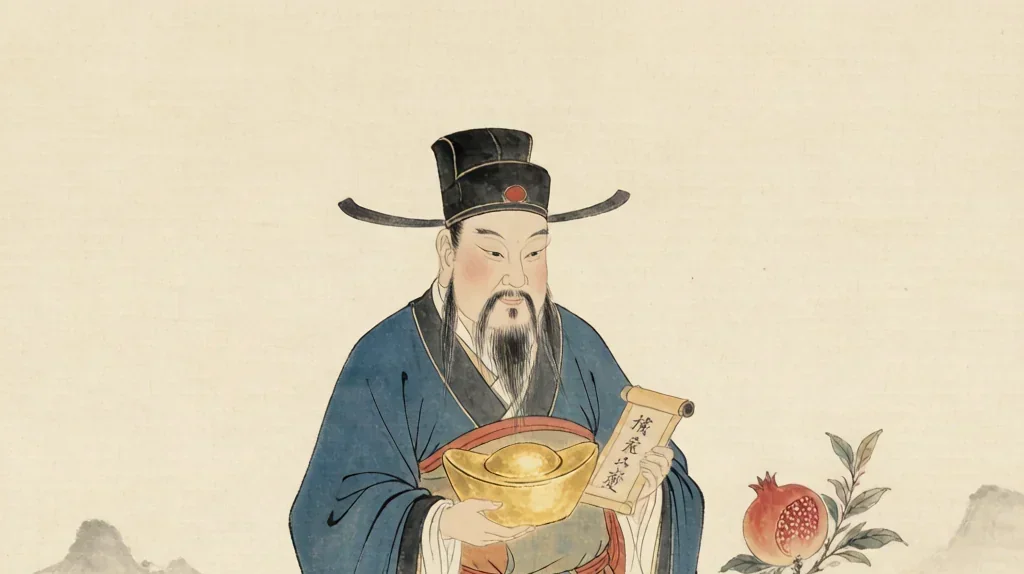
If there is one deity every shopkeeper, investor, and hopeful household wants on their side, it is 财神 (Cái Shén), the God of Wealth. Revered across China in several forms, Cái Shén presides over prosperity, commerce, and good fortune in material matters. His image, carried in parades, perched on altars, and printed on New Year cards, is a smiling invitation to abundance. Yet behind the gold and the grins lies a serious cultural grammar about how Chinese society has long balanced the pursuit of wealth with virtue, gratitude, and the proper timing of ambition. To welcome Cái Shén is to participate in a ritual of hope that is both pious and practical.
Who Is the God of Wealth?
Cái Shén is not a single fixed figure but a title shared by several deities, the most popular being the civil wealth god Bi Gan, a loyal minister of the Shang dynasty revered for his "heart" of fairness, and the martial wealth god Zhao Gongming, a formidable figure riding a black tiger. Regional cults add their own patrons, such as the merchant gods of specific trades. The plurality reflects wealth's many routes: honest administration, brave enterprise, and hard trade.
Despite the variety, the gods share traits: they are affluent, benign, and approachable, often shown holding ingots or a golden rod. Families invite them not to demand riches but to align themselves with the principle of prosperity. In a culture where business and family are intertwined, Cái Shén sits comfortably at the crossroads of the two, blessing both the ledger and the lineage.
Forms of the Wealth God
The civil and martial pair captures a neat cultural split. Bi Gan, the civil god, represents wealth through integrity and service, his open heart a symbol that fair dealing enriches. Zhao Gongming, the martial god, represents wealth through strength and protection, subduing the forces that threaten fortune. Some households keep both, covering the spectrum from office to battlefield of commerce.
Additional figures include the "Three Sisters" or localized gods like the seafarer's patron in trading ports. In folk art Cái Shén frequently appears with children or ingots, amplifying the wish for both wealth and heirs. The visual richness lets each family choose the face of prosperity that fits its dreams, a flexibility that has helped the cult flourish for centuries.
Welcoming Him at New Year
The grandest Cái Shén ritual falls on the fifth day of the first lunar month, known as "receiving the wealth god," when families open their doors before dawn, set off firecrackers, and lay out offerings to welcome him in. Shops time their reopening to this day, hoping his arrival blesses the year's trade. The earlier and louder the welcome, the better the omen.
In the days before, homes may have "sent him off" or simply prepared, sweeping and cooking so the house is worthy of a deity's visit. The fifth-day ceremony is essentially a business opening blessing, blending religion with commerce in a way that feels completely natural in Chinese life. Red banners and images of the god appear in every store, a collective bet on a prosperous year.
Offerings and Altars
Devotees place Cái Shén's image on a clean altar with offerings of fruit, especially oranges for luck, sweets, tea, and sometimes vegetarian dishes, avoiding meat at certain rites. Incense is burned, and prayers ask not only for money but for the wisdom and health to use it well. Some write a wish on paper and burn it as a message to the god, a small act of directed intention.
Propriety matters: the altar should face an auspicious direction, the offerings fresh, and the supplicant sincere. Folk manuals even advise which days are best for wealth prayers. Though elaborate, the core is simple gratitude plus request, the same posture a merchant might take toward a valued partner. The god is treated less as a master than as a generous collaborator.
Wealth, Virtue, and Balance
Importantly, Chinese tradition does not worship wealth for its own sake. Confucian teaching warns that profit pursued without righteousness corrupts, and the wealth gods themselves are often models of virtue, Bi Gan's fairness, Zhao Gongming's discipline. The proper wish is for "proper wealth" (义财), earned cleanly and shared with family and community, not windfall gained by harm.
This moral framing keeps the cult healthy. To welcome Cái Shén is to pledge, implicitly, that one will be a worthy recipient, honest in dealing and generous in giving. The god thus encodes a social contract: prosperity is a blessing that carries responsibility. The gold is real, but the character asked for is golden too.
Cái Shén in Contemporary Life
Today the God of Wealth thrives in advertising, red envelopes, and the gold-foil statues that crown shop entrances during the holiday. Fintech apps invoke him with digital "wealth trees" and lucky draws, and New Year cards still bear his smiling face. The forms digitize, but the wish, a year of enough, and then some, is unchanged.
His persistence underlines a durable Chinese attitude: that seeking prosperity is legitimate and even pious, provided it is tempered by virtue and gratitude. In welcoming Cái Shén, families perform an annual reconciliation of ambition and ethics, asking the universe for abundance while promising to remain decent custodians of it. That balance is the real fortune he brings.
The God of Wealth in Folk Art and New Year Prints
Caishen is among the most painted deities in Chinese folk art. New Year prints, or nianhua, show him as a smiling figure in official robes, holding gold ingots or a rod of wealth, often flanked by children who signal the wish for both riches and heirs. In richer compositions he rides a black tiger, scatters coins from a ladle, or stands before a threshold hung with the character for fortune. These images are not merely decorative; pasted on doors and ledgers they were thought to actively invite his presence for the year. The visual formulas are remarkably stable across centuries, which is why a print from a century ago looks kin to the god on a modern red envelope. The art keeps the deity familiar and approachable, a guest one can recognize and welcome at a glance.
Wealth Gods of Specific Trades
Beyond the famous civil and martial pair, local cults assigned a wealth patron to nearly every trade. Merchants of a particular goods, boatmen, and operators of market stalls each claimed a saint or immortal who watched over their livelihood, and small shrines to these patrons once stood inside guildhalls and shops. This multiplication made the abstract God of Wealth concrete: a trader could pray to the deity who understood his specific business. The pattern reflects a practical Chinese view of prosperity as earned through particular labors, not granted at random. Even today, business associations and market districts may keep a Caishen image or hold a small ceremony at the New Year, continuing the old logic that each trade has its own guardian of honest gain.
❓ Frequently Asked Questions
📝 Chinese Vocabulary
财神 — : the God of Wealth.
财富 — : wealth and riches.
迎财神 — : to welcome the God of Wealth.
义财 — : proper or righteous wealth.
元宝 — : silver or gold ingot, a symbol of riches.
赵公明 — : Zhao Gongming; the martial God of Wealth, shown riding a black tiger.
比干 — : Bi Gan; the civil God of Wealth, a Shang-dynasty minister famed for his fair heart.
利市仙官 — : The immortal official of profit; a helper deity who blesses trade and earnings.
🎉 Fun Facts
- The fifth day of the new year is the major "receive the wealth god" celebration and shop reopening.
- The civil wealth god Bi Gan was a historical Shang dynasty minister famed for his integrity.
- Cái Shén is often shown riding a black tiger in his martial form.
- Digital apps now invoke the god with "wealth trees" and lucky draws at New Year.
- In some shops the wealth god's image is pasted on the safe or the cash register, so prosperity literally guards the money.
- Folk plays and New Year prints often show Caishen riding a tiger while scattering ingots, a scene performed in street parades during the holiday.