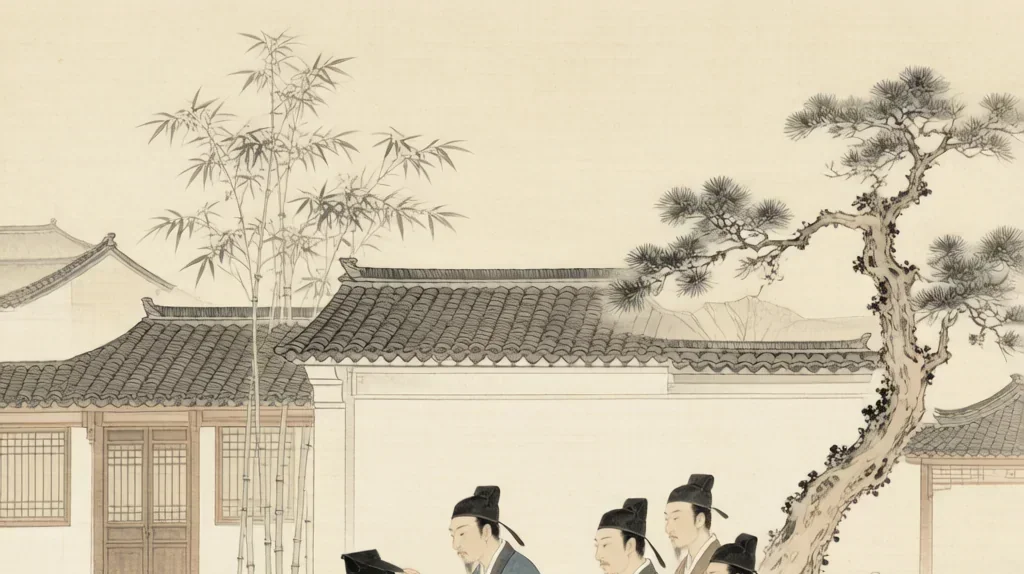
Long before a young man could be called an adult in traditional China, he had to pass through a single, solemn ceremony: the guàn lǐ, the "Capping Ceremony." Performed usually between the ages of fifteen and twenty, this rite marked the moment a boy's hair was gathered, pinned, and capped, and his childhood name replaced by an adult name. It was the male counterpart to the female hair-pinning rite, and it carried the full weight of a society that treated adulthood as something earned, not merely aged into. This article examines the capping ceremony's meaning, its steps, and its place in the Confucian vision of a well-ordered life.
The Meaning of the Cap
In classical China hair was never cut casually; the Book of Filial Piety teaches that body and hair are received from parents and must not be damaged. A boy therefore wore his hair loose or tied simply in childhood. To cap him was to gather that hair into a topknot secured by a pin, then set a formal cap upon it—a visible sign that he had put away childish ways and taken on the responsibilities of a man.
The cap also signaled a change in social standing. A capped youth could now participate in court rituals, be considered for office, and—crucially—marry. In a culture where rites (lǐ) were the grammar of society, wearing the adult cap meant the young man could finally speak that grammar correctly. The cap was not decoration; it was a license to belong to the adult moral community.
The Steps of the Ceremony
The guàn lǐ was conducted by a master of ceremonies, usually a respected male elder, with the father presiding. The youth was first dressed in a special robe. The officiant then placed the first cap—a simpler one—on the gathered hair, and the youth withdrew to change into finer clothes. A second, more formal cap followed, and in some accounts a third cap signifying readiness for official service was added for those of higher rank.
After the capping the youth received his zì, an "courtesy name" used by peers and elders in place of his given name, which was now reserved for parents and the ruler. He then bowed to his parents to show gratitude, to the guests to show respect, and finally visited the women of the household. Each bow deepened the message: adulthood meant new duties toward family and community, not new freedoms alone.
The Courtesy Name
The granting of the zì was one of the most memorable parts of the capping rite. A Chinese male of standing had two names: the míng, given at birth, and the zì, conferred at capping. The courtesy name was usually thematically linked to the given name and was the name friends, teachers, and colleagues used. To be addressed by one's zì was a mark of respect and recognition as an equal.
This dual-name system reflected the relational nature of Chinese identity. One name belonged to the intimate family sphere; the other to the public, social sphere. The capping ceremony was the hinge between them. Historical figures such as the poet Li Bai, whose zì was Taibai, are almost always remembered by such courtesy names, a habit rooted in this very rite.
Confucian Ideals of Adulthood
The capping ceremony was cherished by Confucians because it taught that maturity is performative and communal, not private. The Liji (Book of Rites) states that "a man is capped at twenty, and his character is established." Adulthood meant the capacity to take part in the rites, to govern, and to marry—all roles that served the larger order rather than the self.
Confucius and his followers saw the decline of such rites as a symptom of a decaying society. To revive the guàn lǐ was therefore a moral project: by marking adulthood clearly, a community raised young men who understood obligation before desire. The ceremony was less a party than a curriculum in responsibility, delivered in a single afternoon.
Decline and Revival
Over the centuries the capping ceremony faded from everyday practice, especially after the Tang and under the pressures of modernization in the twentieth century. The Qing fall and the May Fourth movement's suspicion of "old rites" further pushed it aside, and for much of the twentieth century it was rare outside scholarly circles. Hair-cutting fashions made the capped topknot look archaic.
In recent decades, however, there has been a quiet revival. Hanfu enthusiasts, Confucian academies, and some families stage guàn lǐ ceremonies for teenagers, viewing them as a meaningful alternative to Western-style coming-of-age parties. Schools in a few regions have even introduced simplified versions. The renewed interest suggests a hunger for rites that name the transition to adulthood with gravity rather than consumer flourish.
Female Counterpart and Broader Context
The capping ceremony belonged to boys; girls marked adulthood through the jí lǐ, the hair-pinning rite at around fifteen. Together the two rites bookended the coming-of-age of youth in classical society and showed that both sexes entered adulthood through public, family-witnessed ritual rather than by private choice. The pairing underscores that Chinese rites were never only about the individual.
Seen alongside marriage rites and mourning rites, the guàn lǐ completes a life-cycle grammar: one is capped, marries, and eventually mourns—each transition sealed by proper ceremony. To study the cap is therefore to study how traditional China turned the passages of a life into shared, legible events that bound the person to the web of kin and state.
The Social Meaning of Adulthood
In classical China adulthood was not a private feeling but a public status, and the cap was its certificate. Once capped, a young man could take part in the rites that bound society together, be considered for office, and marry, because he was now judged capable of obligation. The ceremony taught that maturity meant new duties toward parents, elders, and the community rather than new freedoms alone. Confucians cherished the rite precisely because it performed this lesson in a single afternoon, showing the boy that he belonged to a moral order larger than himself. To wear the cap was therefore to accept a role in the ongoing life of family and state.
Coming of Age in Modern China
The capping ceremony faded during the twentieth century, yet the hunger for a meaningful rite of passage did not. Today some schools and families hold simplified adulthood ceremonies for eighteen-year-olds, and Hanfu and Confucian groups stage fuller guan li and ji li rites for teenagers. These modern versions borrow the old symbols, the robe, the bow, the courtesy name, while dropping the strict rank and marriage pressures of the past. They show that marking the step into adulthood with gravity still speaks to young Chinese, offering a counterweight to commercial birthdays. The form has changed, but the wish to name the transition remains.
❓ Frequently Asked Questions
📝 Chinese Vocabulary
冠礼 — : the Capping Ceremony marking male adulthood.
字 — : the courtesy name granted at capping.
名 — : the given name received at birth.
及笄 — : the hair-pinning ceremony for girls.
礼 — : rite, ritual, or propriety.
笄 — : The hairpin used to pin up a girl's hair in the hair-pinning ceremony, the female counterpart to the cap.
弱冠 — : Weak crown, a literary term for a young man who has just been capped, marking the edge of adulthood at about twenty.
礼记 — : The Book of Rites, the classical text that records the proper forms of the capping and other life ceremonies.
🎉 Fun Facts
- The capping youth often received a third cap if he was of noble rank, each cap more elaborate than the last.
- Famous poets like Li Bai are remembered by their courtesy names, a habit rooted in this rite.
- The ceremony could be performed early if a boy was to marry or take office as a minor.
- Because cutting hair was filial impiety, the cap worked with long uncut hair rather than replacing it.
- The ceremony was typically led by a respected male elder as master of ceremonies, with the father presiding, so the passage was affirmed by the community rather than kept private.
- A capped youth was expected to take a more serious demeanor, since the rite marked the end of childhood privileges and the start of adult duties toward family and state.