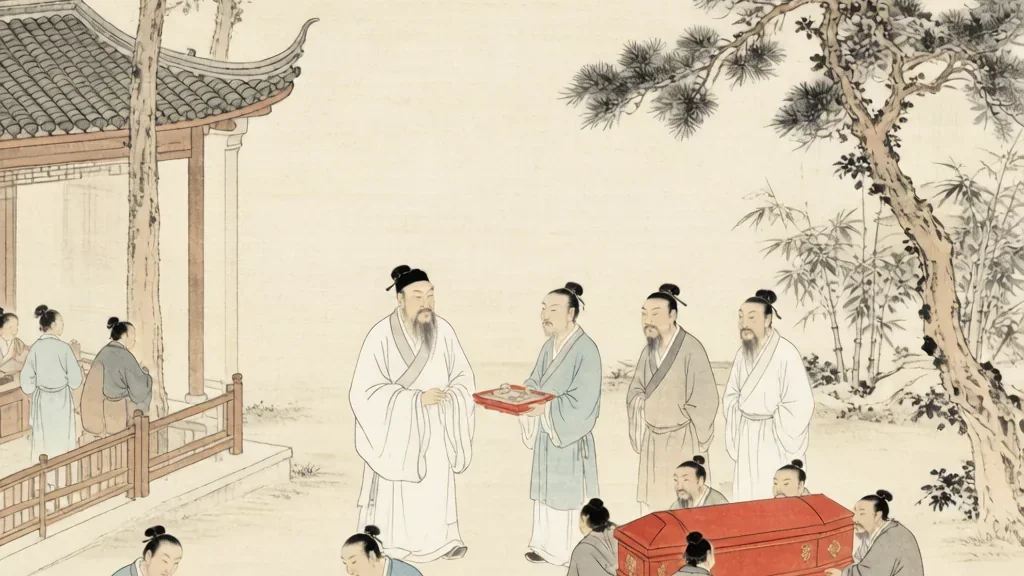
Before a single red lantern is hung or a single cup of cross-cup wine is shared, a traditional Chinese marriage was, above all, a paperwork affair. The system governing it was called sān shū liù lǐ, the "Three Letters and Six Rites." Far from romantic flourish, this was the legal and ritual backbone of marriage for over two thousand years, protecting both families and, ideally, the bride. To read it is to understand that in imperial China marriage was a contract between households, solemnized by letters and sealed by ceremony. This article walks through each letter and each rite, and explains why the framework still echoes in weddings today.
The Three Letters
The "Three Letters" were the written documents that formally recorded the progress of a match. The first was the pìn shū, the "betrothal letter," presented by the groom's family when proposing the marriage and confirming the agreement of both sides. It was the closest thing classical China had to a written engagement contract, and it bound the families' honor to the union.
The second was the lǐ shū, the "gift letter," listing the betrothal gifts—often called the bride price—and their quantities in detail. Because these gifts were a public measure of respect and means, the list had to be precise and was often read aloud. The third was the hūn shū, the "marriage letter," delivered on the wedding day itself and effectively certifying that the bride had been received into the groom's home. Together the three letters created a paper trail that no merely spoken promise could match.
The Six Rites
The "Six Rites" were the staged ceremonies that turned intent into marriage. They began with nà cǎi, the "initial proposal," in which the groom's family sent a go-between with gifts—traditionally including wild geese—to sound out the bride's family. Next came wèn míng, "asking the name," where the bride's birth name and the eight characters of her birth hour were requested so the match could be checked for compatibility.
The sequence continued with nà jí, "reporting good fortune," when a divination confirmed the match was auspicious and the engagement became firm. Then nà zhēng, "presenting the betrothal gifts," delivered the bride price in earnest. qǐng qī followed: "asking the date," in which the groom's side proposed a wedding day, usually deferring to the bride's family's choice of an auspicious moment. Finally came qīn yíng, the "personal welcome," the groom fetching the bride to his home—the climax of the whole process.
Why Written Letters Mattered
In a society without civil registries as we know them, the Three Letters were the proof of marriage. A union lacking the letters could be challenged as informal or even invalid, leaving the wife without standing. The letters also protected the bride: the gift letter fixed what had been promised, and the marriage letter confirmed her proper reception, both of which mattered if disputes arose over dowry or status.
Beyond protection, the letters elevated marriage from a private arrangement to a public, witnessed institution. Scribes, matchmakers, and family elders all handled them, and their careful language reflected Confucian ideals of propriety (lǐ). The very act of writing things down—names, gifts, dates—anchored the marriage in the social order, not merely in feeling.
The Role of the Matchmaker
Almost no step in the Six Rites could be taken directly by the couple. A professional go-between, the méirén, carried messages, negotiated gifts, and shielded both families from the loss of face that direct bargaining might cause. The matchmaker's tongue was said to "join two families with one sentence," and she (matchmakers were usually women) held real social power in village and town alike.
The matchmaker also served as a guarantor of compatibility. Because the bride's birth characters had to be checked against the groom's, the go-between supplied the trusted channel through which that sensitive information moved. In a system built on family honor, an intermediary made agreement possible without anyone appearing to beg. The matchmaker is therefore not a quaint extra but a structural necessity of sān shū liù lǐ.
Survival in Modern Customs
Strictly speaking, the full Six Rites are no longer observed by most families, and civil marriage registration now provides the legal bond. Yet the skeleton survives. The modern betrothal gifts (cǎilǐ), the formal proposal, the careful choice of a wedding date by consulting the almanac, and the groom fetching the bride all descend directly from the old rites. Even the printed "marriage certificates" couples sign echo the hūn shū.
In Hong Kong, Taiwan, and among overseas Chinese, elements are consciously revived for their cultural resonance: the reading of a decorative betrothal document, the presentation of gift lists, the ceremonial escort of the bride. The persistence shows that sān shū liù lǐ was never only bureaucracy—it was a way of slowing down and dignifying the making of a family, a tempo modern couples still find meaningful.
Comparing Past and Present
The greatest change is agency. Where the Six Rites assumed the couple were passive recipients of family strategy, today's partners choose each other and then layer tradition on top. The letters, once legally decisive, are now sentimental keepsakes or staged props. The bride price, once a serious transfer of wealth, ranges from symbolic token to (in some regions) a contested financial burden.
Yet the deep logic endures: marriage still links families, still benefits from witnesses, and still gains gravity from ritual. The Three Letters and Six Rites remind us that Chinese culture has long treated marriage as too important to leave to impulse alone—a contract to be written, gifted, dated, and celebrated in full view of the community.
The Wedding Procession and Bridal Arrival
The climax of the Six Rites was qin ying, the groom personally fetching the bride, and the journey home was a spectacle in itself. The bridal sedan was preceded by lanterns, musicians, and bearers of the betrothal gifts, while firecrackers were set off to drive away stray misfortune. The bride, veiled and sometimes weeping to show her leave-taking of the family, was carried to the groom's gate, where she might step over a saddle or a brazier for luck. Once inside, the couple bowed to heaven and earth, to their parents, and to each other, the three bows that formally created the new household. The procession was not mere pageantry but a public announcement that two families had become one under witnessed ritual.
Gifts and the Bride Price Today
The nà zhēng presentation of betrothal gifts survives in modern China as the bride price, or cai li, though its meaning has shifted. In imperial times the gift list recorded in the li shu fixed what was promised and protected the bride's standing. Today the contents range from traditional items like seafood, liquor, and dates to cash and jewelry, and the amount is negotiated between families as a sign of respect and means. In some regions the bride price has grown into a financial burden that sparks public debate, while in others it is returned, transformed into the couple's household fund. The continuity shows how a ritual of alliance between households still frames marriage, even as young couples choose each other first.
❓ Frequently Asked Questions
📝 Chinese Vocabulary
三书六礼 — : the Three Letters and Six Rites of traditional marriage.
聘书 — : the betrothal letter.
媒人 — : the matchmaker or go-between.
纳征 — : presenting the betrothal gifts.
亲迎 — : the groom personally welcoming the bride.
纳采 — : The initial proposal rite, first of the Six Rites, when the groom's family sent gifts including geese.
问名 — : Asking the name, the second rite, requesting the bride's birth name and eight characters for compatibility.
合卺 — : The rite of joining the gourds, the shared cross-cup wine that sealed the marriage bond.
🎉 Fun Facts
- The Six Rites were already codified in the Book of Rites (Liji), a Confucian classic over two thousand years old.
- Wild geese used in proposals were sometimes substituted with a carved wooden goose if the real bird was hard to obtain.
- Because the bride's birth hour was needed, a girl's exact time of birth was treated as family information of real consequence.
- Some decorative modern betrothal documents are still printed in classical Chinese for the look of authenticity.
- The bride's face was covered with a red veil on the wedding day, both to shield her from inauspicious glances and to preserve modesty until the bridal chamber.
- The three letters were sometimes written in gold ink on auspicious red paper, so they functioned as objects of display and family pride as much as legal documents.