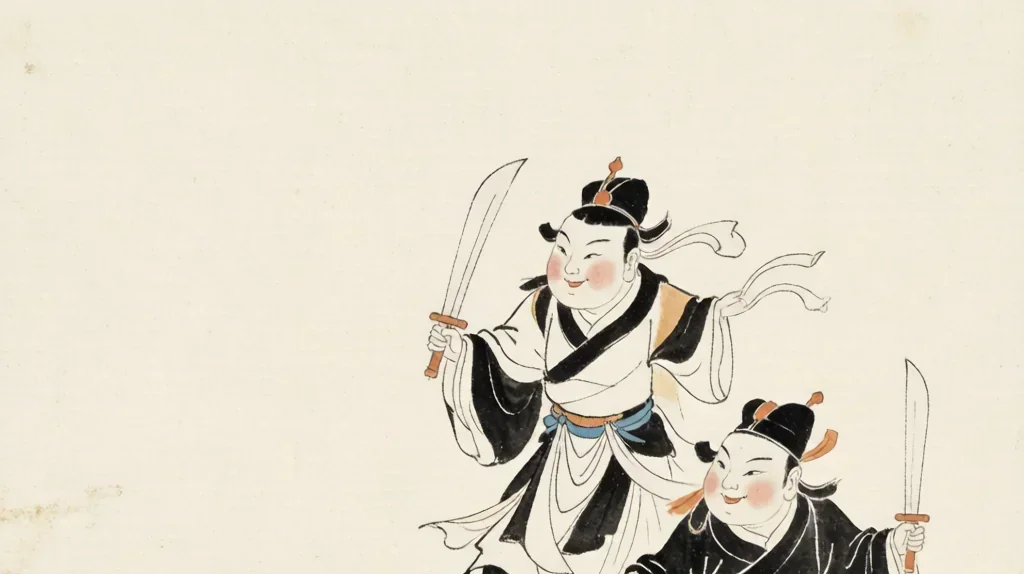
The Heibai Wuchang (黑白无常), the "Black and White Impermanence," are the two ghost-messengers of the Chinese underworld who fetch the souls of the dead and escort them to judgment. Serving under the City God (城隍) and the courts of the afterlife, they are among the most recognizable figures of folk religion: a tall, grinning white figure and a shorter, scowling black one, together enforcing the boundary between life and death. Though eerie, they are not evil—they are dutiful officials carrying out the inevitable summons.
Names and Identities
The White Impermanence is commonly named Xie Bi'an (谢必安, "gratitude, surely peaceful") and the Black Impermanence Fan Wujiu (范无救, "model, no rescue"). These paired names encode a moral lesson: the white one promises that the righteous will be treated fairly, while the black one warns that the wicked will find no escape.
The titles "impermanence" (无常, wuchang) themselves mean "impermanent," a Buddhist term for the ever-changing nature of life—fitting for agents who arrive without warning.
Role in the Underworld Bureaucracy
Chinese popular religion imagines the afterlife as a mirror of the imperial state, complete with courts, judges, and runners. The Heibai Wuchang are the patrol officers and bailiffs of this system, subordinate to the City God and ultimately to Yama (阎王), king of the dead. When a person's lifespan ends, they are dispatched to seize the soul and bring it before the tribunal.
In this hierarchical cosmos, death is administered by civil servants rather than by chaos, and the two messengers are its street-level enforcers.
Appearance and Imagery
The White Wuchang is tall and pale, often smiling or sticking out a long tongue, wearing white robes and a tall hat inscribed with characters meaning "you must see when you arrive" (一见生财 or 你也来了). The Black Wuchang is shorter and dark-faced, with a fiercer expression and a hat reading "find at once" (正在捉你). Their contrasting looks mark the two faces of death: the gentler summons and the stern arrest.
Processions of the City God's birthday often include actors dressed as the pair, part of the lively, theatrical side of underworld worship.
The White One and Popular Fortune
Interestingly, the White Impermanence is sometimes welcomed rather than feared. A folk belief holds that to glimpse him may bring unexpected wealth or good news, since he is associated with "meeting and gaining" (见财). Small shrines and New Year prints occasionally court his favor as a bringer of windfall luck.
This dual reputation—feared as soul-taker, courted as luck-bringer—shows the fluid boundary in Chinese folk religion between the dreadful and the auspicious.
Under the City God
The pair are most often encountered as attendants in temples to the Chenghuang, the City God who governs the dead of a locality. There they stand flanking the judge or guard the temple gate, reminders that the city's protection extends beyond the living into the realm of the departed.
Their presence turns the City God's court into a complete bureaucracy of the afterlife, visible to any worshipper who enters.
Temple Processions and Opera
During the City God's procession (出巡), effigies or costumed performers representing the Heibai Wuchang march through the streets to "inspect" the town and sweep away misfortune. In opera and storytelling they appear as comic yet solemn figures, mixing the macabre with entertainment.
Such performances let communities confront death publicly and collectively, robbing it of some of its terror through ritual familiarity.
Moral Messengers
Beneath the ghost-story surface, the pair teach a moral: life is impermanent and death impartial. Their hats' slogans nudge the living to live well, since the summons comes to all and excuses are few. In this they resemble the broader host of underworld officials who reward and punish according to a person's deeds.
Their inevitability is the point—no wealth or power stays the messenger's hand.
Legacy in Culture
The Black and White Impermanence remain staples of Chinese horror and fantasy, from folk tales to films and games, where they are usually portrayed with the same mixture of dread and affection found in the original cult. They persist as the friendly-face-of-death in a tradition that prefers to personify the unknown rather than leave it formless.
In the end they are less monsters than clerks, doing the one job no one volunteers for but everyone must meet.
The Pair in Temple Architecture and Art
In City God temples the Heibai Wuchang are given a visible station: they stand as guardian figures at the gate or flank the judge within the main hall, carved in wood or molded in clay, their contrasting colors marking the threshold between the living town and the court of the dead. Their fixed postures teach visitors, before a word is spoken, that death's officers are always on duty and that the boundary they guard is absolute.
Beyond temples they appear throughout the vivid vocabulary of folk art—on hell-scroll paintings that depict the courts of the underworld, in opera makeup, and in the paper effigies burned at funerals to staff the departed's journey. Each medium rehearses the same lesson: the passage to the next world is administered by familiar, if frightening, officials who keep records and follow procedure like any bureau.
Modern horror and fantasy have recast them with humor and style, yet the core image holds—two clerks in black and white, impartial and inevitable. Their endurance suggests how readily people personify the unknown, preferring even dreadful companions with names and hats to a faceless void, and how comfort can be found in the certainty that death, too, has its civil service.
Why a Pair, Not One
The pairing of black and white reflects a broader Chinese habit of seeing the world in complementary opposites. Death, like everything else, is presented not as a single terror but as a balanced team—one gentle, one stern—so that the summons can be both kind and firm. The contrast also mirrors the two faces a person shows the world and the two judgments a life may earn.
By sending two, the underworld ensures the soul is neither lost nor alone on its journey. The arrangement turns a lonely terror into a guarded passage, escorted by officials who, however strange, are doing a job they know by heart—a small comfort encoded in the very structure of the pair.
❓ Frequently Asked Questions
Who are the Heibai Wuchang?
They are the Black and White Impermanence, two underworld messengers who fetch the souls of the dead and bring them to judgment.
Are they evil?
No; they are dutiful officials of the afterlife bureaucracy, not demons, carrying out the inevitable and impartial summons of death.
What are their names?
The White one is Xie Bi'an and the Black one Fan Wujiu, names that warn the good will be treated fairly and the wicked find no escape.
Who do they serve?
They are subordinate to the City God and, higher still, to Yama, king of the dead.
Why is the white one sometimes liked?
A folk belief says seeing the White Impermanence may bring unexpected wealth, so he is at times courted for luck.
Where are they seen?
Flanking the City God in temples and in his street processions, and widely in opera, film, and folklore.