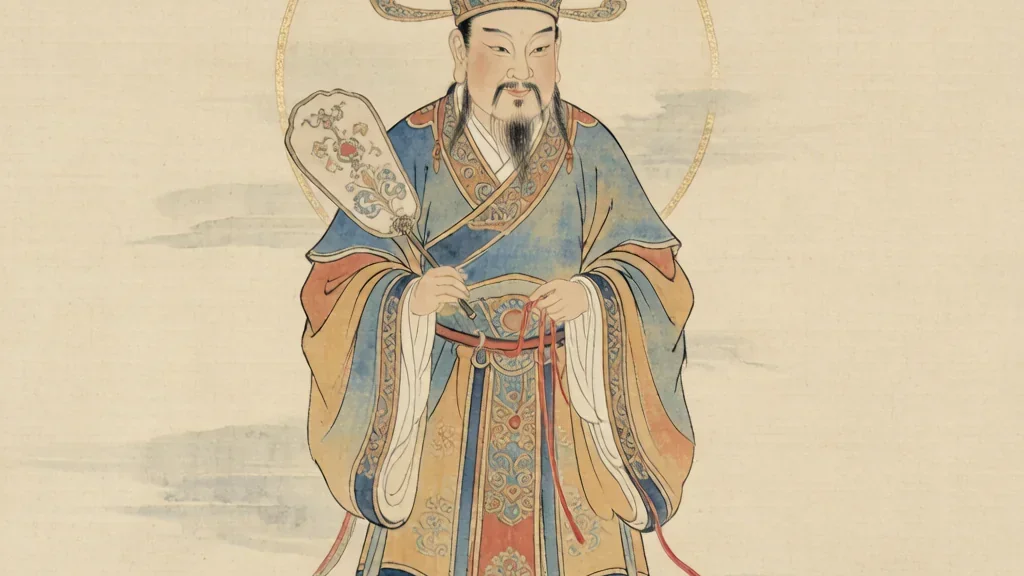
Every culture has a figure who ties lovers together, but few are as charmingly specific as 月老 (Yuè Lǎo), the "Old Man under the Moon," the Chinese god of marriage and romantic destiny. According to legend, he wanders at night with a book of all the world's predestined couples and a red thread, which he quietly ties around the ankles of those fated to wed. No matter the distance or obstacle, that thread cannot be broken. To understand Yuè Lǎo is to understand the Chinese reconciliation of fate and love: that true marriage is written in the stars, yet the bond is as tangible as a single red cord.
The Old Man Under the Moon
Yuè Lǎo is depicted as a kindly old man, often white-bearded, carrying a book and a sack of red thread, and associated with the moon's muted light. He is the celestial matchmaker, not arranging marriages by bargaining but by recognizing a destiny already inscribed. His domain is the deep compatibility that underlies a lasting union, the sense that two people were simply meant to find each other.
Unlike a human matchmaker who negotiates families and dowries, Yuè Lǎo operates on a higher plane of certainty. He does not persuade; he reveals. The red thread he uses is invisible to mortals until they meet the one it binds, which is why lovers often feel, at first sight, an uncanny rightness. He is fate with a face and a gentle sense of humor.
The Tang Dynasty Legend
The god's origin is usually traced to a Tang dynasty tale in the Record of an Evening Chat under the Starry Sky. A young man named Wei Gu meets an old man reading a book by moonlight and learns it lists all marriages. The old man shows him a red thread binding Wei Gu's future wife, a child not yet grown, and indeed years later Wei Gu marries that very girl. The story fixed Yuè Lǎo in the popular imagination as the author of marital fate.
This anecdote is foundational because it establishes the rules: the match is decided early, sometimes shockingly early, and is immune to human interference. Wei Gu's initial horror at marrying a child gives way to acceptance, teaching that the thread's logic surpasses preference. The tale's endurance shows how compelling the idea of destined love remains in Chinese storytelling.
The Red Thread of Fate
The red thread is Yuè Lǎo's signature instrument and one of the most poetic images in Chinese romance. An invisible cord connects those destined to be partners, and no distance, quarrel, or circumstance can sever it. The image has traveled far, appearing in literature, film, and even modern dating metaphors across East Asia, a universal shorthand for inevitable love.
The thread's redness ties it to the broader Chinese symbolism of red as lucky and binding, the same color that seals weddings and wards evil. That a single crimson line can outlast oceans and years is a comforting thought, especially in arranged-marriage societies where love and destiny needed reconciling. Yuè Lǎo assures the anxious heart that somewhere, the other end is already tied.
Prayers for a Spouse
Historically, those seeking marriage, especially women in old society, would pray to Yuè Lǎo at temples dedicated to him, offering incense and asking to be matched well. Some wrote their wishes on red slips or tied symbolic threads at his shrines. The god functioned as a divine dating service, invoked by the lovelorn with the same hope people now pour into apps.
Temples to the moon matchmaker still draw visitors, and during Qixi, the festival of the weaver and cowherd lovers, his altars see extra devotion. The practice reveals a cultural comfort with outsourcing romance to fate: one may strive in life, but in love one may also simply ask the Old Man to do his quiet work. Faith and initiative coexist.
Marriage in Chinese Thought
Yuè Lǎo must be understood against the weight of marriage in Chinese culture, where union has historically been a bond between families, not merely individuals. The god's predestination soothed the tension between family arrangement and personal feeling by suggesting that even arranged matches were, ultimately, written in heaven. He blessed the institution from above.
At the same time, his popularity shows that ordinary people always cherished the idea of a fated, affective match. The red thread is personal, not bureaucratic; it links two hearts, not two households. In Yuè Lǎo the collective and the intimate meet, and marriage is validated as both social duty and destined delight.
Yuè Lǎo in Modern Romance
Today the Old Man under the Moon thrives in popular culture, from television dramas to wedding decor, and "red thread" is a common metaphor for soulmates. Young people may joke about him being slow, but they still invoke him at engagements, and couples visit his temples to bless their unions. The digital age has not killed him; it has only added new ways to wonder where the thread leads.
His lasting appeal lies in the reassurance he offers: that love is not pure chance nor pure arrangement, but a destined meeting one can trust. In a world of endless swipeable choices, Yuè Lǎo proposes something rarer, a single, unbreakable cord. To believe in him, even half, is to believe that somewhere your other end is already tied, waiting under the same moon.
Yuè Lǎo in Literature and Opera
The Old Man under the Moon became a stock figure of Chinese storytelling. Beyond the Tang tale of Wei Gu, he appears in vernacular stories, comic sketches, and opera as the gentle hand behind unlikely matches, often arriving at the crucial moment to reveal that two strangers were bound all along. Playwrights used him to resolve a plot with destiny rather than contrivance, and idioms such as qian hong xian, to pull the red thread, entered daily speech for any act of matchmaking. His presence in popular entertainment kept the idea of fated love alive across centuries and classes, so that even readers who never visited his temple knew the rhyme of his red cord and his book of marriages.
The Red Thread Across East Asia
The motif of an invisible red thread joining soulmates traveled with Chinese culture into Japan, Korea, and Vietnam, where local versions took root. In Japan the thread is often said to tie the little finger, and the idea appears in folk belief and modern romance media; in Vietnam the figure of Ong Tac joins young couples under a similar logic. The shared image shows how a Tang dynasty anecdote became a regional grammar of love, reassuring people across languages that partnership is written, not merely arranged. In each culture the thread does the same cultural work: it reconciles choice with fate and turns the anxiety of finding a partner into a quiet trust that the other end is already tied.
❓ Frequently Asked Questions
📝 Chinese Vocabulary
月老 — : the Old Man under the Moon, god of marriage.
红线 — : the red thread of fate.
姻缘 — : predestined marriage affinity.
月下老人 — : the old man beneath the moon, full title.
媒人 — : a human matchmaker.
牵红线 — : To pull the red thread, a phrase meaning to act as a matchmaker between two people.
良缘 — : A good marriage fate, a happy and destined union.
月老祠 — : A temple shrine dedicated to the Old Man under the Moon.
🎉 Fun Facts
- The red thread of fate from Yuè Lǎo is now a pan-East-Asian symbol of soulmates.
- His legend first appears in a Tang dynasty story about a man named Wei Gu.
- Temples to the moon matchmaker see extra devotion during the Qixi lovers' festival.
- Yuè Lǎo carries a book listing all the world's destined couples.
- Matchmaking agencies and dating apps in China sometimes playfully brand themselves with Yuè Lǎo, and red-thread stickers are common in romantic messaging.
- At some temples visitors tie a red string to a rack or a tree beside the Yuè Lǎo statue, adding their wish to a web of hundreds of threads.