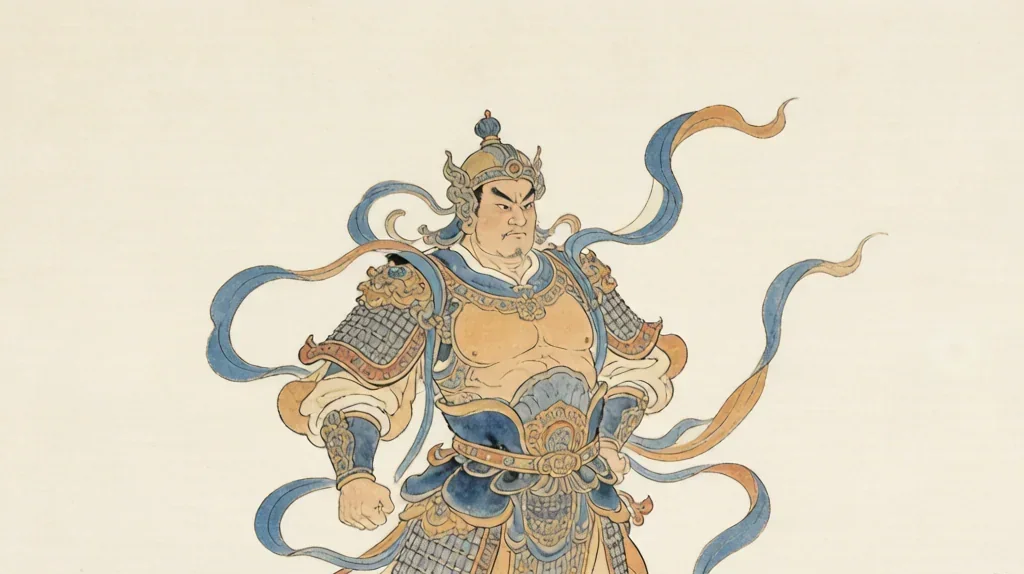
The City God, known in Chinese as Chénghuáng (城隍), is one of the most widespread and enduring deities of local Chinese popular religion. Unlike the great cosmic gods of the imperial state cult, the City God is fundamentally a neighborhood protector — the spiritual magistrate who governs a specific walled city, its wards, and the fortunes of everyone who lives behind its walls. For more than a thousand years, almost every county and prefectural seat in China maintained a City God Temple (Chenghuang Miao), where the god presided over the moral order of the community, watched over the dead, and acted as an invisible counterpart to the living magistrate. The worship of the City God blends bureaucratic logic, Buddhist and Daoist cosmology, and deep local identity, making it a window into how ordinary Chinese people understood government, justice, and the afterlife.
Origins and Early History
The term cheng (城) means a city wall and huang (隍) refers to the moat surrounding it — together the physical defenses of a walled town. In earliest usage the words described the naturalistic spirits of those fortifications rather than a single named god. During the Northern and Southern Dynasties (4th–6th centuries) local cults began to personify these protective forces, and by the Sui and Tang periods the idea of a dedicated urban guardian spirit was taking shape.
The turning point came under the Tang dynasty, when the imperial government began to formally recognize and pacify powerful local deities as a tool of administration. Famous loyal officials and generals who died were sometimes enshrined as City Gods, a practice that linked the cult directly to the Confucian ideal of rewarding virtue after death. The Tang poet Du Mu and other writers already referred to City God worship in their accounts of regional customs.
Imperial Patronage and Standardization
The Song dynasty greatly elevated the status of the City God. In 1208 the court granted the deity formal titles and ranks comparable to those of human officials, integrating the cult into the state sacrificial system. This meant that local magistrates were expected to perform official rites to the City God, blurring the line between civic administration and religious duty.
Under the Ming founder Zhu Yuanzhang in the fourteenth century, the City God system was reorganized with remarkable bureaucratic precision. Every prefecture, county, and garrison was assigned a City God with a rank mirroring that of its living administrator — a prefectural City God outranked a county one, just as in the human civil service. Temples were built facing the yamen (government office), often on a deliberate north–south axis, so that the divine and earthly courts stood in symbolic dialogue.
The City God as Local Magistrate of the Dead
A central belief is that the City God judges the souls of the recently deceased within his jurisdiction. When a person died, it was thought their spirit first reported to the local City God, who reviewed their conduct in life. The god thus functioned as a lower court of the underworld, passing worthy souls upward and consigning the guilty to punishment.
This role made the City God Temple a place intimately tied to funerals and the comfort of the living. Families would pray there for the safe passage of relatives, and the god's judgment was believed to be impartial and inescapable. The parallel between the City God and the living magistrate reinforced a moral message: just as the earthly judge punished crime, the divine judge punished sin that human law could not reach.
Temple Architecture and Layout
A typical City God Temple resembled a miniature yamen. The main hall housed a seated, often stern wooden or painted statue of the god in full official robes, flanked by attendants who recorded good and evil deeds. Behind or beside it stood the "Hall of the Ten Kings" depicting the Buddhist-influenced courts of hell, and side halls for subordinate spirits such as the Day and Night Patrolmen.
The atmosphere was deliberately solemn. Unlike the festive color of some folk shrines, City God Temples stressed authority: stone lions, red lacquered columns, inscribed couplets warning against corruption, and a central court where the god "heard cases." The architectural gravity helped legitimize the temple as a moral institution rather than mere superstition.
Festivals and the Temple Fair
The City God's birthday was the great annual event, drawing thousands for processions in which the god's sedan chair was carried through the streets so he could "inspect" his city. These parades featured lanterns, opera troupes, and martial displays, temporarily inverting normal order as the divine magistrate toured his domain.
Such occasions often grew into miaohui (temple fairs), combining worship with markets, snacks, and entertainment. For ordinary townspeople the fair was both a religious observance and a rare social and commercial holiday, knitting the temple into the rhythm of daily economic life.
The Black and White Impermanence and Subordinate Spirits
The City God's household of spirits includes colorful subordinates drawn from folk imagination. The Heibai Wuchang (Black and White Impermanence) are two messengers who fetch the souls of the dead, rendered as striking figures in black and white with elongated tongues. They belong to the wider Chenghuang bureaucracy rather than standing alone.
Other attendants include the Niutou Mian (Ox-Head and Horse-Face) guardians of the underworld and the recording clerks who tally each person's deeds. This elaborate spirit staff mirrored the real county office down to its scribes, expressing a worldview in which the cosmos itself was administered like a well-run government.
Regional Variation and Local Identity
Because each city enshrined its own worthy dead as its City God, the cult was profoundly local. The City God of Shanghai, for example, was associated with a historical loyal official, while other cities claimed generals or scholars. A person moving to a new town would naturally transfer allegiance to that town's god, making the City God a patron of local belonging.
This localization also meant temples preserved distinct legends, operas, and even dialect prayers. The City God was never a distant universal deity but a familiar neighbor-magistrate whose personality reflected the community that worshipped him — a rare case where official religion and grassroots identity reinforced each other.
Survival in Modern Times
The City God cult suffered during periods of anti-religious campaigning in the twentieth century, and many temples were converted to other uses or destroyed. Yet the belief persisted underground and has visibly revived since the late twentieth century as heritage tourism and renewed religious freedom returned.
Today City God Temples in places like Shanghai, Xi'an, and Taiwan are active worship sites as well as tourist attractions, often surrounded by markets selling local snacks and crafts. The god's ancient role as civic protector has been reimagined as a symbol of urban cultural identity, showing how a medieval institution can be reborn as living heritage.
❓ Frequently Asked Questions
What exactly is the City God?
The City God is the protective deity of a specific walled city who guards its inhabitants in life and judges their spirits after death, acting as a divine counterpart to the human magistrate.
Is there one City God for all of China?
No. Almost every county and prefecture had its own City God, usually a local worthy enshrined after death, so the cult was intensely local rather than national.
How is the City God related to the government?
Successive dynasties granted the god official ranks and titles, and magistrates performed state rites to him; in the Ming era his rank mirrored the living administrator's post.
What happens to the dead in City God belief?
It is believed the soul first reports to the local City God, who reviews the person's conduct and forwards the worthy upward or the guilty to punishment.
Who are the Black and White Impermanence?
They are two subordinate spirit-messengers of the City God who fetch the souls of the newly dead, depicted in stark black and white.
Do people still worship the City God today?
Yes. Many temples have been restored and are active worship sites and heritage attractions, especially in mainland China, Taiwan, and overseas Chinese communities.