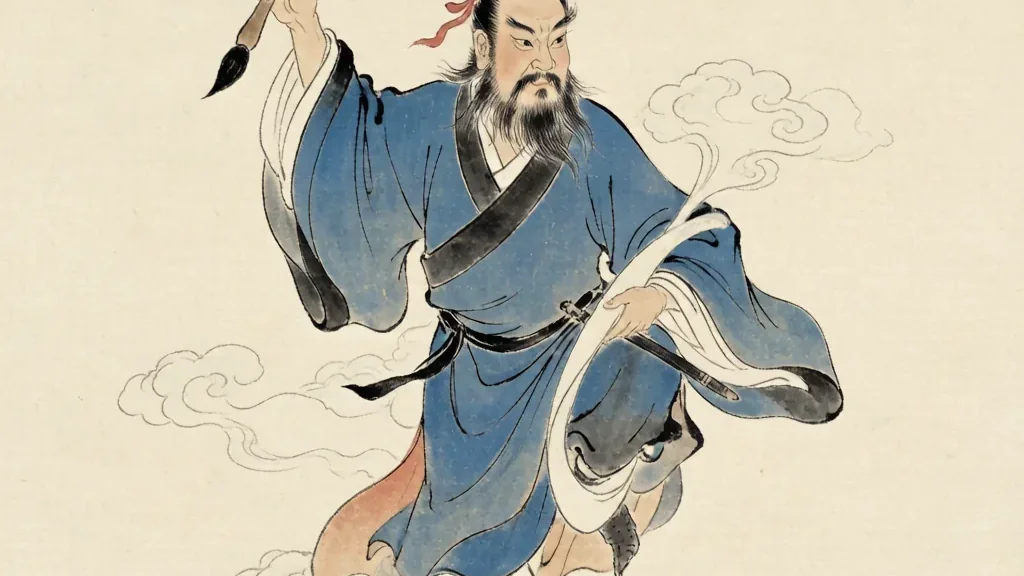
Kuixing (魁星), the "Chief Star," is the fierce, acrobatic patron of literature and the top scorer of the imperial examinations in Chinese folk religion. Usually shown as a one-legged figure balancing on a fish-dragon (鳌) or a giant turtle, brandishing a writing brush in one hand and a ladle (斗) in the other, he is the personification of competitive scholarly brilliance. Where the gentle Wenchang grants literary office, Kuixing is the spark of genius who "points the brush" at the candidate destined to lead the rankings.
Celestial Identity
Kuixing refers to the first star of the Dipper's bowl (the "chief" of the seven stars of the Big Dipper), which ancient astronomers called the leading light of the constellation. Because the Dipper was linked to writing and the civil order, this leading star came to be worshipped as the power behind examination success and literary talent.
The character 魁 itself means "chief" or "leader," and appears in words for the top of a class or the foremost of a group, tying the god to being first.
The Legend of the Ugly Genius
Folklore explains Kuixing through a tale of a brilliant but physically ugly scholar who, despite topping the exams, was denied office because of his looks, and in despair threw himself into the water, where he was rescued and transformed into a star-spirit. The story turns social rejection into cosmic vindication: true talent outranks appearance.
This myth gives the god his poignant, outsider energy, endearing him to students who feel judged by surfaces.
Iconography: The Dancing Scholar
Kuixing's image is among the most dynamic in Chinese art. He stands on one leg atop a mythical ao (鳌), a giant sea-creature; in one hand he holds a great brush poised to write the names of the successful, and in the other a dou, the dipper itself, which he seems to scoop from the sky. His free leg kicks up behind him in a dancer's pose.
The phrase "win the ao" (独占鳌头) for taking first place derives from his stance, making his picture a lucky charm for exam-takers.
Patron of Examinations
In the age of the keju examinations, students prayed to Kuixing for the flash of insight that wins the top rank. His shrines stood in schools and examination compounds, often beside Wenchang's, so candidates could appeal to both the institutional grantor and the inspirational spark of success.
Holding the brush, he was believed literally to inscribe the list of passers, a cosmic registrar of merit.
Kuixing Towers and Pavilions
Communities built Kuixing lou (魁星楼) or Kuixing ge, towers and pavilions dedicated to him, often on high ground at a town's literary quarter. Like Wenchang pavilions, they were thought to "nourish" a place's scholarly fortune and to mark the civic ambition of producing top scholars.
Some survive as heritage sites, their leaning, energetic roof-lines echoing the god's own off-balance poise.
Kuixing in Popular Art
New Year prints and scholar's desk objects frequently depict him mid-leap, alone or with Wenchang and other literary stars. Small figurines were kept by students as mascots, and his image appeared on the covers of examination primers and on the seals of academies.
The visual energy made him an effective emblem: ambition made visible as movement.
Relationship With Wenchang
Kuixing and Wenchang are the two poles of literary devotion. Wenchang is the sober Divine Lord who administers the system; Kuixing is the unpredictable genius who decides the ranking. Together they cover the full emotional range of a candidate—hope for fairness and hope for brilliance.
Schools that enshrined both acknowledged that success needs both institution and inspiration.
Modern Echoes
Though the old exams are gone, Kuixing's leaps still appear at graduations and before major tests, and his name lives in idioms about taking first place. He endures as a symbol that talent, even when awkward or unrecognized, can be lifted to the heights.
In a culture that prizes the written word, the dancing star remains its most spirited champion.
Kuixing and the Ao in Legend
The giant ao (鳌) beneath Kuixing's foot is itself a figure of legend. In old tales the ao is a colossal turtle or sea-dragon that supports continents on its back and stirs the oceans when it moves; placing the literary star upon it links scholarly triumph to cosmic stability. To "stand on the ao's head" became the vivid image for leading the empire's candidates and bearing the weight of the realm's hopes.
This imagery fed a competitive culture in which ranking first was the summit of ambition. Successful graduates were said to have "won the ao," and paintings of Kuixing's leap adorned the study walls of countless students as a talisman of exactly that outcome. The god thus did more than bless; he modeled the posture of aspiration itself—balanced, dynamic, reaching upward toward the list of names he alone could write.
In regional lore the ao also appears in flood myths and in stories of magic turtles that carry steles, so Kuixing's mount connects him to a wider world of water-and-stone symbolism. The single leaping figure condenses several strands of belief at once: the Dipper's light, the scholar's hope, and the ancient sea that bears the world, making him a compact emblem of how high a mortal talent, rightly honored, may rise.
Kuixing in Student Culture
Down to the present, Kuixing's leaping figure surfaces wherever students stake their hopes on a test. His image appears on stationery, in graduation art, and in the good-luck charms tucked into exam bags, a descendant of the old prayers whispered at his shrine before the keju.
The persistence shows that the anxiety of being judged—and the wish to shine—is timeless. Though the examinations changed, the god who crowns the first remains, a reminder that every age invents its own ao to climb and its own brush to hope will write one's name at the top.
❓ Frequently Asked Questions
Who is Kuixing?
Kuixing is the Chief Star, the acrobatic patron of literature who decides the top rank in the imperial examinations.
What does he look like?
He is a one-legged figure balancing on a giant ao, holding a brush in one hand and a star-dipper in the other, with a leg kicked up.
What does "seize the ao" mean?
It is an idiom for taking first place, drawn from his stance on the ao, and was a wish for exam success.
How is he different from Wenchang?
Wenchang administers literary office soberly, while Kuixing is the inspirational spark that crowns the top scorer.
Why the ugly-genius legend?
It tells of a brilliant, rejected scholar transformed into a star, affirming that true talent outranks appearance.
Is he still known today?
Yes; his image and idioms survive at graduations and before big tests as a symbol of rising talent.